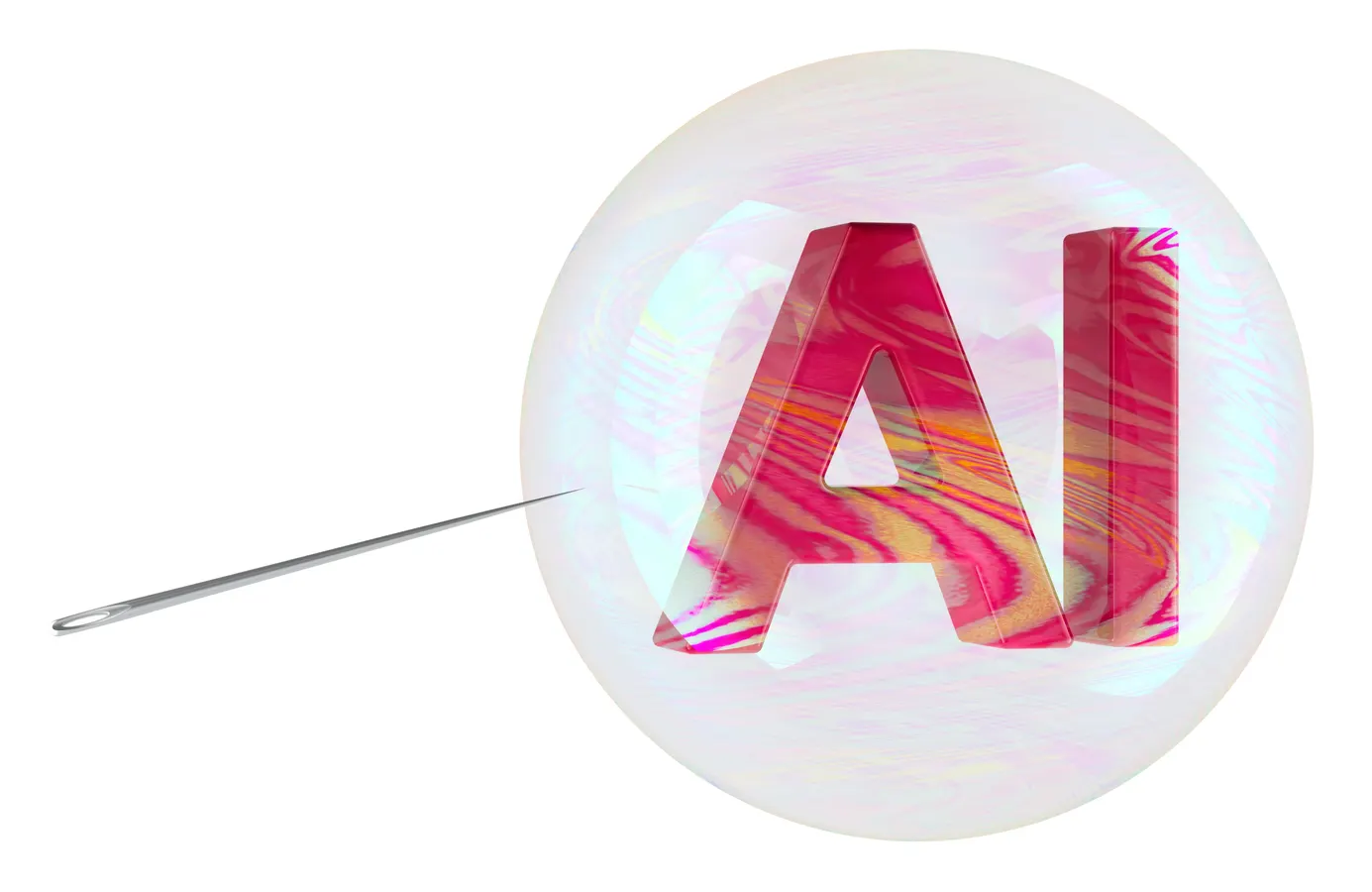
Artificial Intelligence has grown in popularity over the past five years, from something consumers only knew from sci-fi movies to a widely used technology. Many companies are now using AI in some form, and it has become part of everyday life for many consumers, with AI services integrated into internet search engines, phone applications, and other daily interactions. However, as AI is deployed at a faster pace, it is becoming clear that the technology cannot be used as extensively as tech companies had hoped, while companies are realising the value of human workers. Investors have rushed to buy tech stocks on New York stock market indexes, such as the S&P 500 and the tech-heavy Nasdaq, in recent years, as more companies launch AI services. Just seven companies, Amazon, Alphabet (Google), Nvidia, Meta (Facebook), Microsoft, Apple, and Tesla, have dominated this focus. An increasing number of City analysts and financial economists are now warning that the AI bubble will eventually burst.Jeremy Grantham, the founder and investment adviser at a large asset manager, said he planned to sell his tech shares as he expected the AI bubble to burst soon. Grantham said that AI was similar to the invention of railways or the internet in that everyone overinvests and, when they realise it is a utility, such as electricity, they understand that there is not much money to be made from the invention itself, except for the companies that build services around it.Companies and consumers have been wowed by the capabilities of AI technologies, which appear increasingly intelligent. More and more companies are investing in integrating AI services into their operations, while consumers are using AI for basic, everyday tasks, such as internet searches. However, as AI booms, users are slowly losing confidence in certain services, as it becomes clear that there are limits to AI’s “intelligence” or human-like capabilities.In the manufacturing sector, companies have been investing in automation for decades, as engineering and tech firms develop automated equipment capable of performing simple tasks in place of humans. This has helped speed up production lines, reduce the need for humans to conduct more dangerous or monotonous tasks, and lower the price of goods. However, the advent of AI poses a far greater threat to workers in the sector.Manufacturing firms worldwide are showing greater interest in AI as they look to decrease reliance on human workers. However, there are concerns about the risks of rapidly incorporating AI into manufacturing operations, particularly in more complex roles. Automation works well in stable, repeatable environments, which manufacturing plants are not. Companies managing production facilities face a range of challenges, including late deliveries from suppliers, machine failures, fluctuating demand, and regulatory constraints, issues that simply cannot be addressed by existing AI.AI will likely become a critical component in manufacturing, providing services such as predictive maintenance and inspection. However, it could cost companies time and money if used in variable operations that it is not yet capable of performing. In a January Forbes article, the author explained, “For AI to be useful, it has to operate inside production systems, grounded in real data and real workflows, with humans accountable for outcomes. When applied this way, AI helps people move faster and see more clearly. It doesn’t replace judgment."The statistics are already reflecting the early failures of AI in certain industries. For example, S&P Global’s recent executive survey showed that 42 per cent of organisations abandoned most of their AI initiatives in 2025, compared with 17 per cent in 2024. Meanwhile, a 2024 RAND report suggested that more than 80 per cent of industrial AI projects fail, mainly due to process complexity, poor data quality, and lack of real-world context.The automaker Ford has expanded its use of AI in recent years to increase productivity by automating systems that speed up decision-making and simplify development. However, after implementing these systems, Ford quickly realised that some of these AI systems were less resilient than expected, particularly when they received incomplete or insufficiently nuanced data.The vice president of vehicle hardware engineering at Ford, Charles Poon, explained, “Mistakenly, we thought that by just introducing artificial intelligence and adjusting the design requirements that we had, that that would produce a high-quality product.”The firm saw that as experienced engineers left, they took a vast amount of institutional knowledge with them. Vital information was omitted from the datasets used to train AI systems. This has led Ford to bring back and promote over 350 experienced engineers to improve data collection and interpretation methods to support AI training for future applications. However, it remains unclear whether this will be effective.Despite the widespread popularity of AI, seen over the last couple of years, companies are quickly realising the limitations of existing AI technology. While AI can be used to enhance a wide range of operations, it is not suitable for more complex or more variable tasks, and might never be. This is likely to cause the AI bubble to burst at some point, though when remains unknown.By Felicity Bradstock for Oilprice.comMore Top Reads From Oilprice.comU.S. LNG Exporter Reaps Windfall as Middle East Turmoil Drives Fees HigherOil Prices Jump After Iran Attacks Commercial VesselsUS Crude Oil, Product Inventories Fall Even As Hormuz Traffic Begins to Flow
Is the AI Bubble About to Burst? | OilPrice.com
Artificial intelligence is transforming business, but mounting evidence suggests its greatest value lies in supporting human expertise rather than replacing it.
867 words~4 min read