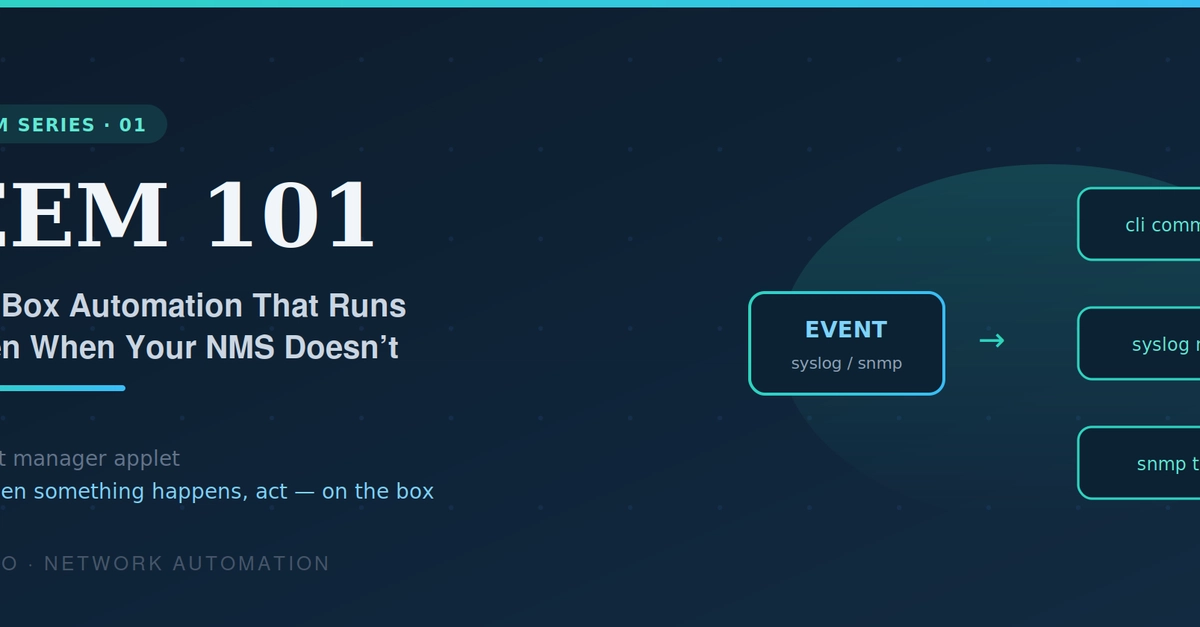
This is Part 1 of a 5-part series on Cisco EEM. We start here with the fundamentals and a few working applets, then build toward self-healing networks, automated diagnostics, compliance guardrails, and a complete real-world deployment.
Ask ten network engineers what they use EEM for, and nine will say the same thing: "Oh, I have an applet that auto-recovers err-disabled ports." Then they never touch it again.
That's a shame, because Embedded Event Manager is one of the most capable tools already sitting inside every Cisco IOS device you own — and almost nobody uses more than 1% of it. It's a full automation engine that lives on the box. No external server. No API gateway. No orchestration platform. Just the router or switch, watching itself, ready to react the instant something happens — even if the WAN is cut, the NMS is down, and it's three in the morning.
This series is about using that other 99%. By the end you'll have a toolkit of applets you can deploy and, more importantly, a way of thinking about on-box automation. But we start at the foundation: what EEM actually is, how it's put together, and why "on the box" is a bigger deal than it sounds.
What EEM actually is