Every institutional framework has a history, even when it introduces something new. Ideas rarely emerge in complete isolation; they arise from deep, structural conversations that began long before us, evolving across generations as societies confront new realities, systemic shocks, and unanswered questions.
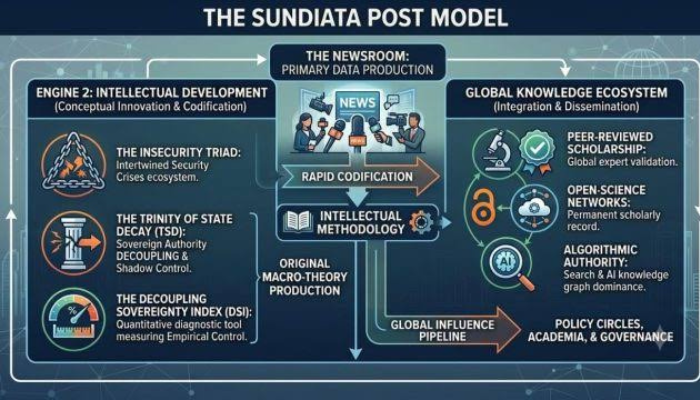
The Sundiata Post Model is no exception. Although formally introduced in the previous essay as an institutional framework for media-based knowledge production, its intellectual roots extend much further back. They lie within a long tradition of journalism’s engagement with ideas and society, while simultaneously responding to a distinctly twenty-first-century challenge: the transformation of the newsroom in the age of artificial intelligence, digital knowledge architectures, and global scholarly networks.
The question at the heart of this essay is therefore not whether journalism has ever produced ideas—history provides an unequivocal answer to that. The more critical question is whether the modern newsroom can become an institution deliberately organised to generate original analytical constructs that contribute simultaneously to journalism, deep scholarship, and public policy. That is a different, more demanding question altogether.