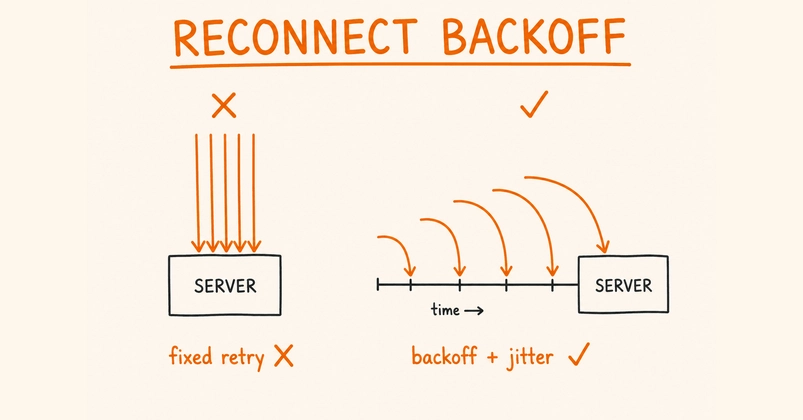
Real-time systems are seductive. You build a basic WebSocket connection, messages flow instantly, and it feels like magic. Then your first user's network hiccups, their browser crashes, or you deploy an update and suddenly 500 clients are screaming reconnect requests at your server. That's when you realize the Hello World examples glossed over the hard part.
I've built real-time collaboration features in CitizenApp, and I've learned that WebSocket architecture isn't about the connection itself—it's about what happens when the connection breaks. This post covers the patterns I actually use in production.
Why Connection Pooling Matters on the Server
Before we even talk about the client, let's address server capacity. Each WebSocket connection consumes memory and file descriptors. On my FastAPI backend, naive implementations spawn a new handler per connection and let garbage collection handle cleanup. That works until you hit 10k concurrent users and your CPU is thrashing.
I prefer explicit connection pooling with a bounded queue: