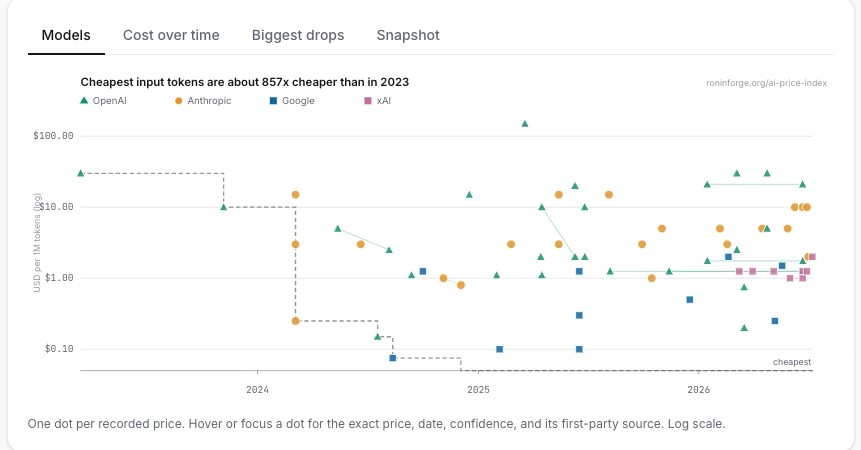
Most tools that tell you what your AI usage costs work the same way: count tokens locally, multiply by a shared price table. For most of the ecosystem that table is a single JSON file in the LiteLLM repo, and its only automated check is jq empty, which verifies the JSON parses. That is the entire quality gate: no value validation, no cross-check against provider pages, no guard against swapped input and output prices, no dates, no provenance.
This is not an obscure file. LiteLLM (BerriAI/litellm, ~51k stars, MIT) prices roughly 2,783 models. ccusage (~16.4k stars) re-pins it hourly, tokencost vendors a copy, ccost embeds it. An error in it is not one tool's bug; it is the whole ecosystem agreeing on a wrong number, with nothing left over to disagree.
Why I was in there
I maintain a spend monitor for Claude Code called BudgetClaw: it tails the local JSONL logs Claude Code already writes, computes cost in real time, and on a budget breach sends SIGTERM to the process. Zero keys, zero prompts, zero added latency. What sent me upstream was a Saturday spent grouping a month of usage by branch: about $2,770 total, one refactor branch at $543 by itself, mostly retry loops re-sending an 80K+ token context. But a tool that kills processes over dollars has to get the dollars right, and cache pricing makes that delicate: a cache read bills at 0.1x the base input rate, a 5-minute cache write at 1.25x, a 1-hour write at 2x. One wrong multiplier and the kill switch fires at the wrong moment or not at all. Quietly wrong is worse than loudly wrong. So before trusting the table, I read it.