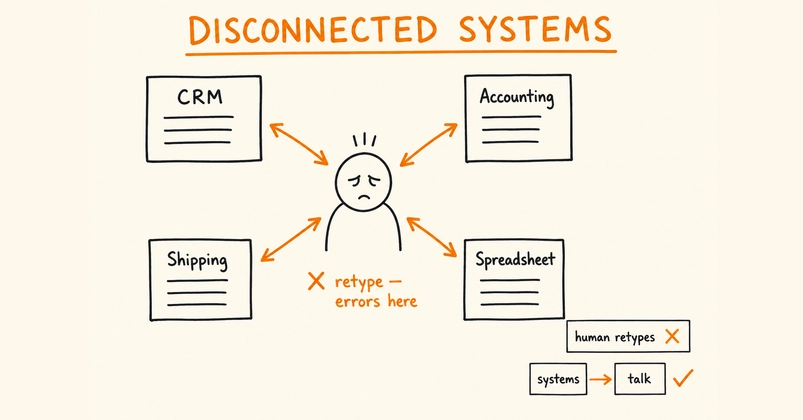
I build integrations for a living: ecommerce to ERP, CRM to invoicing, and lately ERPs to AI agents. Every one of them has the same quiet security problem, and most "ISO 27001 for developers" content misses it because it stays at the policy level.
Here is the thing nobody says out loud: integrating two systems means taking data out of the place where it lived protected and moving it across a network you do not control. Names, tax IDs, amounts, addresses, emails. That journey is the attack surface. Not the database. The trip.
You do not need to be ISO 27001 certified to care about this. Certification is a formal audit that makes sense when a client demands it. Applying the controls is what actually protects the data, and you can do it on the next integration you ship. So let me map the ISO 27001:2022 Annex A controls that land directly on integration work, in plain terms, with what I actually do for each one.
The controls, translated to integration reality
A.8.24 Use of cryptography. Data in transit goes over a network you do not own. In the clear, anyone on the path reads it. Rule: TLS 1.2+ end to end on every call, no plain HTTP between services, ever. Any intermediate copy (queue, staging, cache) is encrypted at rest.