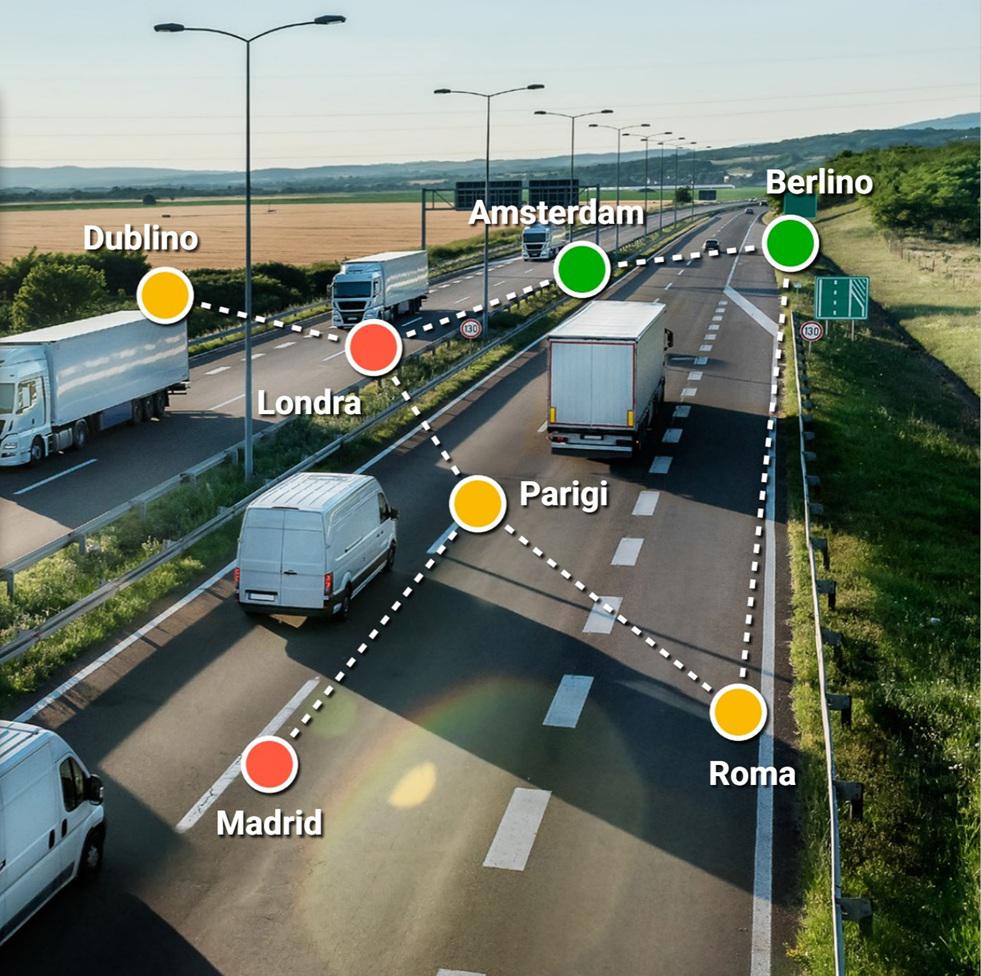
If you build routing, dispatch, or telematics software for European trucking, the routing algorithm is rarely what slows the roadmap down. The road data is. A truck plan from Rotterdam to Bucharest crosses a dozen jurisdictions, and each one publishes what's happening on its roads — incidents, tolls, restrictions, charging — its own way, on its own schedule, under its own rules. Below are the five problems that come up in nearly every conversation we have with European fleet and logistics-software teams. None are exotic. All of them quietly burn engineering time.
1. Twenty-Seven Countries, Twenty-Seven Access Points
The EU ITS Directive did get every Member State to stand up a National Access Point (NAP) publishing road data, mostly as DATEX II. That sounds like a solved problem until you actually connect to a second country. The standard leaves room, and the NAPs use all of it — different DATEX profiles and versions, different authentication, different update cadences, different ideas of what a given field means. And plenty of operationally useful data never travels as DATEX II at all: it sits on municipal open-data portals or in national feeds that predate the plumbing.
So a team that wants genuine continental coverage ends up writing and maintaining a separate integration per country, then babysitting all of them as feeds quietly change shape. This is the problem that eats the most time, because it never finishes. We wrote up how we normalize DATEX II across the European NAPs and how the non-DATEX sources fold into the same schema — the short version is that the per-country mess becomes one consistent events and features contract, and keeping the adapters alive becomes our problem instead of yours.