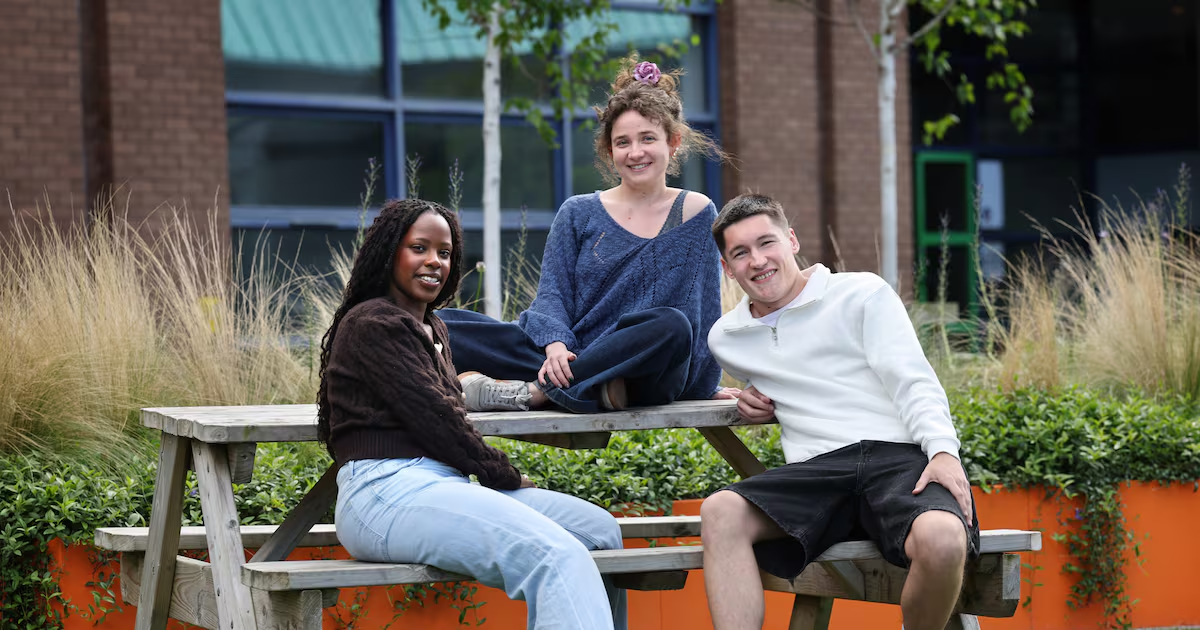
Twenty years ago, when I was in my early 20s, I was single, a bit wild and always out and about. My friends and I could, should we so wish, go dancing seven nights a week. We embraced two-for-one drink offers and chatted up strangers. “Dating” wasn’t our thing – and it wouldn’t be until Tinder arrived here in 2012 – so we shifted people on dance floors, in smoking areas or in the queue for a taxi home. We could be kissing a person for weeks before we got their phone number. “So,” asks 24-year-old Carla Jové, when I tell her about these mating rituals of old, “at what point do you go, ‘What are we?’” This dance could continue for months or even a year before a relationship was declared, I say. “Wow, that’s scary,” says 23-year-old Amanda Uwase, as if I have just revealed the plot of a sci-fi film.Jové, Uwase and Seán Baker (19) are students of mine at Dublin City University, where I lecture in journalism. We’re discussing the dating habits of Gen Z adults, the cohort aged 18 to 29 often portrayed in the media as celibate, with research to back it up: one recent survey of 2,000 single adults in the US, conducted by the Kinsey Institute and datingadvice.com, found that almost half of Gen Z adults aged 18-27 had never had sex, compared with just over one in four millennials.“We are in a completely different point [in our lives] than they were in,” Baker says, comparing how his peers date to how his parents met each other. Reliant on social media and dating apps to kindle relationships, Gen Z’s love lives are a series of online logistics and mind games. For older generations “there was no such thing as ghosting”, he says.If someone vanished into thin air 20 years ago, it could warrant filing a missing persons report, but ghosting – the act of appearing in someone’s love life and then disappearing with no explanation – is part and parcel of modern dating. So is translating the meaning behind all online interactions. “People might send out signals to say that they like you by liking a story [on social media],” says Baker, who is single. He specifically references the cruelty of leaving someone “on delivered”, which means leaving a read message unacknowledged to demonstrate aloofness. “I know a lot of people who are pretty much just waiting for people to text them back all day,” he says. The culture on Snapchat, the third most popular app used by Gen Z after YouTube and TikTok, is to half-open a message so that it doesn’t activate its ‘delivered’ status for the sender. “Toxic is probably the word for it,” says Baker.Dating rulesAmanda Uwase: 'It’s easy to get a date today, it’s just hard to find the one for you.' Photograph: Dara Mac Dónaill Focused on writing their master’s dissertations this summer, Uwase and Jové have combined experiences of living, working, studying and dating in the UK, France, the Netherlands and Luxembourg. As we chat in an empty lecture room in DCU’s School of Communications, their rapport is that of two savvy podcast hosts solving their generation’s problems.First up, Uwase wants to ban all dating rules. “There is the talking stage, which means you have to text someone for three to four months before actually meeting them,” she begins. “There’s rules where men have to pay on the first date, or rules where a woman has to act a certain way: don’t text first, leave them on delivered for seven hours ...” The list goes on.[ Dating apps struggle with the AI revolution as users lose faithOpens in new window ]Jové, who is originally from Spain, adds that the self-imposed rules of “self-care” can hinder her generation from meeting new people. “We’re so focused on keeping our ‘peace’ that if a night out messes with your routine, then you don’t do it,” she says.Therapy language helps them to avoid potentially tricky situations. Case in point is the red flag theory. “Everything has turned into a red flag. When you’re meeting somebody and they do something that you don’t really like,” Jové snaps her fingers, “‘This disturbs my mental peace – they’re out.’”Nightlife and alcoholSeán Baker: 'I can’t really get past the first or second date.' Photograph: Dara Mac Dónaill Dating platform Match says “burnout, emotional gaps, and rising expectations have pushed dating to a breaking point”. Its 2025 survey of 5,000 single people in the US found that 72 per cent of Gen Z singletons don’t want to make the first move. This resonates with Baker. “I’m a very confident person, but when it comes to approaching a girl ...” he pulls a face. “People say that the worst you can say is no, but I fear rejection.”Relationships are a big topic of conversation with his female friends from college, but he’s less candid with his home friends in Coolock. “If I was to say to my mates, ‘Nah, I’m not going out, I’m with my girlfriend,’ they’d just be slagging me the whole time,” he says. He would like to be in a relationship, but has had little success. “If I meet a girl, nine times out of 10 nothing really comes of it,” he says. “It’s a bit like, ‘What am I doing with myself?’”Baker sets the scene of a typical night out, which involves waiting around for signals. “If I see a girl and they look over to me and they almost give me the look, then I know that it’s okay to go over.” Overall, he feels he doesn’t have issues with meeting girls when he’s out, “but it’s just like, what’s after that? It’s almost like I can’t keep up. I can’t really get past the first or second date”.The anxiety among this generation around pushing things forward with people they fancy could be because grouped teen activities, like going to the disco or the cinema, were stalled for years by Covid as they were coming of age. And now, underage events like teen discos – a breeding ground for first crushes, kisses, relationships and heartbreaks – are not as common as they once were.[ Online dating at midlife: ‘He wanted me to drive from north Dublin to Wicklow for sex at 2am’Opens in new window ]Irish nightlife now is a shadow of its former self. Older generations mourn the loss of what we once had, but Gen Z are entering their adult years without knowing how good it could be. From having more than 500 licensed night clubs nationwide in 2000 to just 83 in 2025, their real-life social and flirting opportunities have been decimated.“There’s not enough room for us to go and meet people,” says Baker. Listing off closed venues in areas like Clontarf and Howth that he never had the chance to visit, he declares, “Nightlife in Dublin is just way worse than what it was.”While Gen Z drink less than previous generations, they’re not all teetotallers. Consumption of alcohol among 15- to 24-year-olds increased from 66 per cent in 2016 to 78 per cent in 2025, according to a recent report from Alcohol Ireland, and binge drinking levels are “stubbornly high”. Or as Diageo puts it, they “drink socially a little less frequently than other cohorts, [but] they do so very enthusiastically”, and it’s mostly at home with friends to save money.Drinking isn’t a priority for Uwase, Jové or Baker. When they describe their ideal dates, they opt for budget-friendly activities that can spark something more interesting than a drink in town would. Uwase suggests playing basketball “to see how you manage under pressure or stress”; Jové likes the idea of a museum visit or a hike, because “if it doesn’t work out, you still got something out of it”; Baker suggests bowling or going for a walk or “something that gets a conversation going”.For safety reasons, Uwase prefers not to drink on dates. She recalls how one date was adamant she drink something stronger than the Fanta she ordered, even though he was drinking blackcurrant cordial. “He only wanted me to drink to get me drunk,” she says. If you don’t drink on a date, she says, you can be yourself and focus “on who’s in front of you and pick up on the signs”.Jové also likes to keep a clear head on dates. “If I’m a bit tipsy or whatever, I know the intentions,” she says, connecting boozy dates to more casual hook-ups. “If I get with them on that one night, I know that the alcohol was behind it. My intentions were not, ‘I want to get to know you,’ it’s just that I fancy you.”Too much choiceCarla Jové: 'If I’m a bit tipsy or whatever, I know the intentions. If I get with them on that one night, I know that the alcohol was behind it.' Photograph: Dara Mac Dónaill Jové, who is newly dating someone, has never used a dating app, but she feels overexposure to so many different people on social media weakens her generation’s enthusiasm to commit to a partner. “Every time you meet somebody, you might like them but your brain goes, ‘There might be a better option out there,’” she says. “We just keep meeting people, but never end up deeply meeting them.”In Ireland, 20 per cent of respondents to the European Commission’s Loneliness and Social Connectedness 2023 Report admitted to feeling lonely most of the time, and Gen Z make up the bulk of that figure. Edel Walsh, a health and wellbeing economist and lecturer in University College Cork, says a common measure of loneliness is the mismatch between your desired and actual social connections.“You can be around lots of people and still feel inherently lonely, and I think that’s what this generation is probably feeling,” she says, placing blame on the cost of living and housing crises for limiting Gen Z’s chances to connect meaningfully. It creates a loneliness “that they may not even realise is there”.The match.com survey of American singletons found Gen Z to be the most sexually conservative generation, with 29 per cent saying sex should only happen in a committed relationship. Jové has a theory on this.“When you are in a stable relationship, you can have sex whenever you want,” she says. If you are single or in an open relationship, you can go out whenever you like and hook up with whomever you like, creating a paradox for Gen Z that leaves them paralysed by choice. People her age “would rather take things slow or meet one person at a time instead of sporadic sex”.“A lot of things must align to end up having sex with a stranger,” she says. Things like chemistry, energy, schedules, or the simple matter of privacy – 61.7 per cent of young Irish adults live at home with their parents, according to figures from Eurostat published in May.As a liberal Christian woman, Uwase is searching for a liberal Christian man, ruling her out of hook-up culture. Faith-based apps are usually too conservative, so she used Tinder until last summer. “It just brought so much anxiety,” she says. She was asking herself, “‘Why am I advertising myself for love?’” Now she is returning to the old methods of dating by scoping out suitors in real life. Or, as she calls it, “dating in the wild”. She has no shortage of opportunities to meet people, with a week filled with dance lessons, comedy gigs, working and meeting friends. “It’s easy to get a date today,” she says, “it’s just hard to find the one for you.”She is seeing someone she met at a salsa class. “Once I find people that I really vibe with, I tend to fit them into my schedule,” she says, “especially if they also want to, you know, go to salsa.”
The new Gen Z dating rules: ‘Why am I advertising myself for love?’
Reliant on social media and dating apps to kindle relationships, love lives become a series of online logistics and mind games
1,978 words~9 min read