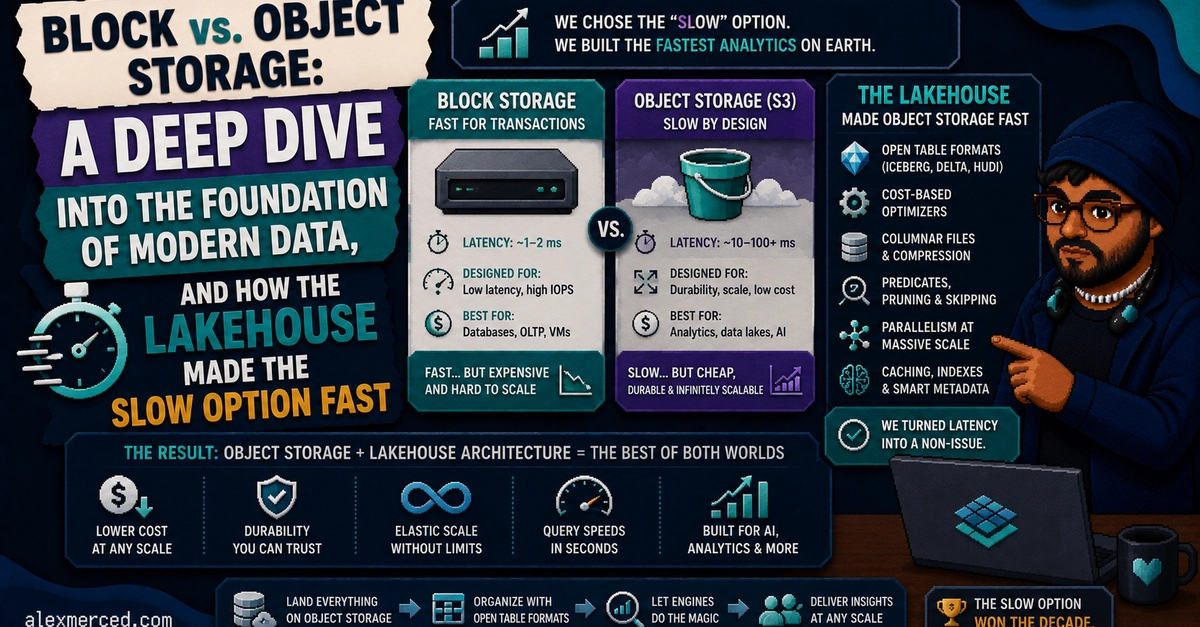
Here is one of the strangest and most consequential plot twists in the history of data infrastructure: over the past decade, the analytics industry deliberately moved its data onto the slowest storage it could find, and got faster.
Amazon S3 answers a read request in tens to over a hundred milliseconds. A modern block volume answers in one or two, and local NVMe in microseconds. By the only metric storage vendors printed on the box, object storage was a fifty-to-hundred-fold step backward. Yet today the world's analytical data, the lakehouses, the training sets, the event histories, lives overwhelmingly on object storage, queries against it come back in seconds or less, and nobody serious is moving back. That plot twist is not a paradox. It is a story about which properties of storage actually matter at scale, and about a decade of brilliant engineering, in file formats, table formats, and query engines, that systematically neutralized every weakness the latency number represented.
This article is the full deep dive. What block and object storage actually are, mechanically, without hand-waving. The honest comparison across latency, throughput, scalability, availability, durability, cost, and consistency, with real numbers. The specific wrinkles object storage inflicts on data workloads, and then the heart of the piece: how Apache Parquet, Apache Iceberg, and engines like Dremio overcome each wrinkle, layer by layer, turning eleven nines of cheap durability into interactive analytics. By the end, the plot twist should feel inevitable, and you should be able to reason about any storage decision, and any vendor's storage claim, from first principles.