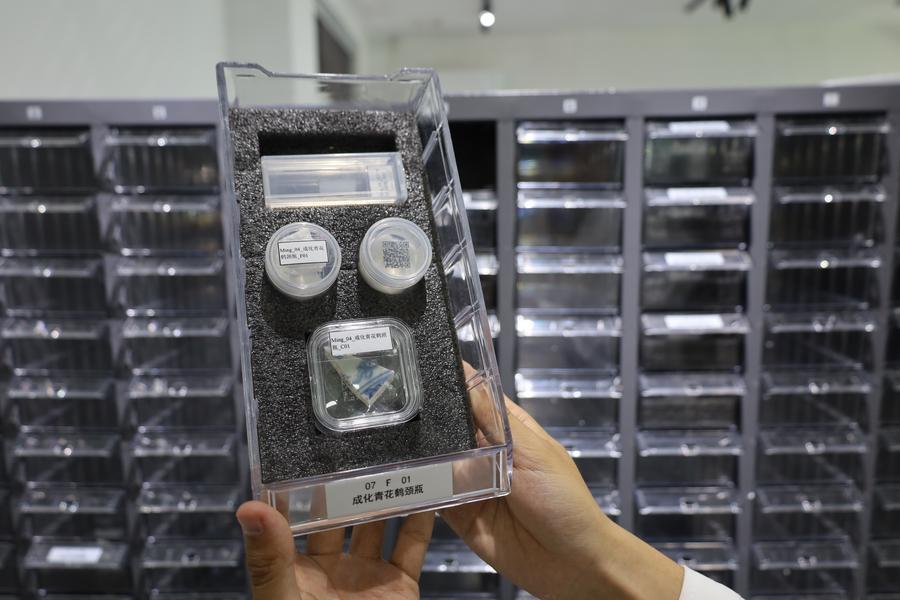
* Jingdezhen City in east China, known as the "porcelain capital," has produced ceramics for over 1,700 years. Beneath the city's famed masterpieces lie layers of broken fragments several meters thick -- flawed imperial ceramics and damaged folk products.* The Jingdezhen Imperial Kiln Institute, together with other partners, has built a gene bank to collect data points from the shards. The bank offers a standardized physical sample library and a unified data framework to support international authentication and academic research.* A researcher from the British Museum noted that with the gene bank, Western ceramic studies can move from "appreciating finished products" to analyzing materials, technology and production systems.This file photo shows a staff member displaying ceramic "gene" samples at Jingdezhen Imperial Kiln Institute in Jingdezhen, east China's Jiangxi Province. (Xinhua)NANCHANG, July 11 (Xinhua) -- Inside the Jingdezhen Imperial Kiln Institute, rows upon rows of grey metal cabinets house thousands of transparent drawers filled with ancient ceramic shards. Together, they form the world's first ancient ceramic gene bank -- a database that stores broken pottery like DNA.Jingdezhen City in east China, known as the "porcelain capital," has produced ceramics for over 1,700 years. Beneath the city's famed masterpieces lie layers of broken fragments several meters thick -- flawed imperial ceramics and damaged folk products. To date, nearly 20 million shards have been unearthed from the city's deep archaeological deposits.The Jingdezhen Imperial Kiln Institute, together with Tsinghua University, Shanghai Institute of Ceramics under Chinese Academy of Sciences and other partners, has built a gene bank to collect data points from the shards.The bank offers a standardized physical sample library and a unified data framework to support international authentication and academic research. Its data encompasses shape, decoration, body material, glaze, color, firing marks and inscriptions.This file photo shows the site of an ancient kiln in Jingdezhen, east China's Jiangxi Province. (Jingdezhen Imperial Kiln Institute/Handout via Xinhua)"GENE BANK" FOR CERAMICSTo become a "gene" sample, each shard is first cleaned and cut into four physical forms -- fragments, cross-sections, thin slices and powder. Scanning electron microscopy is used to examine these prepared samples.Extracting a gene means identifying key characteristics, explained Tong Yuting, a staff member at the Jingdezhen Imperial Kiln Institute. "For blue and white porcelain, we don't just look at the perfectly colored pieces. We also collect shards with paler tones, deeper shades, or even rust spots, as all of these variations are considered feature points."By gathering this full spectrum of color variations, researchers build a complete "color chart" for blue-and-white wares. Analyzing these variations enables researchers to reverse-engineer the cobalt pigment composition, formula ratios, and firing techniques of ancient craftsmen, making each shard a window into historical production methods.The database now holds over one million gene records from 12,000 specimens across 3,000 sets, supported by a standardized system for sample processing, management and preservation. This establishes a benchmark system for dating and authentication.Maria Mayer, curator at the Medeiros e Almeida Museum in Portugal, is studying a group of blue-and-white porcelains made in Ming Dynasty (1368-1644) bearing Portuguese coats of arms. "The gene bank offers a scientific and systematic foundation for classifying ceramic materials, which will help me uncover the cultural exchange history behind this collection," she said.Xin Wenyuan, a researcher at the British Museum, noted that many overseas collections have traditionally been dated and classified solely by style. "The archaeological sequence and technical data from the imperial kiln site give us a more reliable basis for comparison," she said. With the gene bank, Western ceramic studies can move from "appreciating finished products" to analyzing materials, technology and production systems.Xin added that Jingdezhen's gene bank lets researchers observe different stages of production, including glaze composition, trimming methods, firing temperature control and even disposal."I noticed a branch-and-flower pattern on a blue-and-white sauce-glaze bowl fragment that closely resembles pieces in our collection and those from the 19th-century Desaru shipwreck. It's like a matching game, one decoration connects the whole chain -- production, transport, consumption, and museum collection."The data also helps with restoration. Researchers recently reassembled two large dragon-decorated vats made in the Ming Dynasty from 16,000 fragments -- a task once thought impossible. AI algorithms processed each shard's gene data to predict correct assembly paths, bringing the relics back to life.This file photo shows a staff member analyzing an ancient ceramic sample at Jingdezhen Imperial Kiln Institute in Jingdezhen, east China's Jiangxi Province. (Jingdezhen Imperial Kiln Institute/Handout via Xinhua)GLOBAL COLLABORATION IN CERAMIC RESEARCHThe gene bank has also established a collaborative, standardized framework that advances global ceramic scholarship."In English, ceramics are divided into earthenware, stoneware, and porcelain," said Li Baoping, honorary researcher at Oxford University. "In Chinese, there are only two categories: tao (pottery) and ci (porcelain)." This difference has long caused confusion in cross-border research.China is now addressing that gap. Based on the gene bank, the Jingdezhen Imperial Kiln Institute is drafting the ISO TC349 standard for scientific characterization of ancient ceramics -- a proposal already submitted and under vote at the International Organization for Standardization."Standardized data will become a more internationally accepted research language," said Weng Yanjun, head of the Jingdezhen Imperial Kiln Institute. "It used to be hard to describe literally what exactly is glaze ruby or cowpea red. In the future, we can use precise values from the gene bank to describe and recreate them accurately."International engagement is growing fast. In October 2023, the institute launched the Society of International Ceramic Studies (SICS), which has already held two academic conferences involving 89 institutions and over 200 scholars from 22 countries and regions. In December 2024, the SICS advisory committee was formed, bringing together renowned experts from China and around the world.In June 2025, the English biannual Journal of International Ceramic Studies was launched, the world's only English journal in this field, co-published by Elsevier Publishing Group and China Science Publishing & Media Ltd. Its first two issues feature 25 papers from 26 leading institutions across 14 countries and regions.The institute is also building an interactive World Ceramic Interactive Map, linking collections worldwide. By clicking any coordinate on the map, users will see local artifacts, their kiln sites, and global distribution routes -- turning scattered archives into a connected story."Jingdezhen is uniquely placed, as it can serve as both a primary source of empirical data and a core hub for international cooperation," said Teresa Canepa, a member of the Council of the Oriental Ceramic Society in the United Kingdom. She is planning to integrate her decades of research on shipwreck ceramics into the map's backend system."When we pool all this data, and click somewhere in the Middle East or Europe and see links to the Jingdezhen kilns, the Forbidden City, Topkapi Palace or the Guimet Museum, people will be struck by the intertwined histories and memories that emerge," said Weng. The platform aims to gather over 10,000 data points and complete its framework by the end of 2026, with significant progress expected in the next three to five years.Today, the map's rich cultural data is accessible to the public, inspiring ceramic enthusiasts around the world. These shards serve as storytellers that create a new bridge between modern science and ancient civilization.(Video reporters: Yuan Huijing and Wang Zhongqing; video editors: Zhang Yucheng, Zhu Cong and Zheng Qingbin) ■
Xinhua Headlines: Jingdezhen turns bank of ceramic shards into hub for global research
Xinhua Headlines: Jingdezhen turns bank of ceramic shards into hub for global research-
1,203 words~5 min read