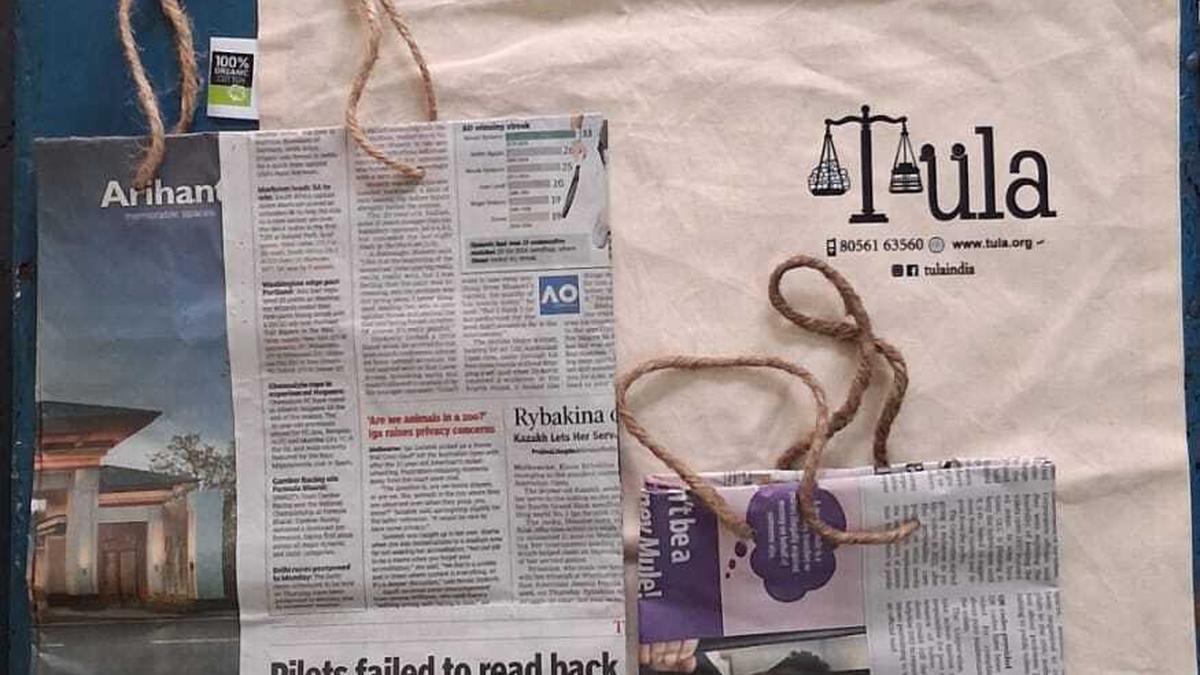
A statement about mindful choicesPackaging doubles as a brand statement. A clothing label at Karpagam Gardens in Adyar, Tula India has dispensed with the branding part and instead made packaging a statement about mindful choices. “We will ask customers to bring their own bags. Most of our customers do, and we’ll also educate them,” says Sushmitha R.K, designer at Tula India.The approach begins well before a garment reaches the store. Cotton is transported in airtight plastic sacks that are reused year after year, while woven fabric moves between production units in reusable sack bags instead of new packaging. “So the cycle keeps repeating. Instead of buying new plastic covers every time and discarding them, we keep reusing what we already have,” she says.Garments are displayed without individual plastic covers. Customers are encouraged to bring their own bags, but those who forget are offered newspaper bags made by autistic adults using recycled newspapers or reusable cloth bags stitched from leftover organic cotton fabric. “Whatever big pieces of fabric are left after production, we make our cloth bags from them,” says Sushmitha, adding that the bags are often pieced together from two or three fabric scraps.The leftover fabric also serves another purpose. Larger parcels are wrapped in these fabric pieces, while smaller consignments are sent in paper envelopes.Interestingly, the cloth bags are not sold despite customer demand. “Many people want to buy those bags because they like them. But we tell them the bag is not for sale. There is no purpose in buying another bag just to own it when you already have many bags at home,” she says.The store also uses conversations and posters to encourage customers to rethink disposable packaging.For more information on Tula’s approach to reducing unnecessary packaging, contact 8056163560 / www.tula.org.inThe bag bankA cardboard box outside the entrance of Kazhani Native Farms in Kottivakkam has become an unlikely solution to a common retail problem. Instead of selling new carry bags, the farm invites customers to drop off extra shopping bags for others to reuse.For Gokulnath Natesan, founder of Kazhani Native Farms, the idea stemmed from a growing dependence on packaging as the farm expanded its range of products. “As the product range increased, the usage of packaging materials also increased,” he says. “We realised that while we were conscious about sustainability and waste management, in another way we were increasing the usage of plastics.”Walk-in customers are encouraged to bring their own bags and containers, particularly for loose produce. For products such as juices and oils, customers are asked to return the same containers for refills. “We will fill it again and give it to you. Until it is good, you can use it instead of throwing it away,” says Gokulnath.The cardboard box outside the store extends the same idea. Customers leave behind extra carry bags they no longer need, allowing others who arrive without one to reuse them.“Instead of charging them, we told them they can take the bag. Similarly, if you have excess bags at home, you do not need to throw them away or keep filling your shelves. Just leave them here,” he says. While home deliveries still rely on plastic packaging where alternatives prove impractical, Gokulnath says the reuse initiative has significantly reduced the farm’s purchase of new carry bags.“It has reduced our bag purchasing costs and plastics, and it has become a good habit for people,” he says. “As others started dropping off excess covers, they also began bringing other waste.”The farm now serves as a drop-off point for vegetable and garden waste, dry waste, e-waste and old garments. “The transaction does not end with the purchase,” says Gokulnath. “It goes back as a message, creates awareness and builds an eco-friendly environment together.”For more information, contact @kazhani.in / Instagram - @kazhanifarmsTake a discount in your own bagFor most shoppers, the bag is an afterthought — a necessity considered only after the purchase is complete. At Restore on East Coast Road, Kottivakkam, it is the starting point of the shopping experience, where customers are encouraged to carry their own bags and rethink the way they approach packaging.
Judge a purchase by its cover: how three enterprises in Chennai make sure packaging does not leave carbon footprints
Restore at Kottivakkam on East Coast Road offers a 2 per cent discount on purchases if the customer brings their own bag; Kazhani Native Farms in Kottivakkam has placed a cardboard box at the entrance inviting customers to drop off extra shopping bags for others to reuse; and Tula India in Adyar encourages customers to bring their own bags, and those who forget are handed handmade newspaper bags
719 words~3 min read