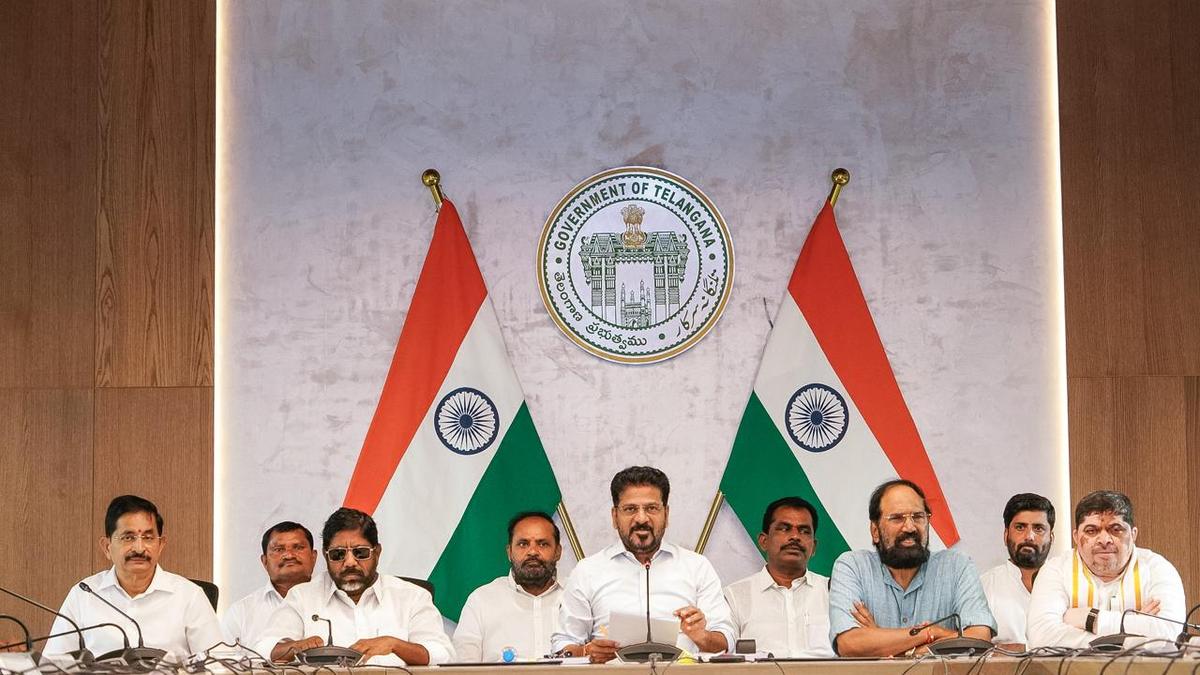
Chief Minister A. Revanth Reddy ruled out lifting floodwaters from the Kannepalli pumphouse on the Kaleshwaram project as it would be disastrous for the three barrages — Medigadda, Annaram and Sundilla — further damaging them.He said a minimum of 4 to 5 TMC water has to be stored for pumping, as water can’t be lifted when it is flowing and the storage option is closed as it would damage the entire barrage, as warned by the National Dam Safety Authority (NDSA) in its report, he said at a press conference on Saturday.Explaining the technical constraints through a PowerPoint, Mr. Revanth Reddy said there was a clear distinction between the availability of river flow and the water level required for pumping operations. While the minimum pumping level required at the Kannepalli (Lakshmi) pumphouse is 93.5 metres, the present water level at Medigadda is only about 89.9 metres. Although the barrage bed level is 88.5 metres and the crest level is 89.5 metres, these levels are insufficient for pumping water through the Kannapalli pumphouse located around 18 kilometres away.He added that similar conditions prevailed at the Annaram and Sundilla barrages. Even if water were lifted from Kannapalli, it would eventually flow back towards Medigadda. Closing the gates to impound water was not permissible in view of the NDSA’s safety recommendations, he said, accusing the opposition of misleading the public by demanding immediate lifting of floodwaters.The Chief Minister agreed that water was going waste, causing suffering to farmers in the present dry spell, and that BRS chief K. Chandrashekhar Rao and former Irrigation Minister T. Harish Rao should take responsibility for the farmers’ suffering. The BRS leaders were demanding to lift floodwaters just to cover up their failures.Alleging that BJP MP Eatala Rajender was speaking at the behest of Mr. Harish Rao, the Chief Minister challenged Mr. Rajender to accompany the BRS leaders to the NDSA and convince the authority to permit water storage and pumping operations. “If the NDSA agrees, we will also move forward,” he said.He also criticised a section of retired engineers forum of Telangana for toeing the BRS voice despite the technical realities surrounding the project, and forgetting that the same engineers had reservations about the project in its conceptual stage.Tracing the sequence of events, Mr. Revanth Reddy noted that the Kaleshwaram project was inaugurated by former Chief Minister K. Chandrasekhar Rao on June 29, 2019. However, within eleven months, Executive Engineer B.V. Ramana Rao had written to the authorities on May 18, 2020 pointing out structural deficiencies in the Medigadda barrage. Since the warnings were allegedly ignored, the defects worsened, ultimately resulting in the partial collapse of the barrage on October 21, 2023.He said engineers lodged a police complaint the very next day and that the NDSA, in its preliminary report submitted on November 1, 2023, identified deficiencies in planning, design and operation and maintenance.Refuting allegations that the NDSA had acted without jurisdiction, Mr. Revanth Reddy said the authority inspected the barrage under the provisions of the Dam Safety Act, 2021, which came into force on December 30, 2021 and empowered it to inspect designated dams across the country.The Chief Minister said the NDSA’s preliminary report had warned that water should not be stored in the Medigadda barrage because damage to Block-7 posed safety risks. Following extensive field investigations and technical studies, the authority submitted its final report nearly ten months later, concluding that the Medigadda, Annaram and Sundilla barrages were not fit for storing water.He cited the report’s findings, saying the Medigadda barrage had become unfit for diverting water due to damage to Block-7, while the Annaram and Sundilla barrages had also suffered severe structural damage, making water storage unsafe.According to the Chief Minister, the executive summary of the report recommended comprehensive redesign and restoration of all three barrages, an overall structural safety assessment and immediate stabilisation measures. He said the NDSA had further recommended that all restoration, repair and redesign works should be undertaken only after obtaining approvals from the NDSA or the Central Water Commission.The Chief Minister also referred to the Centre’s recent decision to constitute a Special Technical Oversight Committee on June 30, 2026 to supervise restoration of the three barrages. The committee, he said, had also acknowledged structural deficiencies and would oversee investigations, quality control, design modifications and restoration proposals.He also renewed his attack on Mr. Harish Rao, accusing him of corruption during the execution of the Kaleshwaram project and questioning the BRS government’s silence when 105 TMC of Godavari water was diverted to the Pattiseema project during its tenure.
Revanth cites danger in lifting floodwaters at Medigadda and challenges BRS and BJP to convince NDSA
Revanth warns against lifting floodwaters at Medigadda, citing safety risks and challenges BRS and BJP to address NDSA concerns.
757 words~3 min read