At re:Invent 2025, AWS announced Lambda Durable Functions. The feature introduces a checkpoint/replay mechanism that allows Lambda executions to run for up to one year, automatically recovering from interruptions by replaying from the last checkpoint.
Lambda's 15-minute timeout is not a bug or a limitation to work around. It is a deliberate design choice that encourages keeping functions simple and focused, and in most cases it does its job well. When a function needs more time, the usual approach is fanout: split the work into smaller Lambdas, orchestrate them, move on. I have done it many times and it works perfectly fine.
But a few days ago I was developing a new Lambda function for a pipeline orchestrated by Step Functions, and the execution time exceeded 15 minutes. I could have done the usual split, but durable functions had just come out and I wanted to try them.
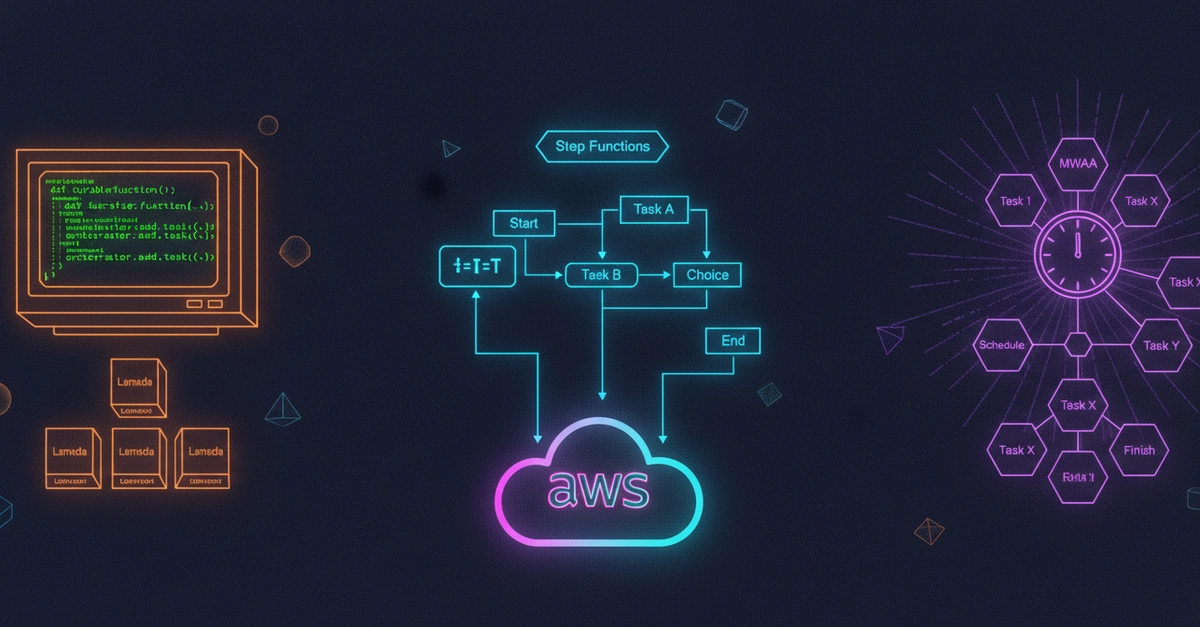
At first glance, durable functions can look like a replacement for Step Functions. Both services manage multi-step workflows, both offer checkpointing and automatic recovery, and both let you coordinate complex operations. For certain use cases, that might actually be the case: if your entire workflow lives inside a single Lambda, durable functions can handle everything on their own without an external orchestrator.