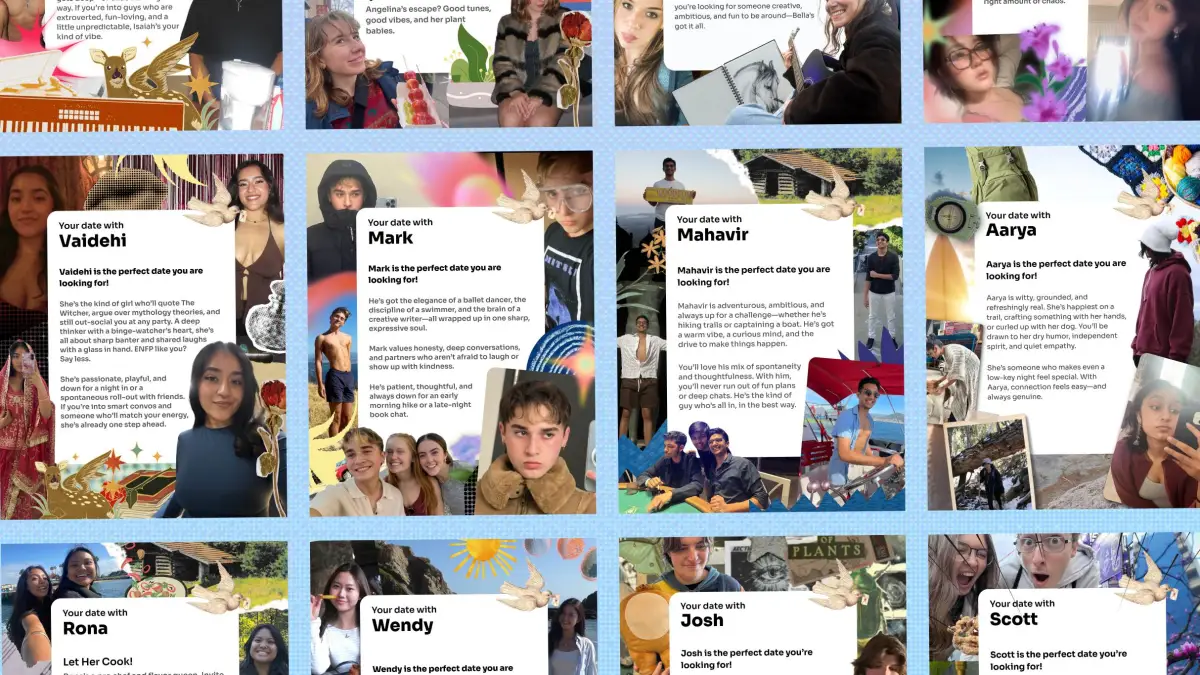
Would you pay $15 to go on a date? It’s just the price of a cocktail, argue Stanford dropouts Celeste Amadon and Asher Allen. They started dating app company Known based on their belief that frustrated Gen Z singles, tired of endless swiping, are willing to pay up. Known cofounders Asher Allen (left) and Celeste Amadon (right)KnownThose signing up for Known start by talking with an AI, an onboarding experience similar to a phone call designed to encourage users to talk more naturally rather than type out answers into a form. Then the San Francisco-based startup introduces daters to one potential match at a time. If both people say yes, the app uses AI agents to book the first date for them and charges each person.Fifteen dollars might sound like a lot for a single date, but Hinge subscriptions can cost between $30 and $50 monthly and Bumble’s monthly cost can range from $40 to almost $100. Amadon and Allen believe the incentives are skewed. They think dating apps should only make money when they actually help people meet IRL. “It seems that most single people we know use dating apps, but they're not willing to pay for them because everyone has woken up to the fact that they're highly ineffective,” says Amadon, 22. “Using a dating app that doesn't help you get dates is just not useful. It makes you feel badly about yourself and people don't want to pay for things that make them feel that way.” The company’s no-show rate is less than 1%, she says. Eurie Kim, managing partner at Forerunner Ventures, which led a $9.7 million funding round for Known in December, says the company’s pay-per-date model fixes that incentive structure. “In the swiping culture, if you find a partner, you're no longer a customer,” Kim says. “That's the underpinning of why the incumbents can't just switch their model. This has to be a new experience that sets different expectations for behavior.”222 cofounders Keyan Kazemian, Arman Roshannai and Danial Hashemi222For years, online dating promised more profiles, more matches and more relationships. But a new crop of young founders are trying to reinvent a product that has come to feel less like a path to romance and more like another algorithmic feed, optimized to keep users looking rather than help them form a connection.Another startup, New York-based social platform 222, is trying to replace the swipe with group dinners, where a total of six people are matched together based on compatibility. Instead of letting users browse profiles or swipe through strangers, 222 has them fill out a personality questionnaire, then sends a message with a reservation for a blind group hangout, usually three men and three women.About an hour into the event, attendees get a text with a second location, where they can meet people from other 222 groups out that night. After the event, users say who they would want to see again as a friend or on a date, and 222 sets them up. That real-world feedback also trains 222’s in-house matching algorithm to decide who to introduce them to next and whether they’d enjoy dinner, drinks or an activity such as salsa dancing. “If we stop having real-life social interactions with the people around us, whether it's our neighbors, coworkers or potential romantic partners, we cease to be human,” says CEO Keyan Kazemian, 27. “When you look back on your deathbed, you're not going to be like, 'I'm so happy I swiped for that long to watch all those interesting TikToks.’ That will all feel meaningless.”Founded in 2023 out of Y Combinator’s accelerator program, 222 began as a research project when Kazemian, COO Danial Hashemi and CTO Arman Roshannai were in school at USC and UC Irvine. They called it “The Serendipity Project,” named after the kind of chance encounters the founders felt their generation had largely missed. The idea was to see whether machine learning could predict social compatibility without feeling overly curated or transactional, Hashemi says. Early tests took place in Keyan's backyard, where participants filled out surveys, met over pasta and wine and gave feedback on which connections they were interested in exploring. Gen Z is widely described as the loneliest generation, despite having more ways to communicate than ever. A 2025 Cigna study found that 67% of Gen Zers reported being lonely, closely followed by Millennials at 65%. At the same time, the swipe-based apps that defined the last decade are showing signs of fatigue: Match Group, which owns Tinder, Hinge, Match.com and OkCupid, has seen its stock fall about 8% so far this year, while Bumble reported that first-quarter revenue fell 14% to $212 million as paying users dropped 21% year over year. The company has also said it plans to phase out its signature swipe feature.Kazemian previously worked at Match.com, where he helped build Dates, a feature that prompted people having promising conversations to meet in person. But Kazemian says he came across a statistic noting more than 80% of paying subscribers never actually met anyone in real life. (A Match spokesperson disputed that figure, saying it does not reflect the company’s data and noted that “more than half of online dating relationships in the U.S. last year began on a Match Group app.”) The problem, Kazemian argues, is that dominant dating apps can still make money without producing relationships. Instead, 222’s business model depends on people actually going out. Users pay $22.22 a month for unlimited access to its events, and 222 also charges local venues, restaurants and event hosts that help curate or stage its experiences. For venues, the pitch is that 222 can deliver groups of young people who are already looking for somewhere to go — and spend money. Now, 222 has thousands of users attending its experiences every week across 17 markets, with New York being the largest. Hashemi says it is already generating millions in annual revenue and is close to being cash-flow positive.Mark Suster, general partner at Upfront Ventures who led 222’s $10.1 million Series A round in December, sees the opportunity stretching beyond dating to the lack of community among young people who move to big cities after college. Ditto cofounder and CEO Allen WangDitto“They won't stop until they believe they're the single best AI-enabled service to help you make plans with friends and strengthen relationships,” Suster says. “It just happens that the need is more acute and instant for dating. That's what people will spend money on earlier.”Berkeley-based startup Ditto also avoids swiping entirely, instead trying to make dating feel more like getting a text from a friend. Founded in 2025 by Berkeley dropouts Allen Wang and Eric Liu and only available for college students, Ditto will initiate contact via text. Those interested sign up with their college email address and fill out a questionnaire. Every Wednesday, Ditto texts one customized match at a time with a brief profile. If the interest is mutual, Ditto takes the grunt work out of scheduling by sending a link to coordinate plans before setting up a time and place to meet.“I really wanted to do something for my generation,” says Ditto CEO Wang. “We wanted to bring back this IRL aspect of no more scrolling, no more swiping, but face-to-face: grab a coffee, go on a walk to the farmer's market and actually experience this chemistry in real life.”Wang says Ditto has roughly 150,000 users across schools including UC San Diego, Berkeley, UCLA, USC, Michigan and UT Austin. The service is currently free, but the company says users have indicated they would pay roughly $15 to $20 per date. Ditto raised $9.2 million in February and says its user base has grown fivefold since announcing the round. With students scattered for internships over summer break, the company is experimenting with city-based matching.These startups are entering a competitive market dominated by a few deep-pocketed players who are also experimenting with more offline and AI-assisted dating experiences. Bumble’s AI agent “Bee" is meant to act like a personalized wingman by suggesting matches and conversation topics. Match Group now offers features like Tinder Events, which lets users browse local activities and see what other singles are planning to attend. Hinge’s Date Ideas feature suggests first-date plans, and its Signals feature identifies people who are highly engaged, indicating to their matches that they’re interested in forming a meaningful connection (it’s perhaps unintentional that the feature reveals who of your past matches are still active on the app). Something is working: Despite a drop in its stock price, Match Group has a market cap of over $9 billion and reported $864 million in first-quarter revenue, up 4% year over year. Tinder registrations returned to year-over-year growth in March for the first time in nearly two years and Hinge delivered 28% revenue growth year-over-year. But the founders of 222, Known and Ditto are betting that the next major dating platform will not come from companies trying to retrofit old apps for a new generation, but from people who understand why Gen Z is looking for something new.“The people running these companies are focused on optimizing numbers, not recreating this beautiful real-life experience,” says Kazemian. “Someone in this generation who has felt the nausea and fatigue of using these products that promise you a relationship—those are the people who are actually going to solve this.”More From ForbesForbesAll Rise: Internet Court For AI Agents Is In SessionBy Nina BambyshevaForbesMillennials Are Buying Blue Collar Small Businesses To AI-Proof Their FutureBy John SchroyerForbesHow Taylor Swift’s Wedding Could Easily Top $20 MillionBy Mary Whitfill RoeloffsForbesMeet ‘Pepper’ Baumer, The Man With Hot Sauce In His BloodBy Chloe SorvinoForbesAI Startups With No Revenue Are Using This Tactic To Supersize Their ValuationsBy Rashi Shrivastava and Iain Martin
Dating Apps Are Ditching The Swipe. These Startups Are Racing To Replace It.
Swiping took dating apps mainstream. Now a new crop of startups is betting that the next big dating platform will feel less like a feed and more like a wingman.
1,622 words~7 min read