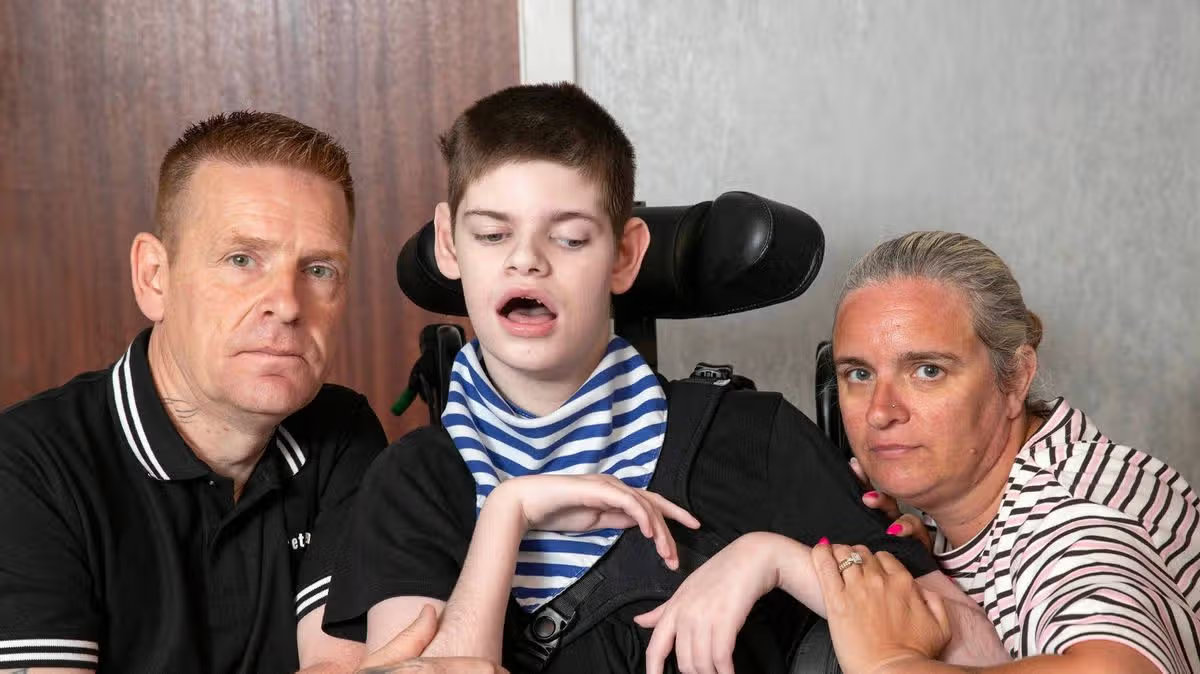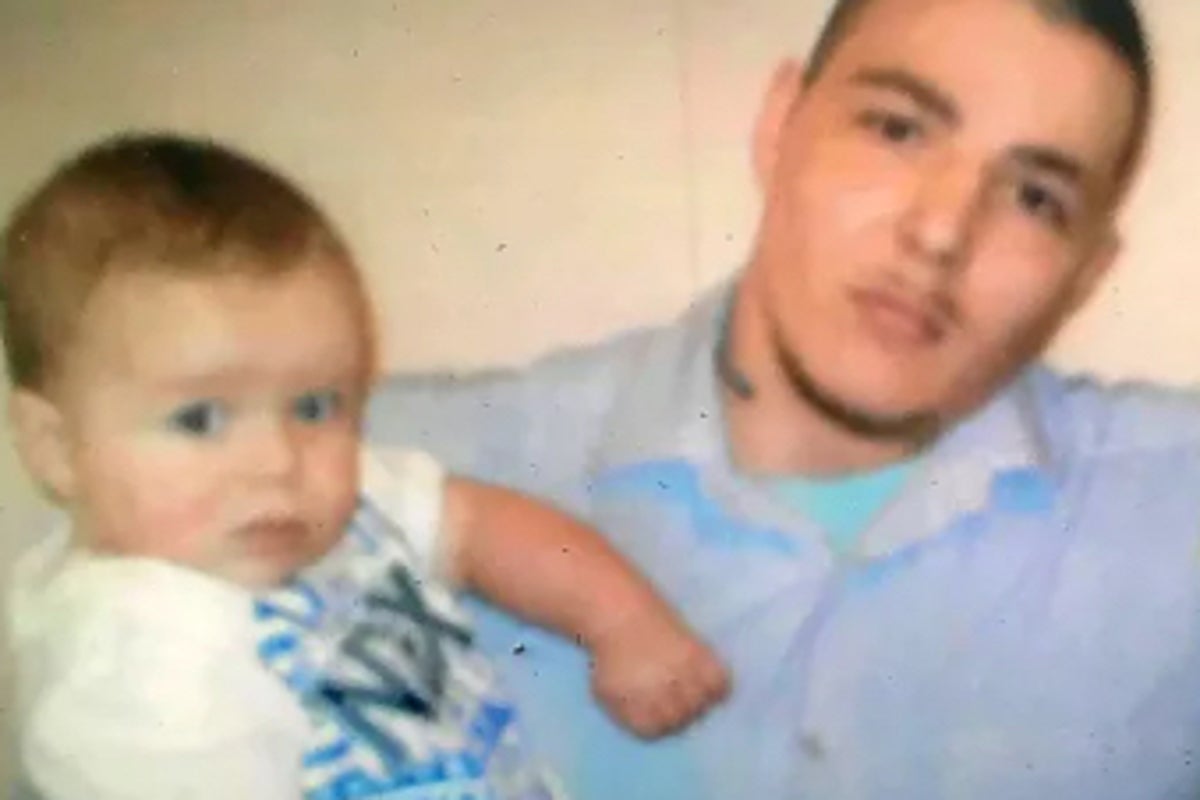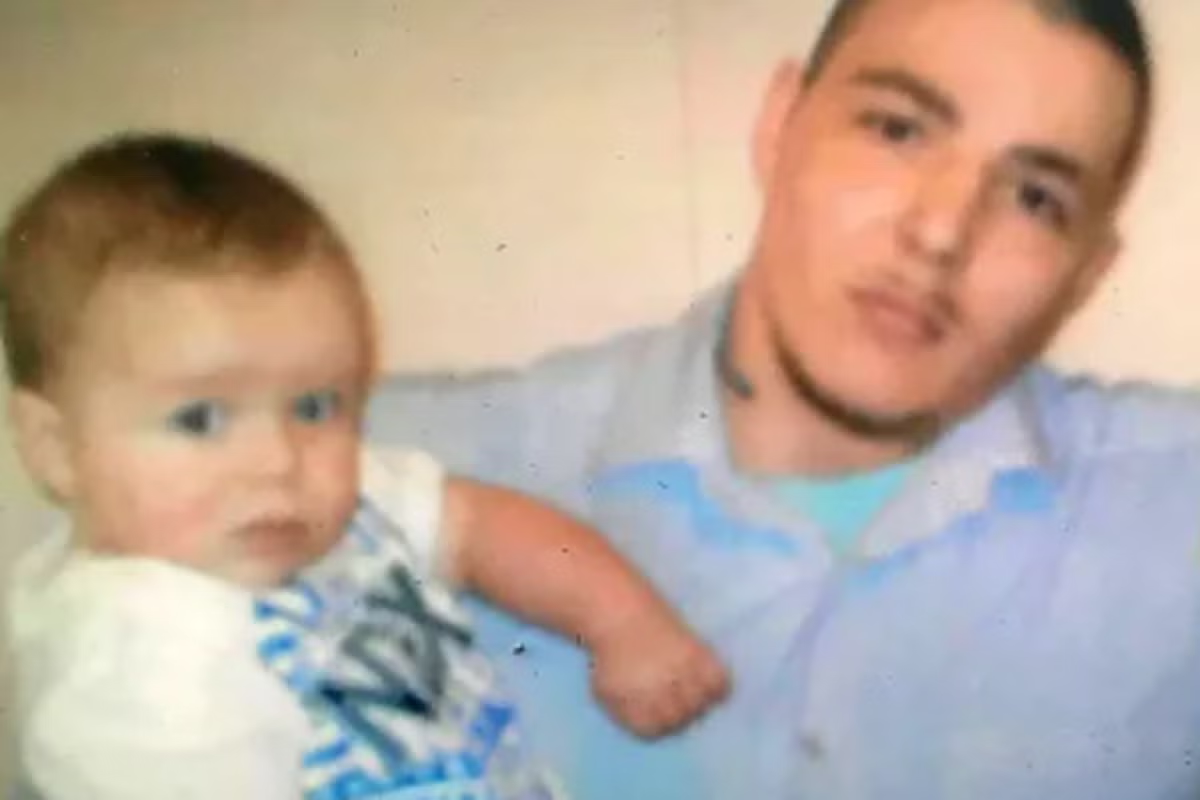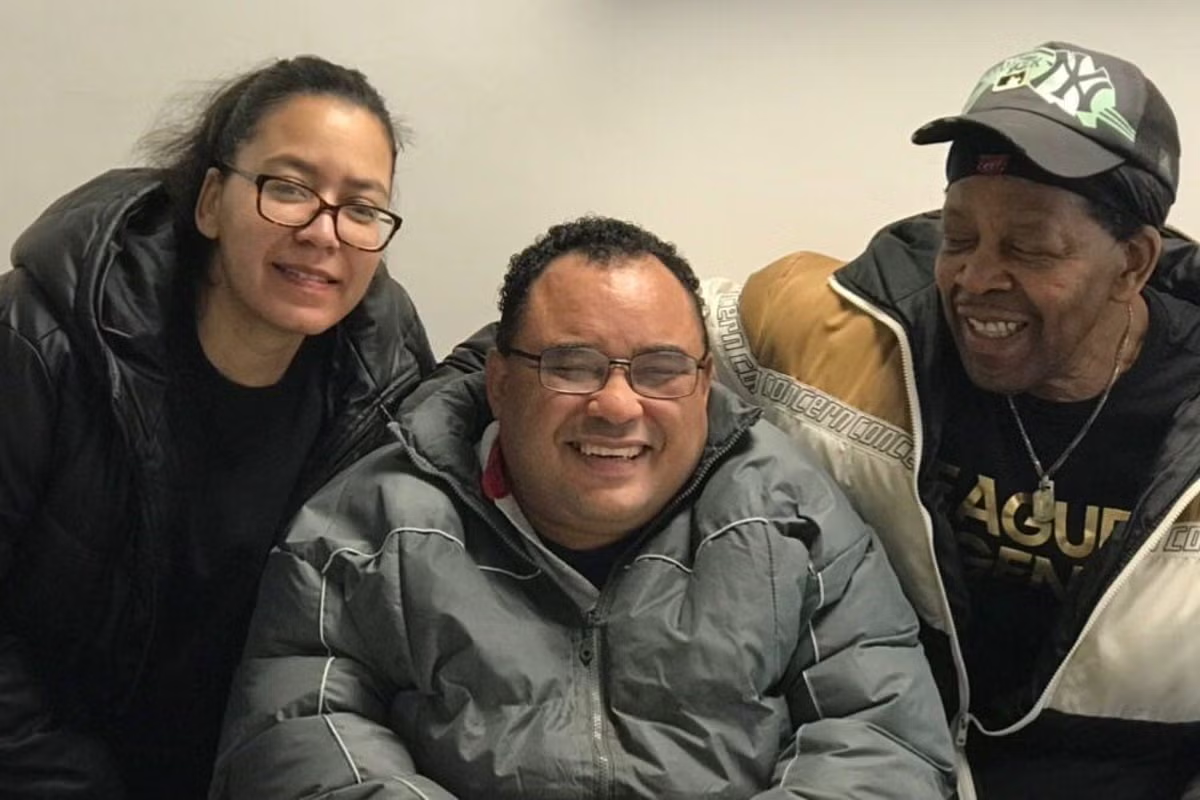
As he speaks, there’s fear in Grant McPherson’s eyes.“You won’t make me go back, Dad. Horrible. Nasty. They hurt me dad. Stay here.”Grant, 48, is in the living room of the specially adapted house he shares with his father Leonard McPherson in Wolverhampton. He has cerebral palsy, sight impairment, epilepsy, a learning disability and uses a wheelchair due to paralysis following a spinal operation as a child.Grant and his father are happy. But they have endured years of heartache in their bid to be reunited at their family home. “Grant is home and I thank God every day that he is,” Leonard tells The Independent. “We are just trying to make memories now.”Leonard is one of hundreds of people across the country who have faced ongoing battles to advocate for their vulnerable loved ones in care after raising concerns about their treatment. During five years trapped in council-sponsored accommodation, Leonard says Grant suffered physically and mentally. Among the roll call of injuries, Grant suffered a severely broken leg, contracted two life threatening infections and was burnt twice – the second time so severely that he spent three months in hospital.But, as Grant was moved between different council care, it was his father Leonard who was put under scrutiny when he asked to remove Grant from care and take him home instead. Incredibly, Leonard was also gagged with legal orders, meaning he could not talk publicly about his struggle to bring his son home. Leonard was on the cusp of being restricted to seeing Grant for just one hour a week – an issue the government has now vowed to crack down on – when a judge finally agreed that Grant could return home to live with his father. He has now been at home for three-and-a-half years. But the family’s ordeal can only now be revealed after two strict legal orders, imposed by the Court of Protection, were finally lifted by a judge.Grant McPherson with his father Leonard and sister Natasha (McPherson family)This is not an isolated case, with concerns raised nationally about draconian conditions placed on parents and guardians, preventing them from advocating for their children, with restrictions often put on visiting rights. Earlier this year, the government vowed to crack down on care companies and councils that ban families from visiting vulnerable relatives and promised to improve visitation rights.The chief inspector of the Care Quality Commission, the independent regulator of health and social care in England, also admitted that care companies who look after people with learning disabilities need to be inspected “more consistently and more regularly”.But the family still have questions over Grant’s treatment and why he was kept away from home for so long.“If I hadn’t been such a strong character, it would have killed me and it would have killed Grant,” Leonard told The Independent.“The system should be there to help and protect people, but the councils can do anything they want without question and without taking responsibility for their actions.“We will never get answers to what has gone on or truly know what he has been through.”The family’s lawyer Rebekah Sambrooks, from Irwin Mitchell, said the case “highlights the importance of local authorities listening to, and working collaboratively with families to ensure some of societies most vulnerable people receive appropriate care and support, in the least restrictive way possible whilst having due regard for a persons wishes”.Mr McPherson, who uses a wheelchair and has disabilities, is now at home with his father (McPherson family)She added: “Leonard fought incredibly hard, over many years, against Grant’s continued deprivation of liberty within various care settings.“Leonard consistently maintained his view that Grant would be happier at home, his needs could be met better by his family, with the added benefit of knowing that Grant’s autonomy would be promoted and he was safe from harm.“Grant is now happy living at home with his father, receiving care in a loving and homely environment.”’All I wanted was to know he was safe’For the first nearly four decades of his life, Grant lived with his father, a widower. Grant needs help with all his basic day to day care needs including washing, dressing and being moved from his bed to his wheelchair, which his father carried out as part of his role as carer. But in 2015, direct living payments from the council – support given to those who care for people with disabilities – were stopped. Leonard said he was never told why but, for two years, he struggled to keep Grant at home until his savings ran out and he could no longer afford to support him. Reluctantly, in 2017, Leonard let Grant move to assisted living accommodation, believing it would be temporary, while the appropriate funding for him to return home was arranged. But the family claim that, following concerns about his safety, and after he had been taking to hospital suffering from a urinary tract infection and dehydration, Wolverhampton City Council moved Grant out of that accommodation and into a specialist care home.Leonard hoped the new facility, which caters specially for patients with disabilities, would be better. “All I wanted was to know that Grant was safe,” said Leonard. “I didn’t care if he was on the moon, if he was being looked after.”But, over the next five years, while at a care home run by Arcare For Forte Ltd in Bilston, Grant sustained a number of injuries. These included the most severe grade of pressure sore on his foot – something which can form due to lack of mobility. An investigation found the wrong dressing had been applied. Another incident came to light on 4 July 2018 when Grant was sent to New Cross Hospital in Wolverhampton to be treated for a blister, surrounded by red skin, on his knee. According to a report from the care home seen by The Independent, the carers said it had appeared two days before, but had burst that day. Medics in A&E thought the blister looked like an old burn wound – as if he had been splashed with hot liquid. There was no history of any such event being recorded at the care home, but an investigation led to all staff being reminded about serving him hot drinks and ensuring his tray was in place on his wheelchair. Then, in September 2019, Grant suffered a broken leg with both his tibia and fibula fractured on his right ankle, which triggered a safeguarding referral. The cause of the fracture was never found. ‘No one cares about me’Leonard tried to remove his son from the home, but Wolverhampton City Council obtained a deprivation of liberty order against Grant to stop him doing so. It claimed Leonard wasn't following the advice of professionals and wasn't acting in Grant's best interests.A transparency order and injunction were obtained at the same time, with both orders meaning Leonard couldn't talk to anyone about the situation. He also couldn't take his son out without permission from the home.A burn sustained by Grant McPherson (McPherson family)“If I wanted to take him out. I had to agree a time to have him back. If he wasn’t back at precisely that time I could be arrested,” he said. “I would stand outside,” he sobs “and didn’t touch my son in case I was accused of doing something”. Two years later, Leonard says Grant was hospitalised with a major burn to his thigh which covered 3 per cent of his body. The injury had been reported by the home as cellulitis but, according to a safeguarding report filed by the hospital and seen by The Independent, a member of staff diagnosed it as a burn. In the report, it said Grant told them "hot water" and "no one cares about me".It adds: “I am concerned as he is a vulnerable adult with complex care needs with a learning disability and is cared for in a nursing home.” It said the safeguarding team had been informed and that he should stay in hospital. His sister Natasha McPherson said that, at this stage, she raised Grant’s care to the regulator Social Work England and the police but claims her complaints were not taken seriously.West Midlands Police said it carried out an investigation after a burn to the victim's leg was reported in January 2022. The police said that, following extensive enquiries, there was insufficient evidence to establish the cause.She said: “They have injured him for life. He’s got a life-long scar. We will never get answers to what has gone on or truly know what he has been through.”Despite the family's wishes, Grant was sent to yet another home, Wrottesley Park Care Home in Wolverhampton. It was on Christmas Day 2022, when the family took Grant his presents, that they became really concerned.“We took him into the lounge and his lips were turning blue and he wasn’t breathing properly,” Ms McPherson said.She called an ambulance. Grant is believed to have another urinary tract infection, dehydration and mild malnutrition. He may also have had a fit.This triggered another safeguarding report by staff at West Midlands Ambulance Service who were concerned Grant wasn’t receiving the care he needed at the home. The report said there was significant swelling to his feet and abdomen, potentially from spending long periods sat in his wheelchair.Abbey Healthcare, which runs Wrottesley Park House, said an investigation into this matter by the appropriate multi-agency safeguarding body “found no failing in our safeguarding and closed the case”.‘What else could they take away from me?’Days after this incident, in a bid to overturn an application to restrict Leonard to supervised visits with his son, Leonard addressed the judge in court – even though he wasn’t allowed to speak.“I wanted the court to know that Grant was loved and we didn’t want him coming to harm. We wanted him home,” he said. That day, in January 2023, after years of battling to have their voices heard, the court decided to allow Grant to return home with the right level of support.Wolverhampton City Council obtained a further transparency order in 2024 which prevented Leonard telling his story. The family have now had that transparency order lifted.Leonard said: “It makes me tear up, but I can’t let it overtake me. Grant is home and I thank God every day that he is home. To see him smile, I can’t ask for anything more.”Wolverhampton City Council said the matter was subject to legal proceedings and they were limited in what they could say.But it said the council had acted “in Grant’s best interests at all times in this matter”. “Since 2020, all decisions regarding his residence and care and support needs were determined by the Court of Protection, with Grant represented by the official solicitor, an independent advocate, during proceedings.“He is now being supported at home with a substantial care package funded by the council, and we understand that Grant and his family are satisfied with the current arrangements."Arcare For Forte Ltd said it could not comment on specific questions because Grant is a protected party. But it said safeguarding is an absolute priority for the company. “If there is any incident where this commitment is compromised, we would report it immediately to adult safeguarding agencies and our regulatory body, the CQC,” it said in a statement. “We will cooperate openly, fully and with complete transparency with any external investigation into our care provision by these agencies and, of course, with any police investigation.”During the time period in question, it said that these agencies had not found any failing in their service provision.The CQC carried out an inspection in January 2022 of Arcare and rated the service as good.Following the burn incident, the CQC said it engaged with the provider to gather more information, as well as the local authority, to ensure safeguarding procedures were followed and people were receiving good safe care.Abbey Healthcare said that at Wrottesley Park House, safeguarding and the provision of quality care has always been an absolute priority.“An investigation three years ago into this matter by the appropriate multi-agency safeguarding body found no failing in our safeguarding and closed the case.“Wrottesley Park House was inspected by the CQC last October and rated good. We are happy to talk with any family members or carers of our residents who may have concerns about any press coverage or social media posts regarding this allegation.”Social Work England said it does not comment on complaints.
I was banned from speaking out on five-year battle over disabled son. I want answers
When Grant McPherson, who has cerebral palsy and uses a wheelchair, temporarily went into care, his father Leonard McPherson had no idea they would be separated for so long. During that time, Grant suffered a string of injuries, including a broken leg and a severe burn — and was almost banned from seeing his father altogether. Now, after a years-long legal fight, Grant and his father are reunited — but he want answers, as Michele Paduano reports
2,070 words~9 min read