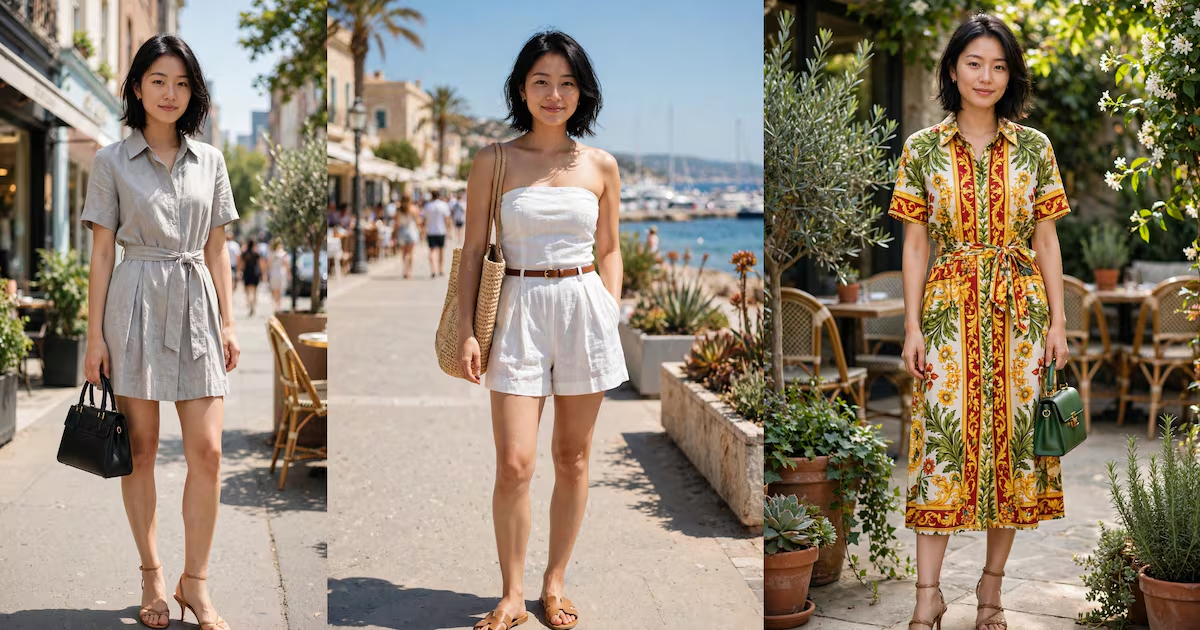
BusinessMuse Image is only available in the U.S. at this time, but the announcement revealed, to the dismay of some, that Meta AI permissions are automatically turned on for users with public accounts in other countries — including Canada — and must be switched off manually in your app settings.Launch of Meta's Muse Image tool reveals people must opt out of AI permissions for photos, videosNick Logan · CBC News · Posted: Jul 10, 2026 4:42 PM EDT | Last Updated: 1 hour agoListen to this articleEstimated 6 minutesThe audio version of this article is generated by AI-based technology. Mispronunciations can occur. We are working with our partners to continually review and improve the results.Some Instagram users were caught off-guard this week when the social media platform launched its new AI tool, Muse Image, and learned that they have to turn off permissions in order to prevent other people using their photos to create AI generated imagery. (Graeme Roy/The Canadian Press)Instagrammers have long used all sorts of filters and tricks to give their pics a glow-up, so it should come as no surprise that parent company Meta is offering new generative AI effects to take content to a different level.Meta launched Muse Image on Tuesday, saying it adds over 30 new effects for Instagram stories, as well as on the messaging platform WhatsApp. It will later be available for Facebook and Messenger."These effects transform your photos with a single tap," reads a post on Instagram's blog, touting that it's the "first AI image generation model from Meta Superintelligence Lab" and that Muse Video is in the works. Is Canada's teen social media ban constitutional? It's complicatedBut it's not making headlines for innovation. Muse Image is only available in the U.S. at this time, but the announcement revealed, to the dismay of some, that Meta AI permissions are automatically turned on for users with public accounts in other countries — including Canada — and must be switched off manually.Users and privacy experts were quick to raise their red flags and share guides on how to opt out."People don't like their images being used in a way that they haven't given permission for," said Katrina German, founder and CEO of Ethical Digital, told CBC News.And while some people may just use the feature for fun, she fears there will be many others who will abuse it. Here's what you need to know about Muse Image and how to change your Instagram settings. A sample of some of the AI-generated images that Meta AI has presented on its website to show how its new Muse Image tool can be used to edit photos. (Instagram; Wendy Martinez/CBC News)How do I turn it off?Let's just cut to the chase. This is why you clicked on the article. The permissions for Muse Image and Meta AI to use your photos to generate images are turned on automatically — again, even if you're not using the tool yourself.This is separate from turning off Meta AI's search assistant and chat bot in Instagram.Turning it off can only be done on mobile devices for now. Go into "Settings and activity" and scroll down to the "Sharing and reuse" section.There, you'll find the Meta AI permissions. If you want to avoid having Instagram's new generative AI feature, Muse AI, use your publicly posted pictures, you must manually turn off the permissions in the 'Sharing and reuse' section of your app settings. (Instagram; Wendy Martinez/CBC News)Meta building its first Canadian data centre northeast of EdmontonCOMMOTIONHow worried should we be about Meta's AI glasses?The first one is: "Allow people to reuse your content on Instagram and with AI features at Meta." It applies to both posts — including your profile photo — and Reels. You must toggle each one off if you want to deny permission.The following permission is: "Allow people to create with and reuse your original audio on Meta AI."You can also simply make your account private, if you haven't already. Meta says that Instagram accounts are default set to private for users under 18 and that parents or guardians must grant permission for children under 16 to change their accounts to public. Australia's teen social media ban struggling to clear age-check hurdles, says testing firmHow could my photos be used? Meta calls Muse Image an "intelligent creative partner," allowing users to apply preset AI generated effects based on the prompts, whether it's restoring an old photo or dressing someone up in different outfits. Meta says there's also an option to create your own effects using prompts.You can do this with anyone's photos, simply by mentioning someone's account with the @ symbol and their username. WATCH | The pros and cons of a social media ban for Canadian children:Canada proposes social media ban for kids — critics say it won't workJune 10|Duration 4:26The Liberal government tabled a bill to restrict young Canadians' access to social media unless companies can demonstrate their platforms are safe. The Safe Social Media Act also aims to limit youth access to AI chatbots.Meta suggest this is for "fun" ideas like "personalized birthday cards, group trip memes or playful edits between friends."The AI-generated creations can then be shared on Instagram stories. Even though Muse Image is not yet available to Instagram users in Canada, Meta does offer the option to test the tool on the Meta AI website by uploading photos.So, why should I be concerned? German says tools like this open the gate for anyone, anywhere to use an image of a stranger in "any form that they want it to be" — something she believes is of particular concern to public figures and parents of young kids. Social media ban or not, parents face dilemma over kids’ online safetySextortion cases surging in Winnipeg, targeting both adults and kids, police sayBut she also says it's a "big game-changer" that people in online spaces are now required to manually opt out of it."Before, we were creating content for ourselves and for our audiences," she said. "And now it makes almost everything that you're creating, unless you opt out, public domain." She says Meta already collects troves of data from its users.Meta has been training its AI models, since 2024, with usernames and details, as well as text, images, audio and video from public posts from Instagram and Facebook — reportedly dating all the way back to 2007.LISTEN | How a Vancouver woman found out someone recorded her on Meta's Ray-Ban glasses:The Current18:50Women are being secretly filmed with Meta glassesMeta Canada said in a statement to CBC News on Friday that there are guardrails."Muse Image includes robust technical protections designed to block the generation of policy-violating content," a Meta spokesperson said in an email, adding that any offensive content is "subject to removal." "Anyone who encounters a generated image they find objectionable can report it by pressing and holding the image, selecting the 'thumbs down' option, and choosing a reason for reporting."Do other platforms have AI image tools? Many AI image or video generation tools are from companies like Google Gemini's Nano Banana 2 and Anthropic's Claude or incorporated into popular creative applications such as Adobe Photoshop and Canva. ChatGPT owner OpenAI shut down its image generator Sora earlier this year, six months after its September launch, over concerns about deepfakes and nonconsensual imagery.Canada's new law criminalizing sexualized AI deepfakes 'too little, too late,' woman saysCBC InvestigatesAI deepfakes of dozens of Canadian women in violent and sexual images shared onlineAmong social media companies, the most notable is from Elon Musk-owned X and the integrated AI chatbot Grok. XAI has been widely criticized for allowing Grok users to manipulate photos of people, including putting them in sexualized poses — often without their consent. Grok then published these images in replies to posts on X. Canada's privacy commissioner investigated Grok and its AI image generation tool and found that it "was launched without proper safeguards or sufficient consideration of potential privacy harms."WATCH | Meta, YouTube held responsible for harm to children. Here's why:Meta, YouTube found liable in social medial addiction trialMarch 25|Duration 3:40A jury has found Meta and YouTube were negligent in the design and operation of their platforms in a lawsuit aimed at holding them responsible for harm done to children who use their services.ABOUT THE AUTHORNick Logan is a senior writer with CBC based in Vancouver. He is a multi-platform reporter and producer, with a particular focus on international news. You can reach out to him at nick.logan@cbc.ca.With files from CBC's Makda Ghebreslassie, Anis Heydari and The Associated Press
Don't want someone using your Instagram pics to generate AI content? Here's what to do | CBC News
Muse Image is only available in the U.S. at this time, but the announcement revealed, to the dismay of some, that Meta AI permissions are automatically turned on for users with public accounts in other countries — including Canada — and must be switched off manually in your app settings.
1,422 words~6 min read