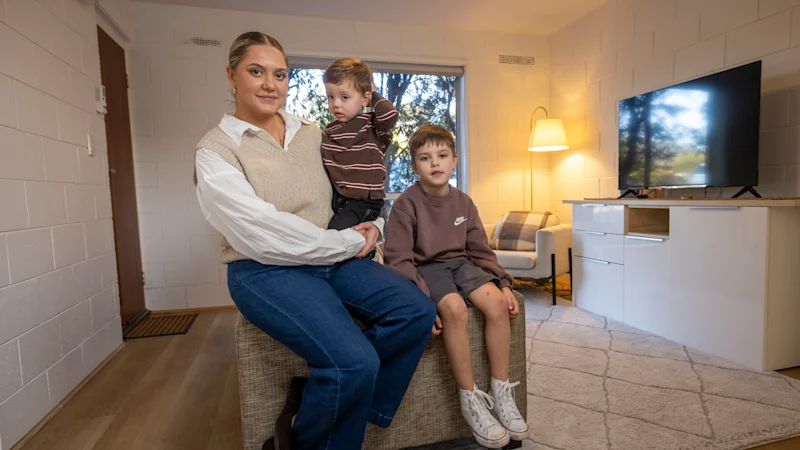
July 11, 2026 — 5:00amHarley Honeyman wants to rent in the Dandenong Ranges. But competition is so tough, and the number of appropriate houses so limited, he is looking at buying instead.The 31-year-old music industry professional and wife Romi have found that when houses do come up, the rent is often disproportionately expensive for what they would get in a suburb only a few kilometres away.Unable to find a house to rent that meets their needs in the Dandenong Ranges, Harley and Romi Honeyman (with four-year-old Phoenix and baby River) are now looking to buy their first home in the area.Jason South“Rentals get nabbed up very quickly,” Honeyman said. “People who live in this area stay in this area.”A recent rental inspection in Belgrave reinforced their decision to start looking to buy.“It was totally fine, but it was a quarter of the size [of our Rowville house], and having two children, it needed to meet some standards,” he said. “It just couldn’t.”Melbourne’s median weekly asking rent for houses hit a record high of $600 in the June quarter, up $5 from $595 in March, data from Domain’s latest Rent Report revealed on Thursday. The median for units was also $600, steady from the March quarter.Over the past year, house rents rose by double digits in several Melbourne suburbs, with Middle Park at 24.7 per cent and Princes Hill (17.6 per cent) leading the way for annual growth.Both are prestigious, tightly held suburbs close to the city with relatively few homes available to rent.Upwey, in Honeyman’s search area, has also recorded significant growth with similar conditions – rents increased 12.3 per cent in the past 12 months, and there were just 30 homes for rent over that period.Domain chief residential economist Dr Nicola Powell said owner-occupier hubs dominating annual growth in rents wasn’t surprising – these were coveted suburbs for family homes, often with relatively small areas and good connections.“It’s a small number of rentals … which means that the supply of rental properties is thin, and even a small shift in volume can have a larger impact on price,” she said.For units, areas such as Moorabbin (18.2 per cent), Burwood (16.3 per cent) and Albert Park (16.1 per cent) topped the list for annual growth.Powell said the top increases for units was a mix of tightly held areas – where, as with houses, low turnover and high demand pushed prices up – and student hubs, which had high turnover and a regular influx of short-term tenants.Despite concerns about an investor exodus that would cut supply and push rents up, she thought it might be too early to read any direct impact of the May budget in Melbourne.“Ultimately, the landscape doesn’t shift if you are a current investor,” she said, noting negative gearing had been grandfathered for existing owners, and reforms to the capital gains tax discount were not due to impact investors until mid-next year.“But the behavioural response is a powerful one ... If landlords are signing a 12-month contract, they would maybe want to capture some of the growth that may occur [over that year].”Angie Zigomanis, head of data insights at Quantify Strategic Insights, agreed concerns about investors “fleeing the market” and pushing rents up immediately after the budget were unrealistic.“If an investor decided to sell today, they would probably contact a real estate agent, and agents would take two or three weeks to get all the things in order, and then it takes at least three or four weeks’ time from when photos are taken to maybe actually selling,” he said.In the longer-term, he thought investors might move to focus on areas with higher yields – specifically apartments in the city, which had the highest rental yield at 7.45 per cent – and avoid negative gearing altogether.Honeyman’s broker, Loan Market Rowville director Kris Faife, said he had noticed some investors already “pivoting” to houses on the urban outer edge for the same reasons.“What these investors are saying is, ‘We’re not going to stop purchasing ... but we’re also not going to live or die by negative gearing, like we would in the inner suburbs,’” he said.For first home buyer clients like Honeyman, the motivation is simpler.“We just want to live where we want to live,” he said. Renters and Housing Union secretary Adu Hani said concerns about the impact of the budget on rents missed that rents in Melbourne have been hitting record highs since COVID.“I think the fears [of investor flight] are exaggerated,” he said. “The trends of the market that we’re seeing were going to happen anyway.”He thought higher rents and worsening conditions were already affecting tenants, and those afraid of being evicted or blacklisted for reporting issues or flagging unfair increases weren’t helped by policies aimed at helping first home buyers.“Focusing on home ownership is missing out on a really big part of the problem,” he said. “There’s no social safety net out there that’s actually helping [renters].”More:Victoria residential propertyProperty investmentProperty marketProperty pricesAffordable housingMelbourne house pricesProperty listingsFrom our partners
The Melbourne suburbs where rents have risen the most
In some parts of Melbourne, households are being asked to fork out for double-digit increases compared with last year.
834 words~4 min read