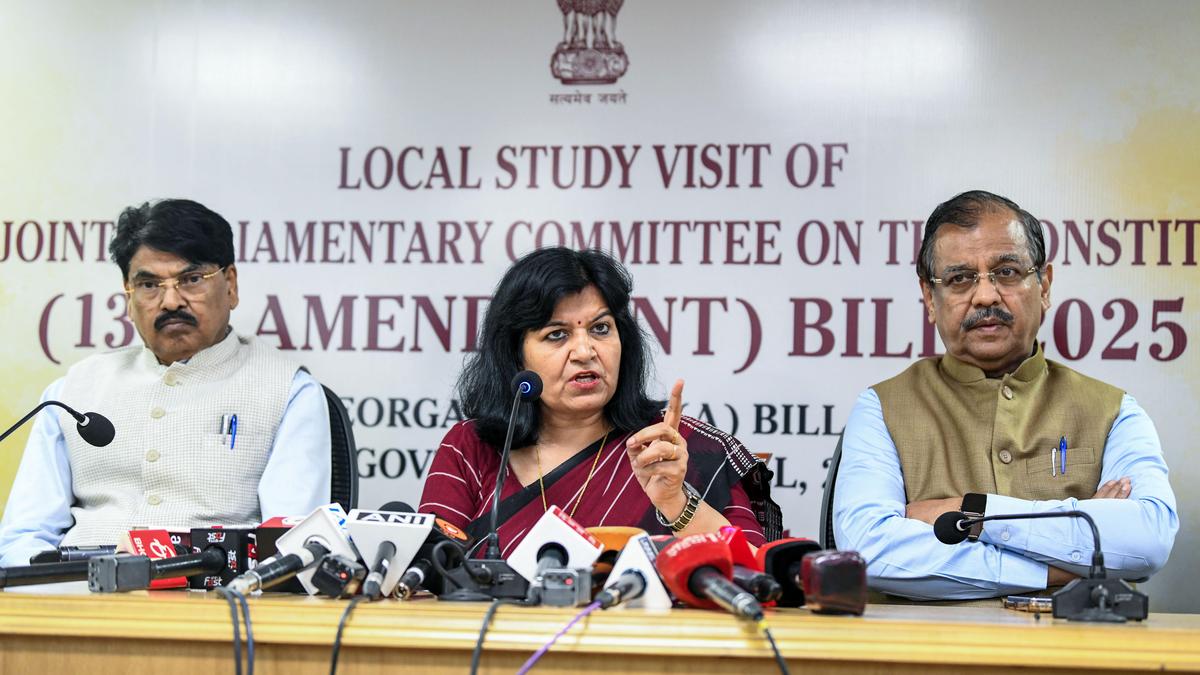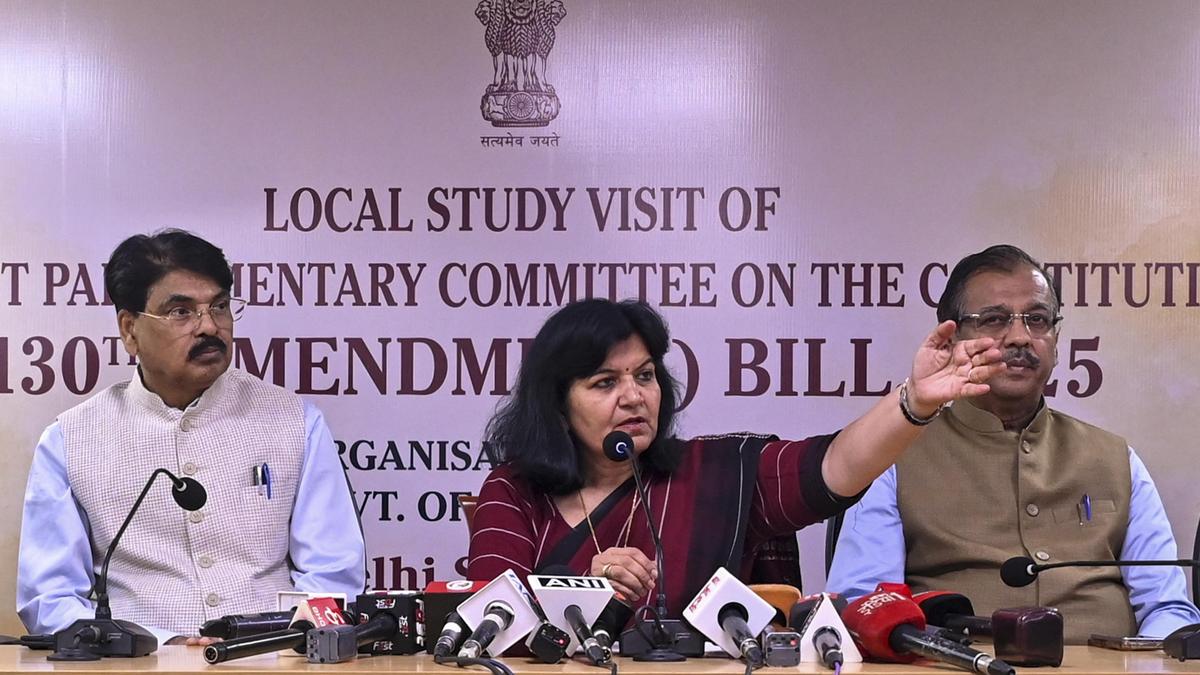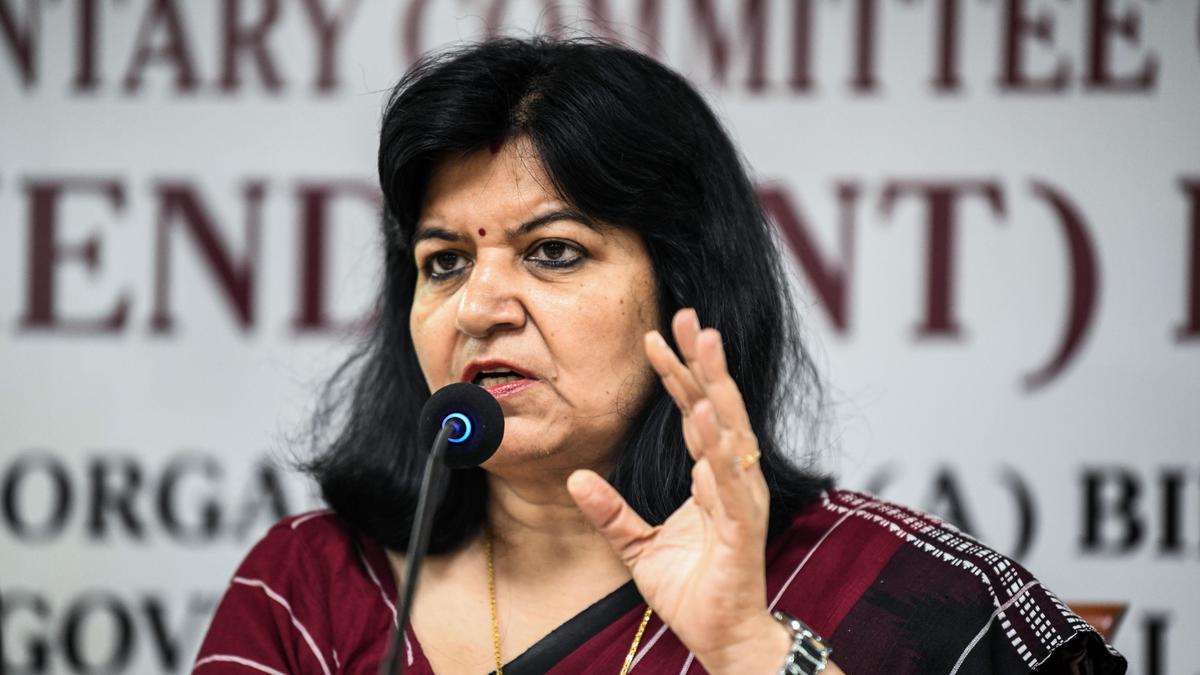
Joint Parliamentary Committee Chairperson Aparajita Sarangi. File
| Photo Credit: ANI
A Joint Parliamentary Committee examining the Constitution (One Hundred and Thirtieth Amendment) Bill has recommended replacing the provision for automatic “removal” of a Prime Minister, Chief Minister or Minister after 30 consecutive days in judicial custody with “suspension”, though the immediate consequence in both cases would be that the public functionary demits office.Most Opposition parties, arguing that the Bill was driven by “malicious intent”, had declined to join the panel headed by BJP MP Aparajita Sarangi. The proposed constitutional amendment seeks to address what the government describes as a vacuum in cases where public functionaries continue in office during prolonged incarceration.The panel has made five recommendations. These include replacing the Bill’s provisions for a Minister’s “removal” or requirement to “cease to be a Minister” with “suspension”. The recommendation follows submissions from stakeholders that terms such as “removed” and “shall cease to be a Minister” carried “an unwarranted air of finality and stigma”. By contrast, suspension, similar to service rules under which government employees detained beyond a specified period are placed under suspension without any presumption of guilt, is viewed as a reversible measure.The committee has also recommended defining “serious criminal offences” as offences punishable with imprisonment of five years or more. It proposed an automatic reversal clause under which suspension would lapse upon discharge, acquittal, or failure of the prosecution to proceed within a specified period. The panel also called for fast-track courts to hear cases involving high constitutional functionaries and for a separate schedule listing offences that would attract the proposed provisions.Constitution silentAccording to the committee’s draft report, there was broad agreement among stakeholders that both the Constitution and the Representation of the People Act, 1951 are presently silent on the consequences of a sitting Prime Minister, Chief Minister or Minister being arrested and held in custody on serious criminal charges. However, the report notes that the sharpest disagreements centred on the mechanism chosen by the Bill rather than its objective.“Notably, even within the supportive cluster, no stakeholder defended the Bill’s present formulation without qualification; and even within the critical cluster, no stakeholder rejected the legislative objective itself,” the report says. “The disagreement lies overwhelmingly in the design of the trigger mechanism and the safeguards attending it, not in the underlying policy goal.”The most contested provision was the Bill’s trigger mechanism, under which a public functionary would automatically lose office after spending 30 continuous days in custody in connection with offences punishable with five years’ imprisonment or more.Problematic clauseThe report states that “an overwhelming majority of stakeholders”, including institutions otherwise supportive of the legislation, found the trigger constitutionally problematic because it was not linked to any judicial finding of guilt.It notes that law universities, civil society organisations and political parties repeatedly argued that arrest is “an executive/ procedural device” and “is not a judicial determination of guilt”. Consequently, attaching constitutional consequences to custody rather than conviction or even trial “risks treating an unproven accusation as a de facto disqualification”.Several institutions, including NALSAR Hyderabad, National Law University Delhi, West Bengal National University of Juridical Science, Kolkata and the Association for Democratic Reforms (ADR), instead proposed that the trigger should be shifted to the stage of framing of charges by a court.Threshold for offencesThe report also records concerns about the Bill’s threshold for qualifying offences. Several stakeholders argued that the five-year threshold was “poorly calibrated” and inconsistent with other laws that use a seven-year threshold for serious offences. Some pointed out that the provision could cover more than 140 offences, many of which have no direct connection with probity in public life.The committee did not accept the demand to raise the threshold to seven years but recommended incorporating a separate schedule of offences punishable with imprisonment of five years or more.The panel also recorded concerns that the mechanism could be misused against Opposition-ruled States through the actions of central investigative agencies.A “substantial majority” of academic and civil society stakeholders argued that stringent bail provisions under laws such as the Prevention of Money Laundering Act and the Unlawful Activities (Prevention) Act could make release within 30 days difficult, potentially allowing the provision to be used to unseat Chief Ministers and Ministers without any finding of guilt. The panel did not make any recommendation on this issue. Published - July 10, 2026 10:01 pm IST