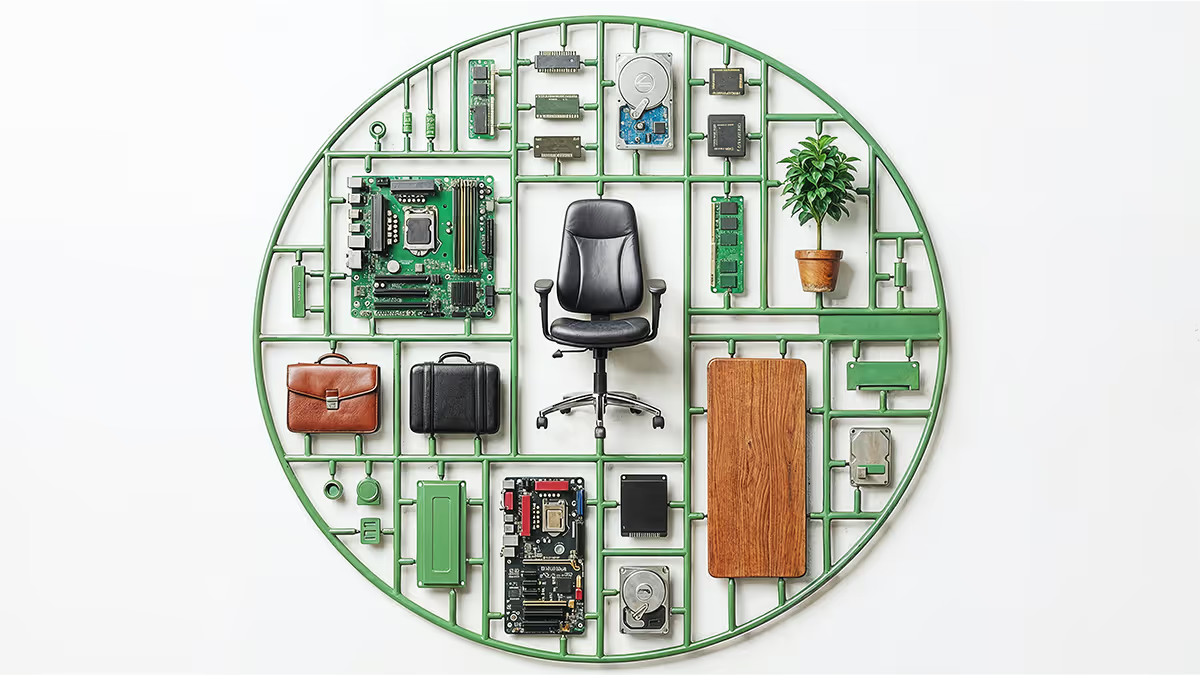
Signe Jancis, Group Head of IT Strategy and Governance at SYNLAB.gettyWhile boardrooms worldwide debate AI strategy, platform selection and AI governance, one strategic question is emerging: How easily can we replace what we choose today?The real strategic risk isn't choosing the wrong platform but becoming dependent on a single one in a rapidly changing market. Continuous change defines the AI market. The organizations that can adapt the fastest will have the long-term advantage.The real strategic risk is dependency.The pace of model evolution now surpasses enterprise decision making. What seems important today may be replaced before implementation is complete.The main business value of AI lies at the application layer, where dependence is most costly across workflows, interfaces and operating models. Not all AI tools create the same dependence; interchangeable tools without embedded logic have low switching costs. The key issue occurs when business logic becomes tightly linked to a specific solution. This is what I refer to as model debt.Model debt arises from dependencies in integrations, prompts, data pipelines and workflows, which reduce agility, slow down change and increase costs. It diminishes flexibility over time. While deep integration can enhance speed or differentiation, neglecting or poorly managing it is the main risk.It impacts RAG pipelines and orchestration layers. Tightly coupling agents to a vendor's architecture makes upgrades costly and requires expensive redesigns. AI agents embed workflows more deeply within proprietary systems, increasing the complexity of change.Ignoring model debt can trap organizations, leading to a high "AI tax"—costly, outdated systems while competitors innovate at lower cost.Organizations must shift from tool-centric thinking to capability strategy.A more durable approach is to define AI strategy in terms of business capabilities rather than tools. Tools will change, but the main capabilities remain stable.Organizations focused on tools often rebuild their operating model as vendors, models and interfaces evolve, while capability-centered organizations can adapt continuously without losing momentum. This is the strategic shift many organizations still underestimate.This isn't an argument against AI. Organizations should move quickly, experiment aggressively and deploy AI where value can be captured. With every decision, however, they should ask themselves: If this system becomes obsolete in 12 months, how easily can we replace it?That question is structural. For enterprises, avoiding dependency means decoupling business logic from provider-specific components, designing replaceable workflows and measuring how quickly these components can be replaced, alongside traditional metrics such as ROI, cost, risk and adoption. Organizations that can't replace models, providers or workflows without major disruption have merely converted risk into dependency. This isn't just about buying tools or building internally. Dependency can be formed on vendor platforms or re-created internally if business logic, workflows and control points aren't designed to be replaceable.Governance is essential, but it's not a substitute for strategy.Governance protects the business, but it doesn't define strategy. Problems arise when organizations treat governance as a destination rather than a foundation.Most AI-related risks are familiar enterprise weaknesses (such as poor data quality or weak access controls) amplified at scale. AI exposes these problems. Governance must be embedded as a baseline capability, as rigorous as financial control or cybersecurity.The real tension isn't "governance versus innovation" but the speed of governance versus technology. Effective governance should boost agility by enforcing standard interfaces and modular design, making component swapping routine and safe.It's time to look at AI through a new strategic lens.Many still evaluate AI initiatives using traditional metrics that measure value and performance in the present but not flexibility in the future. Leaders need a new metric: time-to-replace—the time, cost and organizational friction required to replace an AI component, provider or workflow without disrupting the business. If you can't measure it, you are already locked in.Use this rule of thumb: If your time-to-replace is measured in months rather than weeks, you're managing dependency.The time-to-replace audit involves the following five questions for any board-level AI discussion:1. How difficult is it to replace the underlying model?2. How quickly can an alternative provider be adopted?3. How much of the workflow depends on provider-specific logic?4. How easily can a failed or obsolete implementation be retired?5. How much retraining, redesign or rework would be required?Most organizations realize their true time-to-replace when they attempt to make a change. By then, it's already too late to design for it.How can organizations design for replaceability?To operate effectively in the AI era, enterprises must design for replaceability from the outset, balancing initial architectural overhead against long-term agility. That requires three shifts.1. Separate core business logic from model dependencies. AI tools should enhance workflows, redesign processes and create new uses. Benefits shouldn't depend heavily on one provider’s models, APIs or interfaces, as changes could be costly and disruptive.2. Make adaptability measurable by showing time-to-replace in decisions. Unmeasured, it's assumed to be low (often wrongly).3. Treat volatility as a design constraint instead of a procurement issue. Evaluate AI initiatives for both expected value and the cost of changing direction later.True governance protects the business by making systems safely replaceable. In the AI era, the ability to change is a test of whether the system can adapt without disruption.In a market of continuous change, replaceability becomes strategic.Strong governance is essential for enabling safe adaptation, especially in the AI era. Organizations must remain flexible to survive and thrive amid continuous change. Success belongs to those who can adapt quickly and keep replacing what no longer serves them. In this evolving market, replaceability becomes a strategic necessity.Forbes Technology Council is an invitation-only community for world-class CIOs, CTOs and technology executives. Do I qualify?
AI Strategy For Continuous Change, Not Dependency
Continuous change defines the AI market. The organizations that can adapt the fastest will have the long-term advantage.
910 words~4 min read