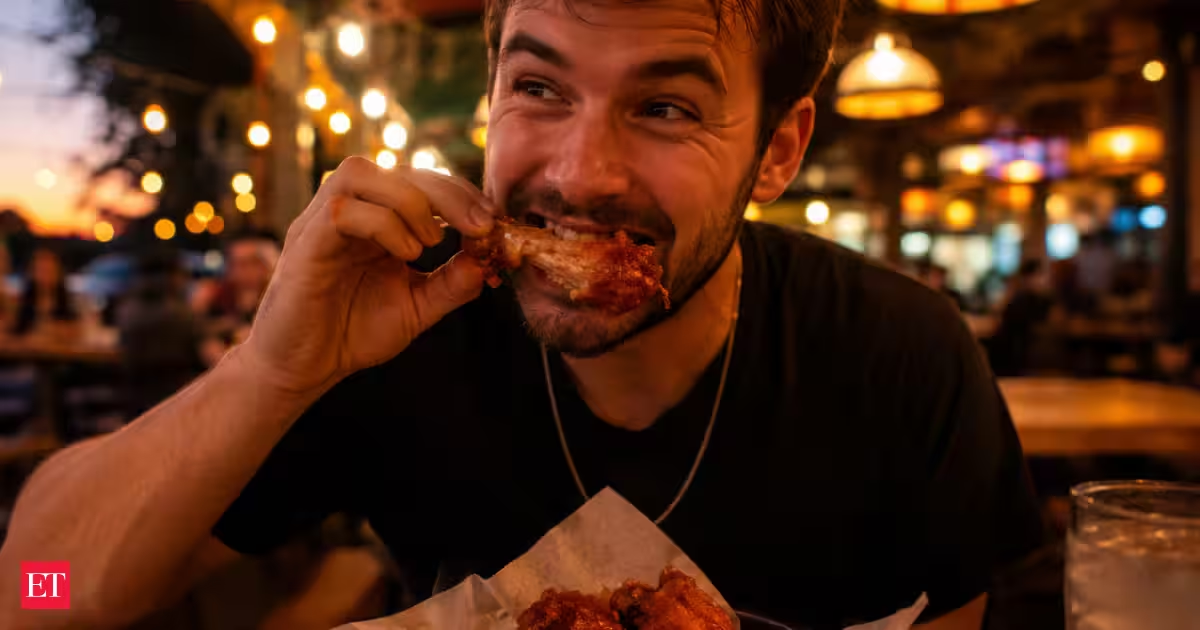
You probably know that one friend. The one who skips the mild sauce, skips the medium, and goes straight for the wings that come with a waiver to sign. You think they’re just trying to impress the table. According to a 2013 study, ‘Glad to be sad, and other examples of benign masochism,' by the University of Pennsylvania that surveyed 243 college students and 147 adults recruited online, there's a real, documented pattern behind this. The researchers coined a name for it: benign masochism.The science has a name: benign masochismBenign masochism, according to Rozin and his co-authors, is liking something that your body initially perceives as a threat, once your brain has determined that you are safe. In their 2013 paper, the researchers identified 29 different everyday activities that followed this same pattern, grouped into categories such as fear, sadness, disgust, and physical strain.Spicy food sits alongside things like sad movies, roller coasters, deep-tissue massages, and the ache of a hard workout. In the same study, they found that people like to push these experiences as far as they can without crossing the line. Their preferred level of intensity is just below the point where it stops being fun and becomes truly unbearable.The detail the researchers point to again and again is safety. According to Rozin and his co-authors, what makes this work is something they call a "protective frame," borrowed from psychologist Michael Apter's research on play: a kind of mental distancing from a potential threat, where part of you registers the danger signal while another part stays aware you're safe.A ghost pepper wing works on that same principle; your mouth is burning, but your brain also knows you're sitting in a restaurant, not in danger. The enjoyment is in the space between “feels scary” and “is actually fine.” But the study notes a limit to this: not every unpleasant sensation becomes pleasure this way. Nausea, for example, rarely does, because your body is not convinced that it is really safe.Some brains crave the burn more than others. Image Credits: ChatGPTIt might also be about your personalityNot everyone loves heat, and that’s worth stating outright: many mild-orderers are simply wired differently, not less adventurous. Food scientists at Penn State who published their findings in 2013 in a study titled ‘Personality factors predict spicy food liking and intake’ found that people who score high on “sensation seeking,” a personality trait associated with a love of novelty and intensity, are more likely to truly enjoy spicy food rather than simply endure it.According to the same researchers, there's also a link to something called “sensitivity to reward,” meaning these are people whose brains respond strongly to the payoff of an experience, not just the discomfort involved in getting there. So if your friend loves the burn, there’s a measurable personality trait behind it, not just bravado.How the brain learns to love the burnThis liking usually isn't something people are born with. The taste for spicy food is something that people develop gradually through repeated exposure to ever-increasing amounts of chili, not something they crave from the first bite, noted Rozin and Schiller, whose 1980 research followed chili eaters across Mexico and the United States.That slow build-up is important because capsaicin, the compound that makes peppers hot, doesn’t actually do any damage to your mouth at normal food-safe levels; it just stimulates the pain and heat-sensing nerves, which is why your body reacts as if something is burning when it really isn’t. Over time, as people learn that the sensation is uncomfortable but not dangerous, that false alarm can begin to feel exciting rather than scary, especially with good food and good company.The relief right after the danger. Image Credits: ChatGPTBefore you order the reaper wingsA word of caution, because this is easy to overstate. These are based mostly on what people say they like, not brain scans or blind taste tests. So they point to a strong pattern rather than a hard rule anyone must fit. Rozin and his colleagues said liking spicy foods tells you nothing specific about an individual's character. It's a pattern seen across groups, not a verdict on an individual. The original research only looked at US adults, so these preferences may not translate to other countries. If you’re the friend who sticks to mild sauce, it’s not a personality flaw. It just means your specific wiring doesn't get the same reward from the burn.The bottom lineThe next time you’re at a wing joint watching someone sweat their way through a spicy food challenge, you’re not just watching someone being brave. What you are seeing is a little, safe experiment their brain is running: how close can I get to the edge of “too much” but still know that I am fine. According to the research, for a lot of people, especially those who also love a scary movie or a roller coaster, that edge is exactly where the fun lives.
Psychology of eating spicy food: People who chase the hottest wings on the menu aren't just showing off; researchers call it “benign masochism,” the brain enjoys a scary signal it knows can't actually hurt you
Discover the psychology behind our craving for spicy food, exploring the concept of benign masochism and how our brains interpret the thrill of heat while keeping us safe.
823 words~4 min read