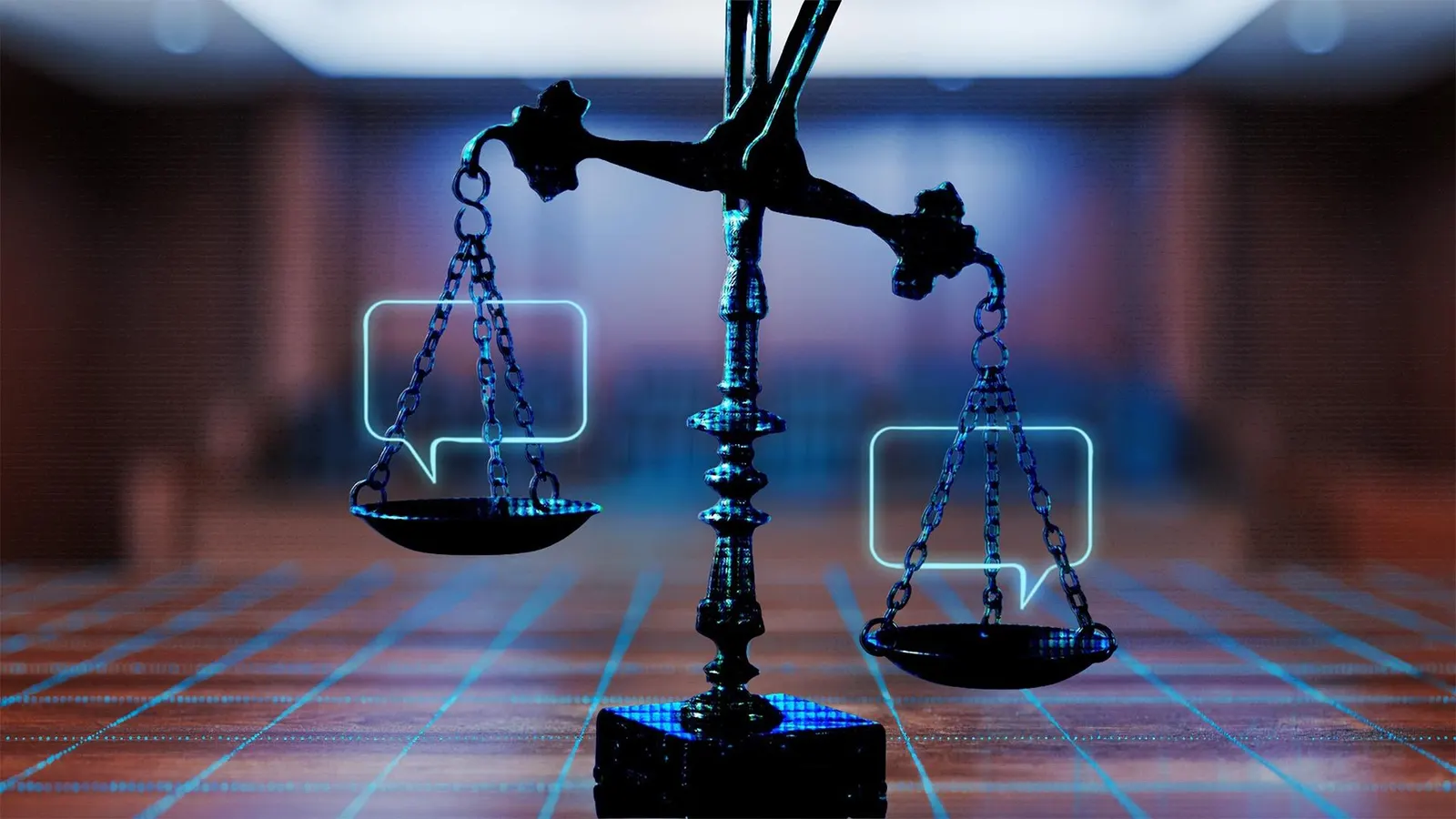
In the not-too-distant future everyone will be using so-called AI agents. Connected to the cloud, they will live inside your mobile phone ready to assist in whatever tasks you need accomplished, from replying to emails and booking flights to tax-loss harvesting in your portfolio. Robinhood’s customers now use AI agents to analyze stock market gyrations and make autonomous trades based on custom instructions. SAP’s Joule helps its enterprise customers analyze inventory, source the best suppliers and procure goods. Shopping agents operating at machine speed like Amazon’s Buy for Me will scan the web for the best deals, negotiate terms with agents representing the seller, establish delivery windows and make purchases.Well-known AI and crypto companies, from Anthropic and OpenAI to Coinbase and Circle, are already racing to make this bot-driven future a reality for all.But what happens when the couch your agent ordered arrives in the wrong color? Or gets delivered two weeks late, or damaged in a way the seller insists happened after delivery?This is a potentially expensive and perhaps unavoidable problem hiding inside the grand vision of agentic commerce. Software may already be able to shop, bargain, hire and pay on behalf of humans and businesses, but AI hallucinates and commerce has never been only about the exchange of money. Mishaps are inevitable.“Agentic commerce is reaching a critical turning point, and we’re not prepared for the potential fallout,” says David Riudor, CEO and co-founder of the GenLayer Foundation, a Cayman Islands-based entity that helps run a new blockchain called GenLayer and its main application, Internet Court, which is designed to adjudicate agentic disputes. The court operates free of human interference and is backed by 26 other crypto and AI companies, including heavyweights like crypto exchange OKX, wallet provider MetaMask and Binance’s BNB Chain.As ambitious and futuristic as it sounds, Internet Court is not an attempt to fully replace judges with a stack of bots. It is better understood as a system that helps agents create contracts with clear terms, and if they can't agree on the outcome, an AI jury evaluates the evidence and delivers a verdict in minutes.Riudor says the technology is most useful for smaller transactions where hiring a lawyer would be irrational, but doing nothing would still be costly. “We’re not trying to compete with the legal system,” says Albert Castellana, co-founder and CEO of GenLayer Labs, which developed the blockchain. “We just want to provide an alternative where hiring a lawyer to dispute a claim for $10,000 is not economical. Instead, you can use this system to arrive at a resolution, which may ultimately cost you a few cents.”The potential market could be enormous. AI-referred traffic to retail sites has grown more than 14 times since October 2024, according to Adobe Analytics, and McKinsey projects that AI agents could mediate between $3 trillion and $5 trillion in global consumer commerce by 2030. Most of the emerging infrastructure underneath the budding economy, however, is still focused on the happy path: the agent finds what its human owner wants, pays, receives the product or service and moves on. For now, Internet Court is being used in more limited ways. Collective Memory, a social platform that rewards users for capturing real-time photos, videos and reports, uses GenLayer when it needs help assessing whether a disputed image might be fake. For example, a video from a bombed school in Gaza or the streets of Tehran. Internet Court then reviews the available evidence tied to the upload—including its time, location, related submissions and the user’s prior activity—and issues a decision on whether it considers the upload authentic.Ultimately, Internet Court’s architects want the system to automatically intervene when AI agents start arguing with each other.Imagine a small online clothing company whose owner has handed much of the daily grind to AI agents. One manages inventory, another buys ads, a third commissions creative work. The owner asks for a new logo, and her agent finds a designer who is also represented by an agent. The two agents agree on design, price and delivery date. The logo arrives and looks good, until a reverse-image search suggests it may have been lifted from someone else’s portfolio.Internet Court is supposed to take care of situations like this by enabling agents to agree up front on the terms, place payment in escrow and send any dispute to a jury before the money moves.That so-called jury is where blockchain technology kicks in. The jury is a randomly selected group of five blockchain participants, or validators, each running a different AI model (e.g. Claude, GPT, Gemini). One of the five is chosen to act as the leader and proposes a decision. The others commit votes without seeing each other’s positions, then reveal whether they agree. If there is consensus, a 30-minute dispute window opens, allowing an agent or human to challenge the result by posting a bond. If the result is challenged, the jury expands to 11 validators and further until consensus is reached and no one disputes the verdict.The system’s design is based on Condorcet’s jury theorem, which holds that, under certain assumptions, the probability of reaching the correct answer increases as the number of independent evaluators grows. Enlightenment philosopher and mathematician Nicolas de Condorcet formulated the theorem in 1785 and later died in prison during the French Revolution. GenLayer argues that using multiple AI models makes the process harder to game than relying on a single model or a single human arbiter.While talk of agent-to-agent disputes sounds premature and somewhat abstract, Internet Court is already up and in beta testing mode. The network is processing roughly 350,000 transactions a day, or about 20,000 to 25,000 decisions, according to Castellana. He says a public launch is planned for later this year and will include a token designed to attract more validators—a role anyone will be able to take on.Riudor, who leads the foundation, says this adjudication system could eventually be used far beyond agentic commerce, including for prediction markets. For instance, Polymarket relies on UMA, a protocol that escalates disputed outcomes to a vote among UMA token holders, but AI-assisted resolution would be faster, he claims.“We're talking with some of the largest [prediction markets] already,” says Castellana. “They are still waiting for our full launch but they are evaluating us.”Andrew Hall, a professor at the Stanford Graduate School of Business and a research advisor to Andreessen Horowitz’s crypto team, wrote earlier this year that using large language models (LLMs) as resolution judges could help prediction markets scale because they can’t be bribed and are improving quickly. But he also cautions that models hallucinate and can be manipulated through clever prompts or corrupted training data.Lindsay Lin, former counsel and current COO at New York-based crypto venture firm Dragonfly, sees the same tension. “A lot of LLMs can be correlated because they share training data and common failure modes, whereas humans tend to be more independent,” she says.Still, “people will be tempted to use AI to adjudicate disputes, especially low-value ones, because it’ll be cheaper and faster than human jurors, and the volume of agentic commerce will potentially create a large volume of them,” Lin adds. “It does make sense for agents to have standardized protocols so that they understand what are the terms that they're working together on, and the recourse if their transaction hasn't been consummated properly.”Others are reaching a similar conclusion. Just two weeks ago, the American Arbitration Association-International Centre for Dispute Resolution—the largest arbitral institution in the world—announced a similar standard for agents called the Legal Context Protocol. The standard is co-stewarded with Denver-based blockchain firm Integra Ledger and launched with contributors including Google, IBM and a host of leading crypto firms such as Circle and Ava Labs.Of course, whether these standards take hold ultimately depends on widespread adoption and AI models becoming reliable enough to alleviate hallucination and bias concerns.But the infrastructure for agents to find, hire and pay one another is already beginning to appear. In recent weeks, GenLayer’s partner OKX and the team behind the AI-focused NEAR blockchain launched marketplaces where agents can hire other agents to perform paid tasks, from fetching datasets to helping review code.Meanwhile, real courts are already being asked to decide what happens when AI agents break rules. In one of the most high-profile AI-related cases, Amazon sued Perplexity in November 2025, alleging that Perplexity’s AI-powered Comet browser logged into customer accounts, disguised itself as a standard Google Chrome browser and made purchases without authorization under Amazon’s terms of service. In March, a federal judge in California issued a preliminary injunction blocking Comet from shopping on Amazon, though an appeals court later paused the order while it considered Perplexity’s appeal. Whatever the courts ultimately decide, the case points to a larger potential challenge facing agentic commerce. How do you police millions of AI agents acting across platforms on behalf of users when no common enforcement mechanism exists?More from ForbesForbesHow OpenAI Plans To Win Over Doctors, Patients And HospitalsBy Amy FeldmanForbesAI Data Centers Are Set To Electrify This $13 Billion Family’s 76-Year-Old CompanyBy Simone MelvinForbesAI Startups With No Revenue Are Using This Tactic To Supersize Their ValuationsBy Rashi Shrivastava
All Rise: Internet Court For AI Agents Is In Session
If autonomous bots are going to shop, negotiate and pay on behalf of humans, they will also need a way to resolve disputes. Crypto firms think blockchain and AI juries can help.
1,520 words~7 min read