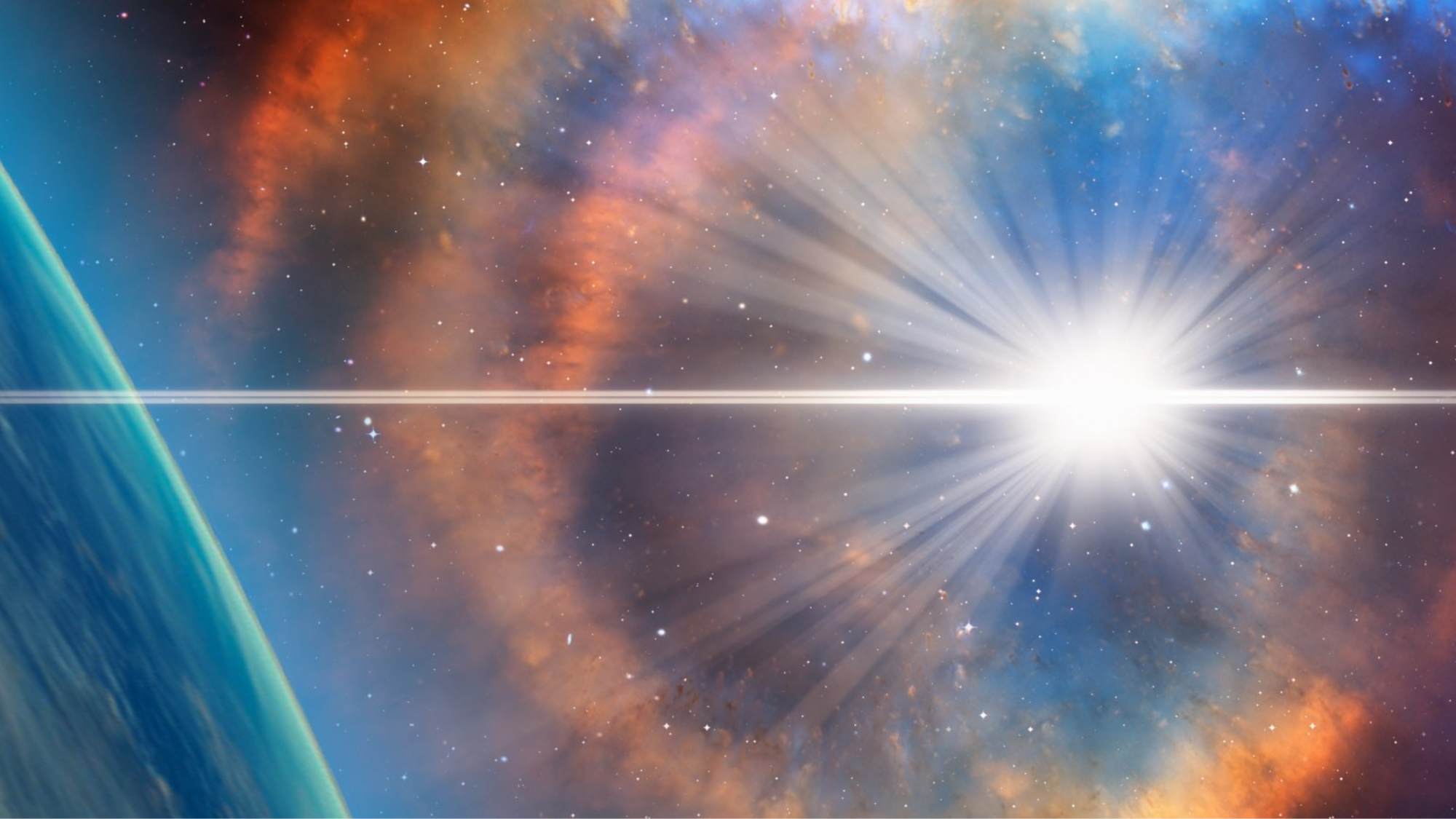
An illustration shows a supernova explosion bombarding Earth with neutrinos
(Image credit: Super-Kamiokande Collaboration)
The universe is haunted by "cosmic ghosts" called neutrinos, and new research suggests they may be the "whispers" of stars that died in supernova explosions over the course of billions of years.The discovery is an important step forward in our understanding of the life and death of stars and how they enrich their environments with metals, elements heavier than hydrogen and helium. It could also help better understand how black holes and neutron stars are born when massive stars die.The second most common particles in the universe, neutrinos get their spooky nickname because they are chargeless and near-massless, so phantom-like that around 100 trillion neutrinos pass through you at nearly the speed of light every second, but over your entire life only one will interact with the atoms of your body, if you're lucky.The newly suggested connection between neutrinos and a history of supernova blasts has emerged from the first detection of a flux of neutrinos called the Diffuse Supernova Neutrino Background (DSNB). It was detected by one of the world's largest neutrino detectors, the Super-Kamiokande, located 3,280 feet (1,000 meters) underground in Gifu Prefecture, Japan."Observing the world's first indication of the Diffuse Supernova Neutrino Background is a deeply meaningful achievement and has been a long-cherished goal since the beginning of the Super-Kamiokande project," Hiroyuki Sekiya of the University of Tokyo said in a statement.Stars go out with a bang but continue with a whisperSupernovas come in a range of types, but the ones this research concerns are so-called "core-collapse supernovas." These occur when stars much more massive than the sun reach the end of nucleosynthesis in their cores. When they are no longer able to fuse elements to create metals heavier than iron, the stars become unable to produce the outward energy that for millions of years has balanced them against the inward push of gravity. Thus, with gravity the ultimate winner of this cosmic tug of war, the star's core collapses, sending violent shockwaves rippling outward into the outer stellar layers, which are ripped away. This leaves the core as a stellar remnant, either a neutron star or a black hole, initially surrounded by an expanding shell of supernova debris.The energy from these events is carried away by particles of light (photons) spread across the electromagnetic spectrum, but also by neutrinos. Yet, despite the fact that supernovas have been erupting every second over the course of 13 billion years or so to produce the neutrinos that accumulate as the DSNB, this ghostly signal is still faint, a whisper rather than a shout.