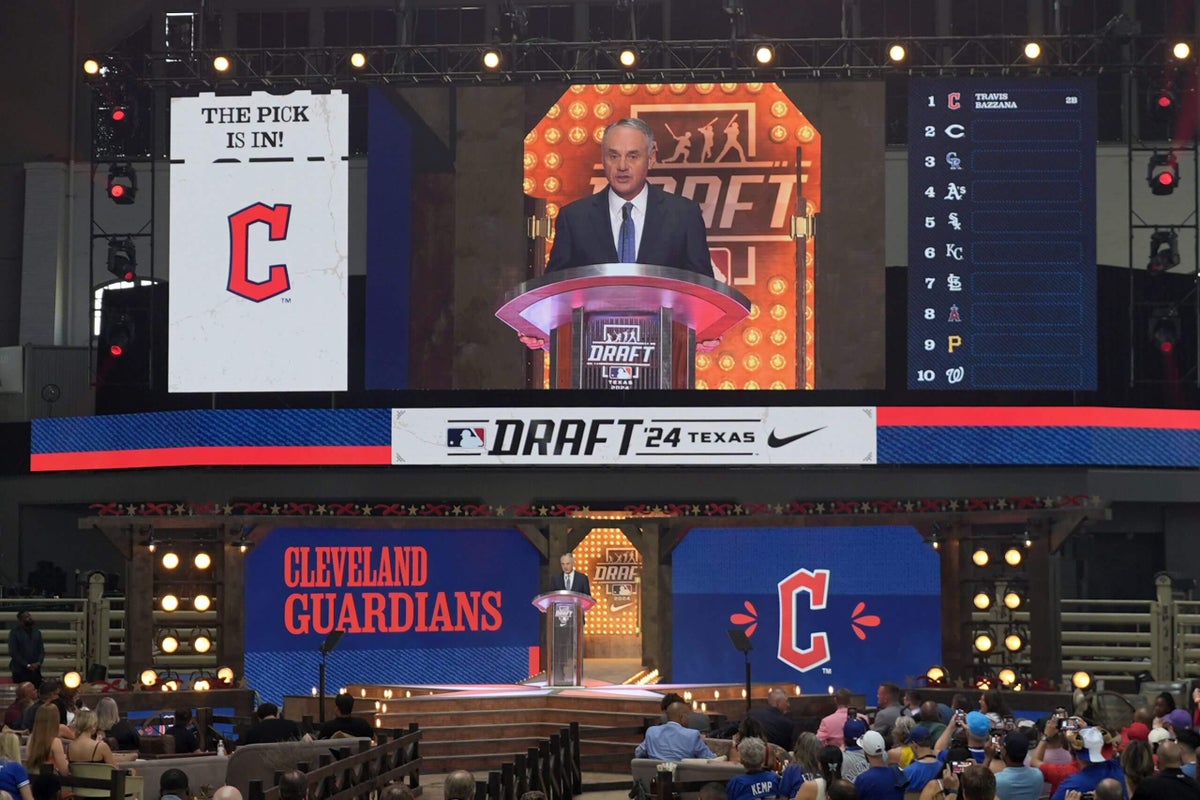
MINNEAPOLIS — Travis Bazzana and a crowd of supporters — including some who had flown across the Pacific Ocean for the occasion — gathered in the Omaha Room, overlooking the baseball diamond at Oregon State’s Goss Stadium on July 14, 2024.About 20 minutes before the start of the MLB Draft, the Cleveland Guardians called. Bazzana was going to be the No. 1 pick. TV interviews, video calls, news conferences and a whirlwind would follow.Few players have that sort of draft-day mayhem.Shawn Armstrong was asleep on the couch when he was selected, for instance. Slade Cecconi faked a contract signing in his living room in 2020, thanks to the COVID-19 pandemic.“We have first overall picks. We have undrafted free agents,” Guardians reliever Erik Sabrowski said. “We have a 14th-rounder (him). I’m sure there’s a 30th-rounder, and they don’t even have 30 rounds anymore.” His fellow reliever, Tim Herrin, in fact, was taken in the 29th round.With the MLB Draft this weekend, The Athletic asked a slew of Guardians players for their draft-day recollections.“We all have a different story,” Sabrowski said.They just threw it away in the garbageWhere was Cecconi when he learned he was the 33rd pick in 2020?“In my freaking living room during COVID,” he said.That draft was different, thanks to the pandemic. Five rounds, all remote. Cecconi knew he was a borderline first-rounder, and he was “tightly wound” as each pick scrolled across.He said he took about 50 video calls with teams leading up to the draft. Teams with top 10 picks were interested in him as an early second-rounder. Teams with late picks considered him in the first round.“You couldn’t really enjoy the process,” he said. “It was like a job interview.”Cleveland was one of the few teams that didn’t bother. The Arizona Diamondbacks didn’t seem interested, either. He recalled them telling him, “We appreciate your time, but don’t think so,” after a second call.Slade Cecconi was drafted amid the COVID-19 pandemic. (Brian Fisher / Cal Sport Media via Associated Press)The Diamondbacks ended up selecting him, though. At that moment, he was watching on TV with his family and his best friend. MLB had sent camera equipment to record his reaction. The league also sent a jersey and cap for every team. He’d wear the gear of his new team and ship the rest back.Usually, a player chosen that early travels to the big-league ballpark to see the facilities, take batting practice or throw a bullpen session and, as Cecconi said, “feel like you’re a part of it.”His experience was … different. He signed his contract electronically.“It was anticlimactic. It was crazy,” he said. “Literally, track pad your signature. Send. ‘Oh, that was weird.’ It’s me signing my contract, sitting alone in my living room, pressing a button on a keyboard.”His mom, however, wanted to make the moment memorable. She had him don the Diamondbacks gear, printed out a copy of the contract and had him sign it with an actual pen, not his finger, “just so I could feel something.”They tossed the papers in the garbage after the fact, but she was adamant, telling him, “You’re going to sign this and feel like you signed your contract. You’re not going to just press a button.”“It was a very nice gesture,” Cecconi said.An awkward arrival at a banquetAustin Hedges was convinced he would be a first-rounder in 2011. He had a camera crew and reporters at his house to chronicle the moment. The first round unfolded at the same time as his high school team banquet. When he finally arrived at the event, everyone looked in his direction, as if he were a doctor leaving an operating room to relay news to loved ones in the waiting room.Hedges shrugged and shook his head. He wasn’t a first-rounder. He thought the Boston Red Sox would grab him at No. 26, but they instead opted for catcher Blake Swihart.The next day, Hedges’ mom woke him up a little after 9 a.m. to tell him the San Diego Padres had taken him in the second round, the 82nd pick. He didn’t really care. He planned to attend UCLA, unless, he told agent Scott Boras, the Padres offered him $2 million. Boras instructed him not to sign for anything less than $3 million. Sure enough, the Padres offered him $3 million, about seven times slot value.Bacon, eggs and a life-changing momentSabrowski started as a hitter at Cisco College in Texas before he transferred to Cloud County Community College in Concordia, Kan. He said he spent college pitching in front of about 11 people each game, all players’ girlfriends and parents. He never pondered a path to the big leagues until he struck out 18 in seven innings in front of a few scouts who happened to be in attendance to watch the opposing team.Sabrowski thought he would be a Day 2 pick in 2018, so he watched every second of coverage that day. His name never popped up, though. He was frustrated. The next morning, he was cooking breakfast — he’s pretty sure it was bacon and eggs — for himself and his wife, Renee. She was monitoring the draft on a laptop.“Erik, that’s you!” she shouted. “San Diego!”The Padres took him in the 14th round.“When it happens, it’s, ‘Holy s—, I just got drafted,’” he said. “‘This is the coolest thing in the world.’”Upstaging your brother’s graduation partyTim Herrin was drafted in the 29th round. (Adam Hunger / Associated Press)Herrin was the 883rd pick in 2018. He thought he might go in the teens, but he dropped to the 29th round, and by that point, he was only casually tracking the draft. He was socializing with friends and family at his younger brother’s high school graduation party.Herrin’s agent texted him that Cleveland was interested, and assured him it was a good organization to join as a late-round selection. Cody Allen, a 23rd-round pick, had flourished as the team’s closer. The team and Herrin’s agent settled on a $100,000 signing bonus, and Cleveland turned in his name. Herrin said he tried not to upstage his brother’s accomplishment, but it certainly turned into a dual celebration.Wake up. You got draftedArmstrong was projected to go in the first 10 rounds in 2011, but since he could return to East Carolina for his senior season, he didn’t want to settle for an underwhelming signing bonus. He turned down offers from a few teams and, discouraged by the process, went to sleep on the couch in his family’s living room. His mom woke him up to tell him Cleveland had taken him in the 18th round.At 11:52 p.m. the night of the August signing deadline, Cleveland called with an offer, about $20,000 below what Armstrong had requested. Armstrong called his parents, but they didn’t answer. He called his coach, but he didn’t answer. He called his pitching coach, who didn’t seem thrilled to be receiving a call so late at night. Armstrong relayed Cleveland’s offer. The coach told him to accept it. So he did.“If you would’ve told me 10 years ago that I’d be here today,” Armstrong said, “I’d be like, ‘No way.’ Being optioned 21 times. The (18th) round. That’s just impossible. Never going to happen.”Disbelief and deprecationOregon State churns out MLB draft picks, so the team gathered in the players lounge in 2018 to watch Trevor Larnach, Nick Madrigal and Cadyn Grenier become first-rounders. Steven Kwan had been told to expect a team to take him in the rounds 10-12 range. During the fifth round, his agent called and rattled off a list of teams that might have him on their radar. He also cautioned to watch out for Cleveland.“Literally, Cleveland was next in the tracker,” Kwan said, “and I saw my name pop up.”Steven Kwan was a fifth-round pick out of Oregon State. (Frank Jansky / Icon Sportswire)The Oregon State players were following the draft in the cafeteria that day. Kwan said they were a bit desensitized to it after watching three teammates go in the first 37 picks the night before. Still, he was in “disbelief” when Cleveland took him.“The deprecator I am,” he said, “I’m like, ‘Ah, it’s probably not going to happen.’ And then it just happened. It was so matter-of-fact, being like, ‘Oh, wow, that’s my name.’”A ‘bitter, interesting feeling’Joey Cantillo wasn’t thrilled with his senior season of high school. If he had pitched better, he stressed, he would have been selected higher in 2017. (Granted, he had a 1.24 ERA and was the Gatorade High School Player of the Year in Hawaii.)Cantillo followed the draft on his laptop in his room in Honolulu. He saw his name pop up and alerted his parents in the other room.“I was definitely disappointed in myself that day,” he said. “It was kind of a bitter, interesting feeling.”Cantillo, who went in the 16th round, had every intention of attending the University of Kentucky, but the Padres coveted him enough to hand him a signing bonus north of $300,000.“Everybody has a different path,” he said, before pointing out Bazzana. “I wasn’t the No. 1 overall pick like our boy here, but I wouldn’t have it any other way.”Pick a hatParker Messick laid out a cap for each team at his grandparents’ house in Florida the night of the 2022 draft. He received a call from the Guardians, who planned to snag him in the second round with the 54th pick. He didn’t tell his friends and relatives the identity of the team on the other end of the call, though.So, everyone else in the room tried to guess which hat he’d be placing atop his head. With each pick announcement, they recorded video of the TV, waiting to hear his name. Then, a dejected reaction and a hat removal.Finally, the Guardians made the pick. Four years later, he’s an All-Star.A team that never showed interestHoskins watched Day 2 of the 2014 draft with his four roommates and 10 family members from his house off the campus at Sacramento State. The Diamondbacks called him and said they planned to take him with their third-round pick. They didn’t. The Philadelphia Phillies called him in the fifth round, even though he never heard from them during the scouting process, one of only a handful of teams that didn’t reach out.The Seattle Mariners picked before the Phillies, and Hoskins was on the phone with the Phillies’ scout.“Did the Mariners take you?” the scout asked. “No? OK, yeah, we’re taking you.”Hoskins said he remembers realizing how far Philadelphia was from his hometown of Sacramento. First, though, the Phillies sent him to their Florida complex before assigning him to Low-A Williamsport.“It was, ‘Wow, this is so cool,’” he said. “‘Holy cow, I have to leave tomorrow.’”‘Whoa! That’s me!’“To see your name is something really special,” Cleveland Guardians manager Stephen Vogt said. (Phil Long / Associated Press)Stephen Vogt went undrafted in 2006 out of Azusa Pacific, so he was a senior prospect in 2007 who had little leverage. Whenever he was selected, and whatever the offer was, he was taking it. At 9:30 a.m. on Day 2, the Tampa Bay Rays took Vogt with the first pick in the 12th round.“(You’re) watching the ticker on the computer and waiting for your name to pop up,” Vogt said, “and all of a sudden you see your name pop up, and you go, ‘Whoa! That’s me!’”He was the 365th player selected.“It’s long-awaited,” he said. “You don’t know if your dream is going to happen or not. To see your name is something really special.”It all started with an emailMatt Festa started out at Dominican University, a Division II school in Orangeburg, N.Y., about an hour from his native Staten Island. He wanted to pursue baseball a bit more seriously, though, so he emailed every Division II school he could find, seeking an opportunity. He received interest from two: East Stroudsburg and Millersville, a couple of rivals in the Pennsylvania State Athletics Conference.East Stroudsburg invited him on a campus tour and showed off its fieldhouse, a building typically used for wrestling and track and field, but a place where he could long toss during the harsh winter.The Mariners selected Festa in the seventh round in 2016, as he watched the livestream of the event with some family and friends. He was surprised to go that early as a redshirt senior.His mom sent him a picture last month on the 10th anniversary of that day. He said his journey taught him “(scouts) can find you anywhere.”‘That means the world’Kahlil Watson and his family reserved a spot at a golf club in Raleigh, N.C., the night of his draft in 2021. Really, he said, it felt like “the whole city” was there to celebrate. Watson had been projected to go as high as the back half of the top 10. The Miami Marlins ultimately took him at No. 16.Watson had committed to NC State, so he felt at ease no matter when he was chosen. Watson moved out of Chase City, Va., about an hour south to Wake Forest, N.C., in part to gain more exposure. Once he noticed a dozen scouts lining up to watch him play, he thought, “This is getting real.” He stopped playing football, focused on baseball and wound up a first-rounder.“If it wasn’t for that day five years ago, I wouldn’t be here right now,” he said. “That means the world to me.”
Bacon and eggs, fake contracts and disbelief: Guardians players remember their MLB Drafts
The Athletic asked Guardians players for their draft-day recollections. "We all have a different story," Erik Sabrowski said.
2,234 words~10 min read