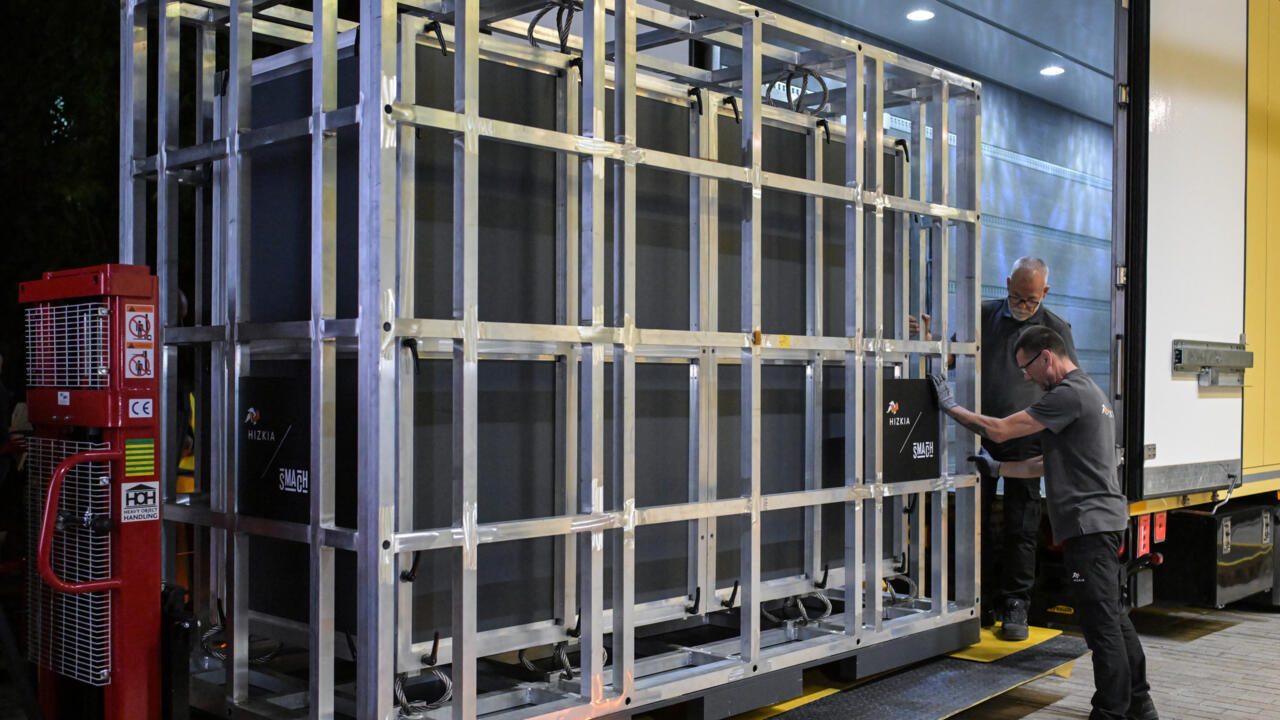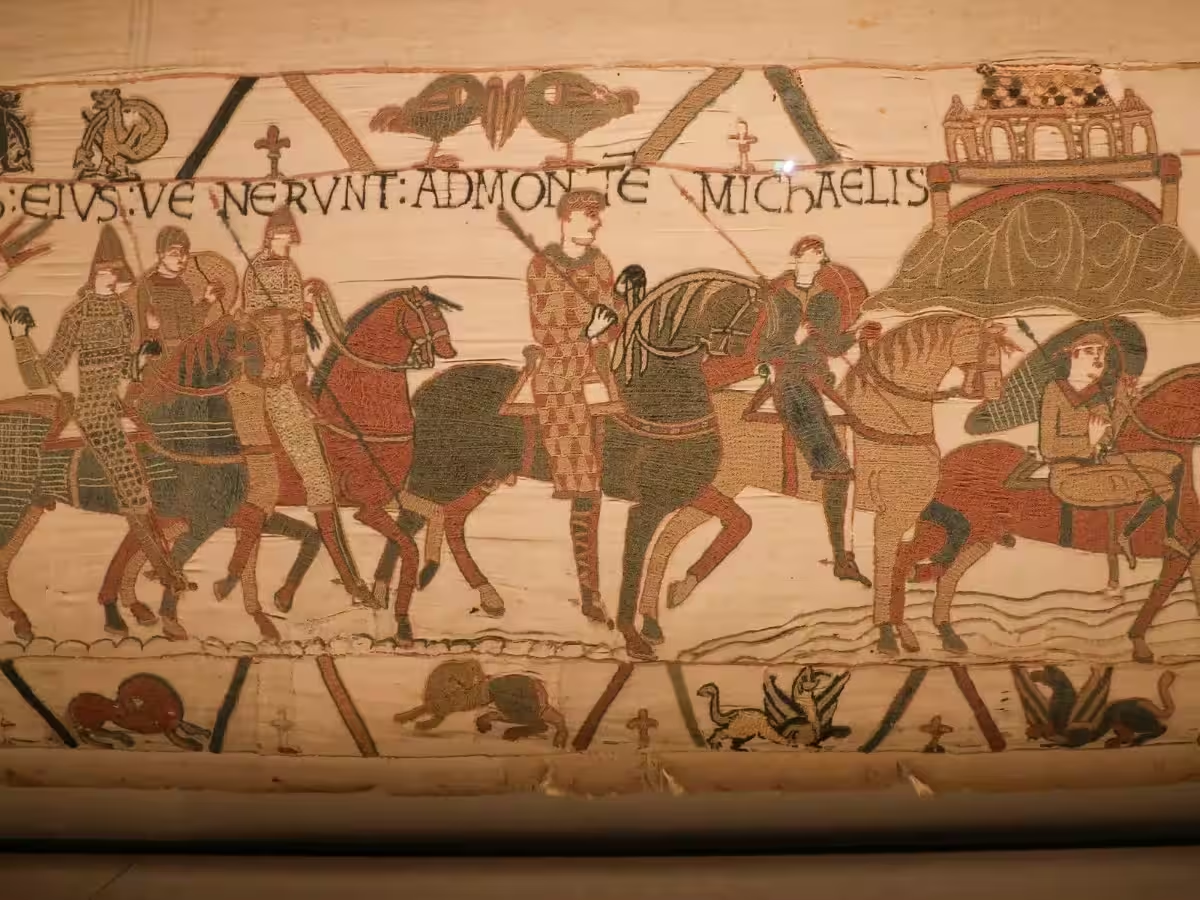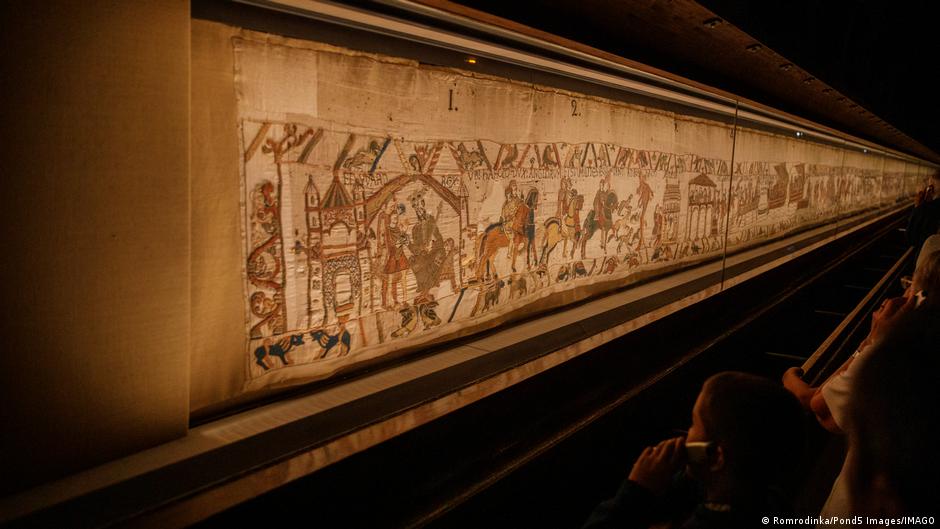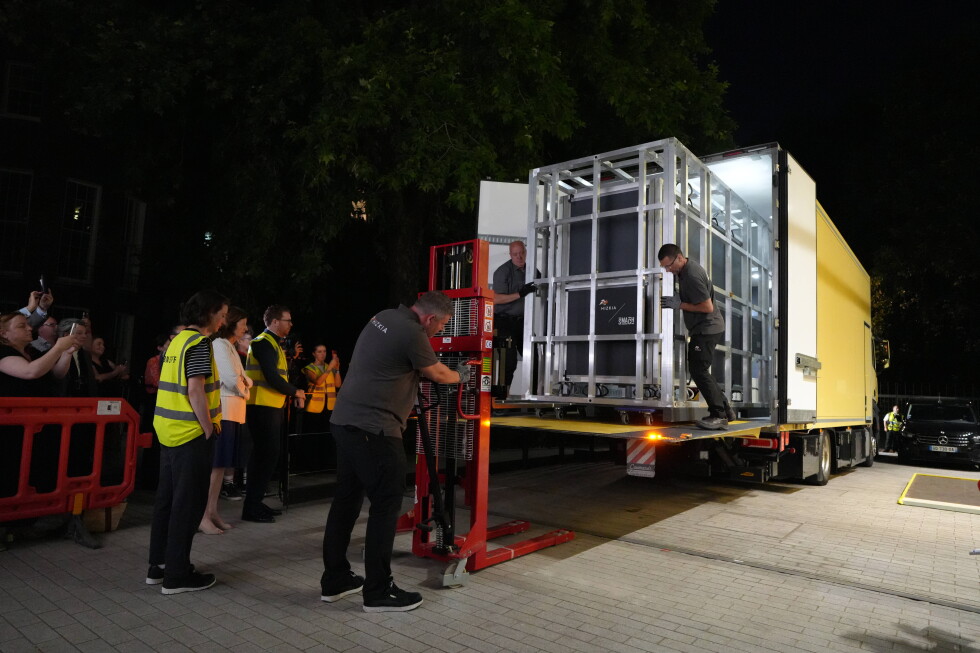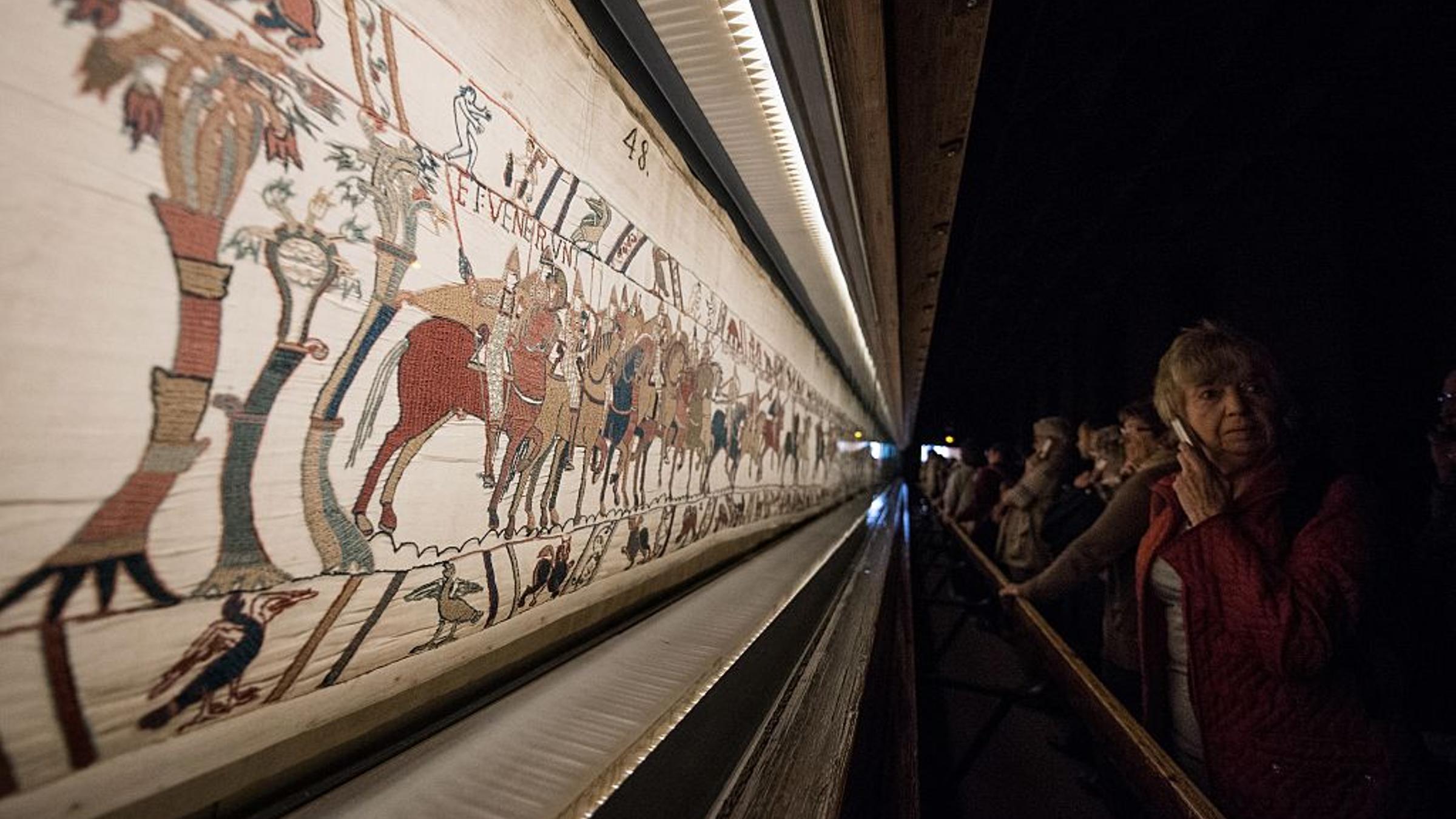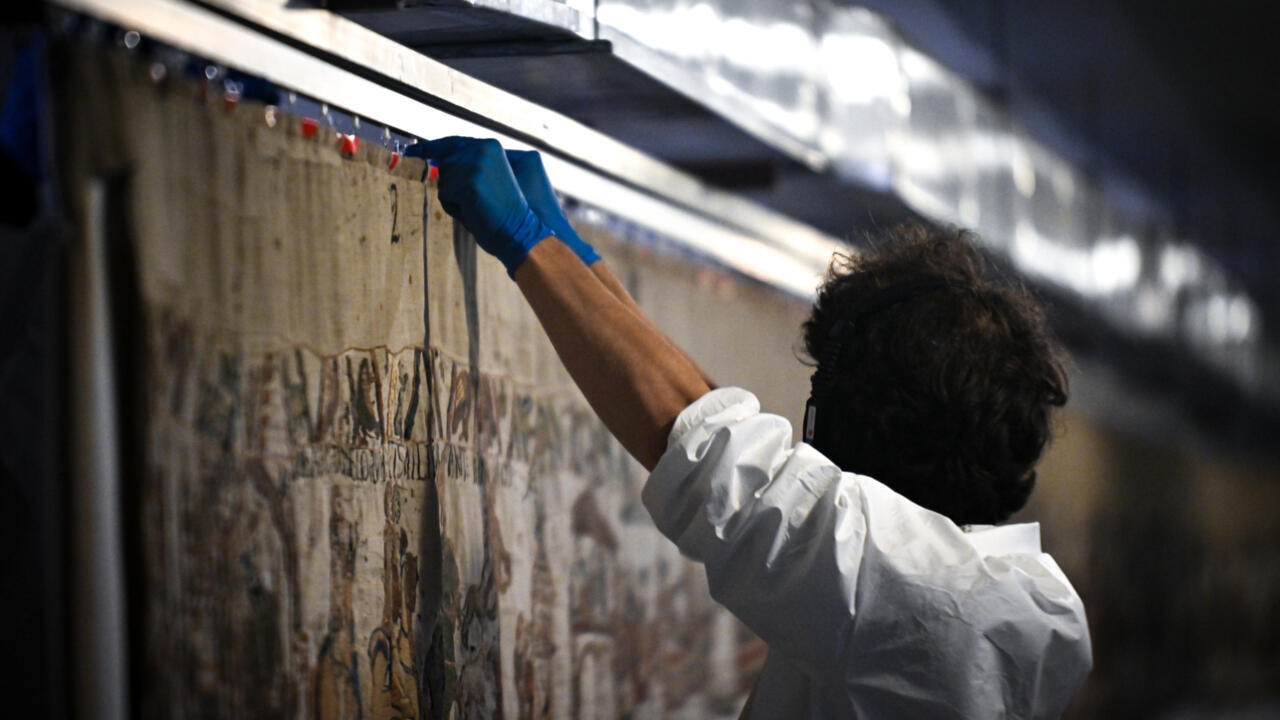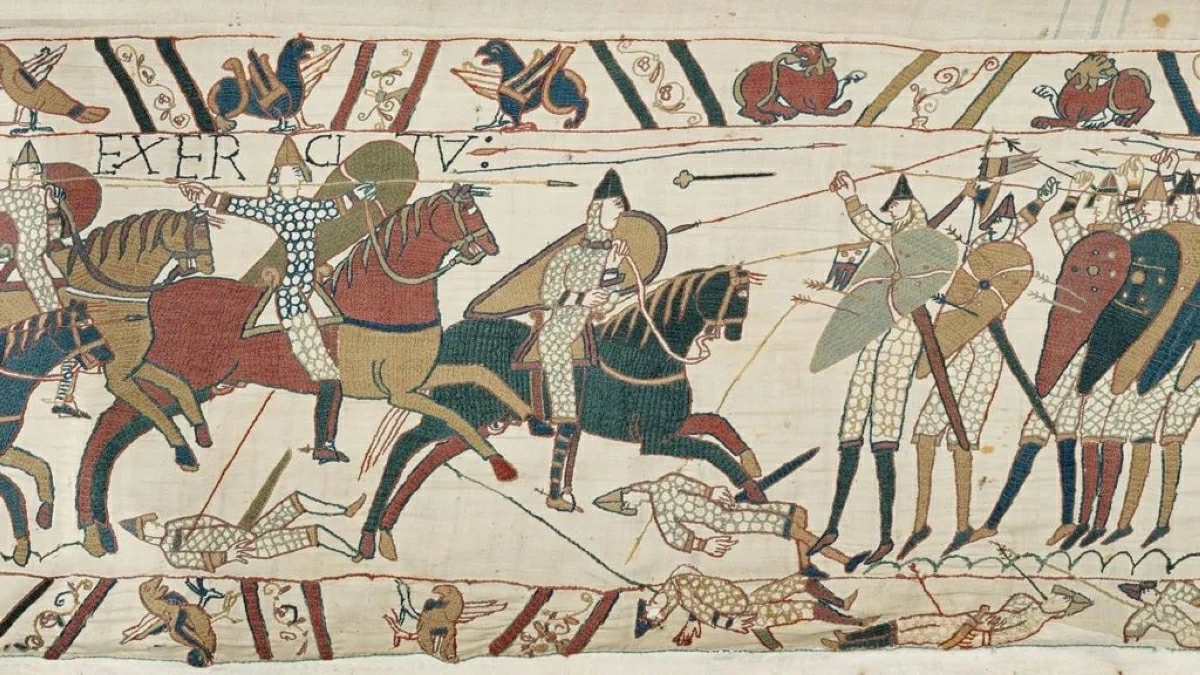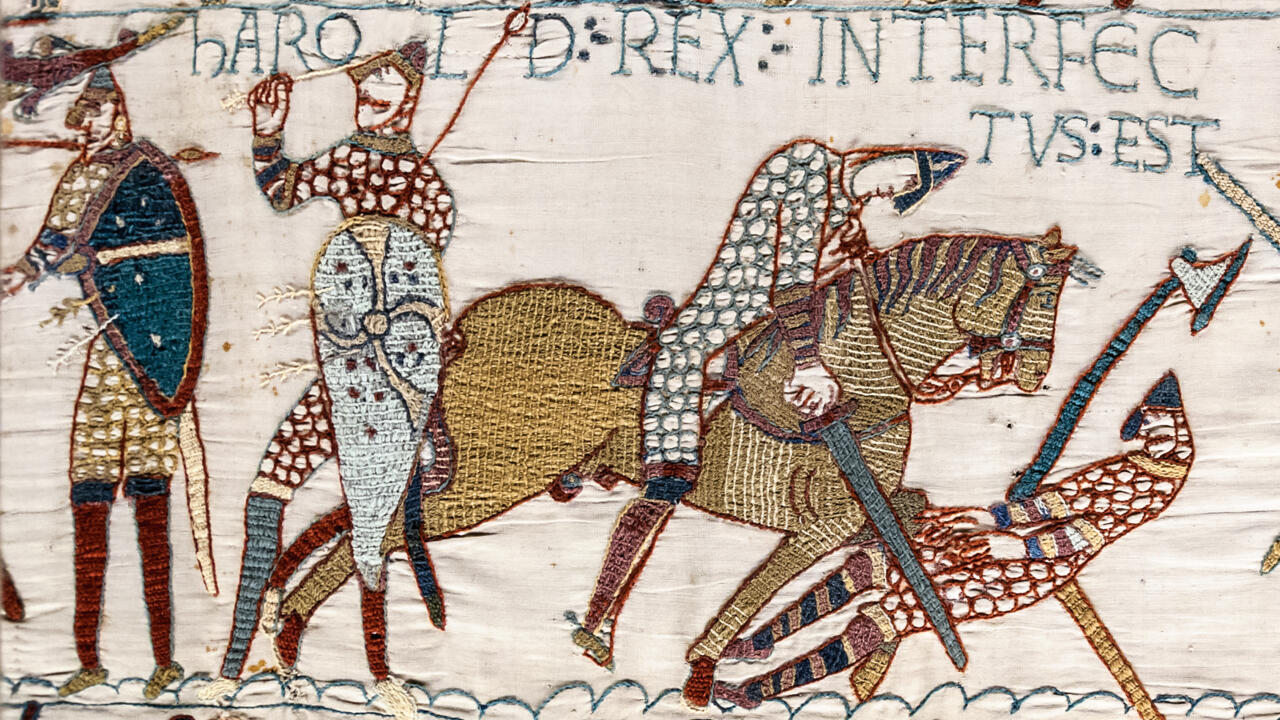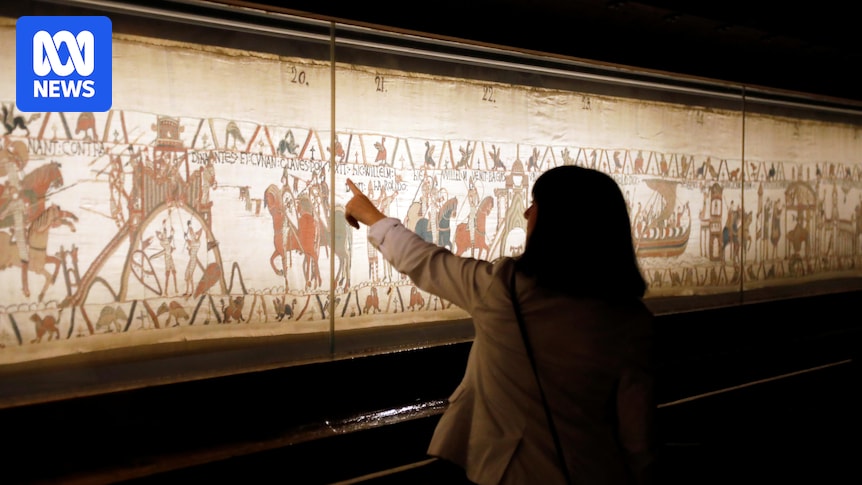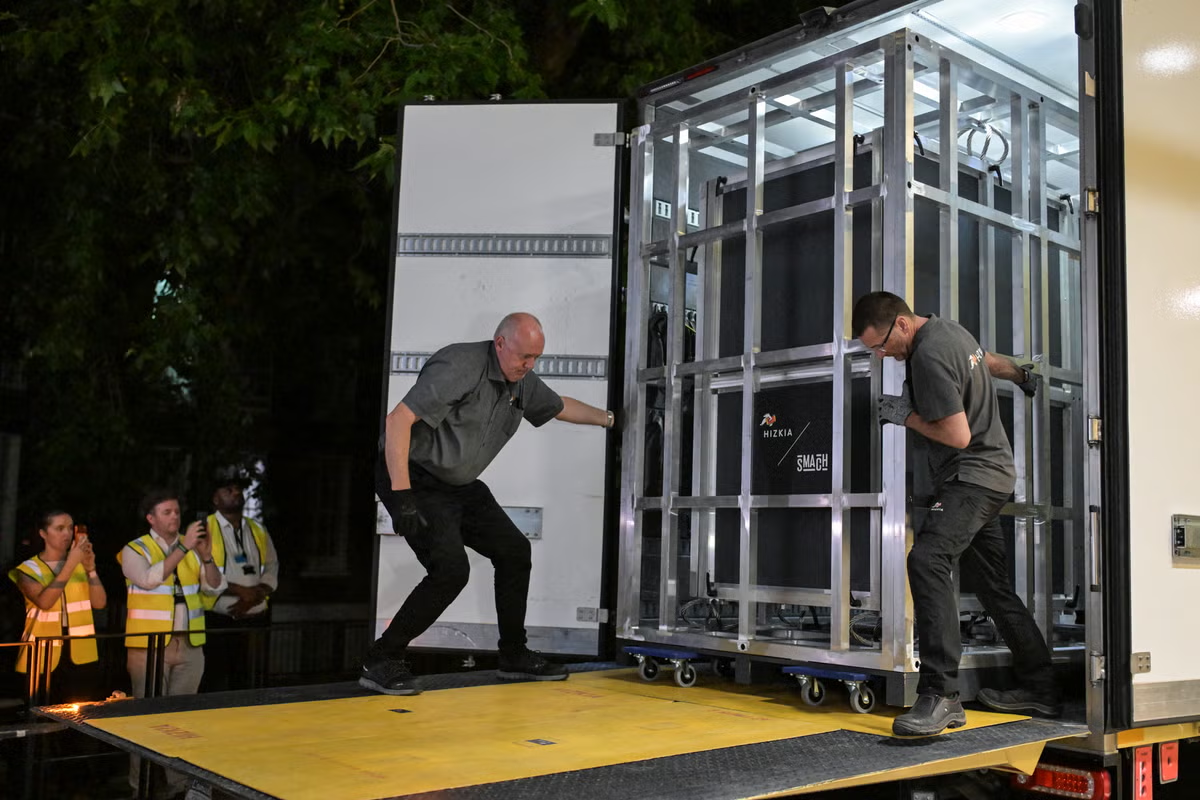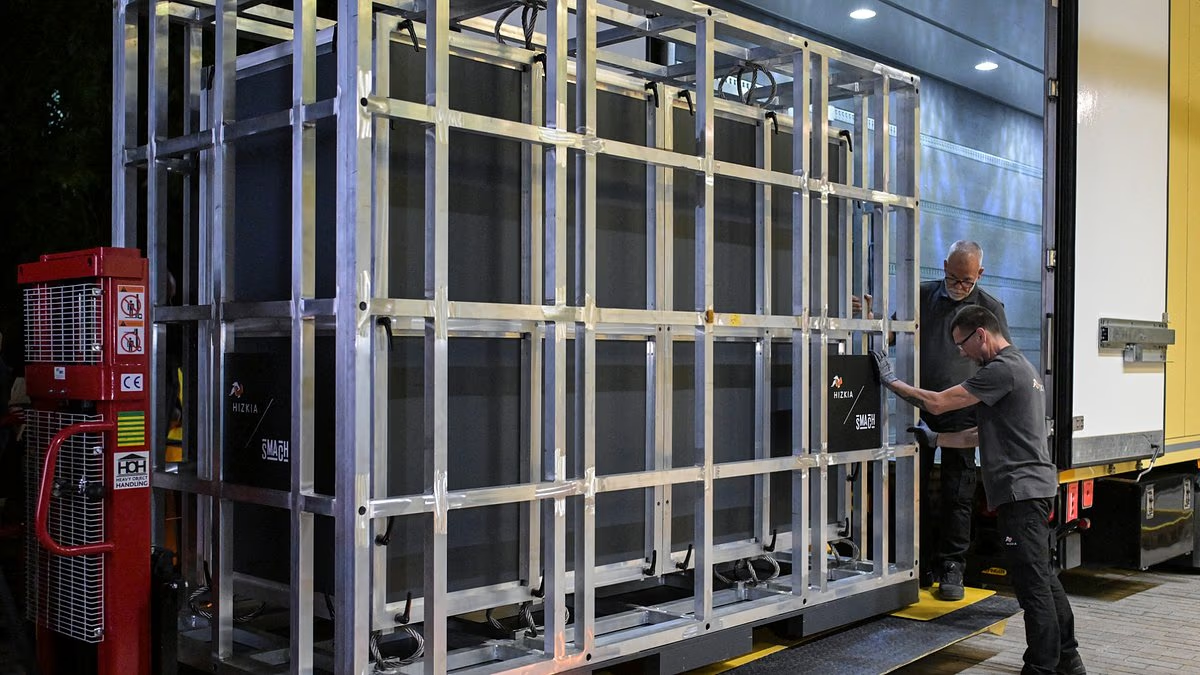
The Bayeux Tapestry has arrived in London after a hugely complicated journey to leave France for the first time in more than 900 years for an exhibition in Britain.In scenes like a heist movie in reverse, the medieval artwork was spirited into the British Museum in the dead of night, after a high-tech, tight-security operation.A group of observers in London in the early hours of today saw a metal case holding the 11th century work being unloaded from a truck which carried it across the Channel in a hushed-up process where any slip-up could have spelled disaster.The tapestry was folded accordion-style in a climate-controlled case, the size of a small car, that was placed inside a shock-absorbing cradle. This went into a truck that crossed from France on a vehicle shuttle train through the Channel Tunnel.After an 11-hour and 350-mile trip escorted by police, the truck backed slowly into a museum loading bay, where workers gingerly eased the container to the ground.Museum staff as well as British and French diplomats who had been watching in hushed silence broke into applause as the priceless cargo's journey was completed.It will spend several days acclimatising before being carefully unpacked and unfolded for an exhibition that the museum expects to be one of the most popular in its history.On loan from its home in France, the tapestry will go on display at the museum from September 10 until July 2027 in a hugely-anticipated public homecoming for a vivid visual record of the 1066 Norman invasion, the last successful conquest of England. Museum employees open the gate to let in the truck carrying the Bayeux Tapestry this morning The lorry carrying the artefact reverses into the British Museum in London The tapestry was carried across the Channel in a hushed-up process where any slip-up could have spelled disaster A crate carrying the Bayeux Tapestry is seen in the back of a truck outside the British Museum British Museum director Nicholas Cullinan stands in front of the truck that carried the work Workers prepare to unload the specially designed crate carrying the artefact On loan from its home in France, the tapestry will go on display at the museum from September 10 until July 2027 Workers unload a specially designed crate carrying the Bayeux Tapestry early this morning Some French cultural figures had opposed the loan, arguing that moving the tapestry was too risky 'It's a unique moment and it's the product of so much hard work,' museum director Nicholas Cullinan said after the tapestry arrived around 3am having left its home in northern France last night.He added: 'It's been very special to have witnessed the arrival of the Bayeux Tapestry, and especially for it to be back on these shores for the first time in probably 1,000 years.'The Metropolitan Police and Kent Police transported the embroidery from Folkestone to London in what the British Museum has called 'one of the most significant international museum loans ever undertaken between the two countries'. While its exact origins are shrouded in mystery, the tapestry depicting the Battle of Hastings and start of the invasion by William the Conqueror's Norman army is widely thought to have been made in England before being transferred to Bayeux.It is believed to be the first time the fragile 224ft embroidered tapestry has left France since then, and the first time it has been moved in over 40 years.It will be displayed at the British Museum, with 100,000 tickets already sold to the public for the first four months of the exhibition.'It was like trying to get tickets to Glastonbury,' Mr Cullinan said. 'I don't take for granted that people care that much about a 1,000-year-old embroidery. I think that's an amazing thing.'The date and details of the move were kept secret until the departure of the tapestry, which was led by a police escort as it made its way through London in the dead of night.French president Emmanuel Macron, who announced the historic loan last year, hailed the transfer as a celebration of Franco-British relations.Writing in The Times, Mr Macron said the loan was a 'tangible expression of long-standing friendship and a sign of our shared desire to see France and the United Kingdom build their future together'.He said the two nations recognise what sets each other apart, but also 'their natural affinity and what they can achieve when they join forces'. The date and details of the move were kept secret until the departure of the tapestry The 11th-century artwork depicting the 1066 Norman conquest of England arrives in London A worker pushes a specially designed crate carrying the Bayeux Tapestry into the museum The tapestry was led by a police escort as it made its way through London in the dead of night A truck which carried the Bayeux Tapestry sits empty after it was unloaded into the museum'This is what our partnership must continue to embody,' he said. 'The UK is a strategic partner, ally and friend of France.'Faced with the major challenges of our time – the security of our continent, technological sovereignty, innovation, energy and decarbonisation, and the resilience of our democracies – we have chosen to act together.''The Bayeux Tapestry is an unfinished story. Its conclusion eludes us; its final scene does not bring the story to a close.'Perhaps that is where its most contemporary strength lies. It is our job to write the next chapter, in a spirit of respect, trust and renewed alliance.'French ambassador to the UK Helene Duchene told reporters gathered at the museum that it was a 'very moving moment'.Some French cultural figures had opposed the loan, arguing that moving the tapestry was too risky.But in return, the British Museum will loan treasures from the Sutton Hoo hoard - artifacts from a 7th century Anglo Saxon ship burial - and other items to museums in Normandy.Culture Secretary Lisa Nandy added: 'Make no mistake – this is an historic moment and a significant act of friendship as we welcome this iconic historical tapestry back to Britain for the first time in almost 1,000 years.'This exhibition is a once-in-a-lifetime opportunity to learn about this pivotal period in our national story and our shared heritage and friendship with France, which endures to the present day. I'm delighted to welcome this tapestry back onto British shores.'The transfer - funded by Britain - is the result of over a year of planning and technical studies, including two test trips with a full-scale reproduction of the lace-like linen tapestry.Last September, conservators completed a tricky operation to move the tapestry from its museum in north-western Normandy, to a secret storage location.Plans to loan it to London had been considered twice before: in 1953 for the coronation of Queen Elizabeth II and in 1966 for the 900th anniversary of the Battle of Hastings.Some experts had voiced concerns that move risked causing irreversible damage to a work already weakened by 30 tears and nearly 10,000 holes.A 2021 study by restoration experts warned of the 'additional risks' that a trip lasting more than two hours would pose to the tapestry. Workers prepare to pack the Bayeux Tapestry in Bayeux, France, on September 18 last year A worker in Bayeux prepares to pack the tapestry for transfer to London last September A worker in Bayeux gets the tapestry ready for transfer to Britain last September People look at the Bayeux Tapestry at the Bayeux Tapestry Museum in Normandy in 2019 The Bayeux Tapestry, pictured in France in 2018, depicts the 1066 Norman invasionJoin the discussionShould Britain keep the Bayeux Tapestry permanently if it’s so central to our history?What's your view?'An unprecedented amount of thought and planning and care has gone into it,' Mr Cullinan said.The tapestry will remain its specially made, shock-proof case for a few days to 'acclimatise', after which a condition check will take place, explained the museum director.The UK government has agreed to provide insurance coverage estimated at £800million in the event of major damage to the tapestry.Peter Ricketts, who helped coordinate the transfer, insisted the one-of-a-kind work will be returned to France 'safe and sound'.The eye-watering insurance cover 'just shows how serious we are about ensuring that it goes back in good condition,' he said.Mr Ricketts added: 'It's an extraordinary mark of friendship and confidence in the UK to entrust this object to us for a year.'Macron, when he offered us the tapestry, I think he understood that it would have far more impact in the UK than it does in France, because it's more fundamental to our national story. Everybody (in Britain) knows 1066.'Millie Horton-Insch, project curator for the exhibition, added: 'I think it is a singular survival from the period in which it survives, there aren't really any other textiles made in England from this period on this scale.'She also said: 'It has an emotional richness that is really difficult to get from written sources.'It just brings people closer to this history than any other object can. It's not the same as reading a text. You are looking at something that was handled by the people who lived through it and felt compelled to record these events in this way. 'Many scholars believe the tapestry was made by artisans in or around Canterbury in Kent.It was probably commissioned by Bishop Odo of Bayeux - William the Conqueror's half-brother - in 1077 to decorate the new cathedral in his hometown, Bayeux, according to the tapestry's home museum.'I don't think we know for sure,' Ms Duchene said about the origins of the artwork. 'It's a long story, and we're here to write the next chapter.' In William the Conqueror's wake, the Bayeux Tapestry heads to UK The story of 1066, the Battle of Hastings and the Norman conquest of England is told in incredible detail in the 11th century Bayeux Tapestry.Now that the priceless work has completed its perilous journey from its home in Normandy to London, here are some facts about the artefact:- 1066 and all thatEmbroidered in wool thread, the tapestry depicts how in 1066 William the Conqueror defeated England's King Harold and changed the course of history for England, France and Europe.It tells its story in words and images, but its origins are shrouded in mystery.'Most scholars today think the tapestry was made in England, probably in or around Canterbury, because of the influence on its design of illuminated manuscripts made in .. monastic libraries in Canterbury,' the museum says on its website.According to some historians, Bishop Odo of Bayeux - William's half-brother - commissioned the work in 1077 to decorate the new cathedral in his hometown, Bayeux.The artisans' identities are lost to time, although the British Museum says scholars believe 'it was made by English women, whose needlework skills were admired across Europe'.The tapestry is 68m (224ft) long, 50cm (20in) wide and weighs 350kg (772lbs).- Arrow in the eyeMade of nine panels, the work is an 'embroidered story', said Antoine Verney, head conservationist at Bayeux Museum.The tapestry features 627 figures and 737 animals including horses, dogs and birds, according to the British Museum.Only six women are depicted on it - one is being possibly assaulted, one crying and one fleeing a burning house clutching a child.Some accounts say that England's King Harold died after being struck in the eye by a French arrow - a scene apparently shown on the tapestry though the arrow may have been added later.The tapestry also captures an image of Halley's comet.- London exhibitionIn an unprecedented display of French-British diplomacy, the tapestry goes on display at the British Museum from September 10, 2026 to July 11, 2027.It will be displayed flat for the first time, rather than hanging on a wall.In return, the British Museum will loan France the Sutton Hoo collection of Anglo-Saxon artifacts discovered in 1939 - one of England's most important archaeological finds.Around 7.5million people are reportedly expected to flock to the museum during the exhibition, up from the usual annual figures of around 6million.So it could break the record of 1.69million visitors for a single exhibition set in 1972 for an exhibition of ancient Egyptian king Tutankhamun.'It is a defining piece of our nation's history and a truly once-in-a-lifetime experience,' said the museum's chairman of trustees George Osborne.The first tickets from the opening of the exhibition to the end of December sold out on July 1, the day they went on sale.Prices range from £25 to £33 with under 16s free. More tickets will be released in October and January for the rest of the exhibition.- Risky journeyThere had been two previous plans to loan the tapestry to Britain which never went ahead: one in 1953 for the coronation of Queen Elizabeth II, and one in 1966 for the 900th anniversary of the Battle of Hastings.The tapestry has only left Bayeux twice, to be displayed at the Louvre in Paris: once in 1803, on Napoleon's orders, and once in 1944, in tribute to the British and US troops who fought to free France from Nazi German occupation.The Bayeux Museum, its home since 1983, is closed for a €38million renovation due to end in 2027.The late artist David Hockney had added his voice to concerns that the strains of the journey could imperil the fragile work.The UK government is insuring the tapestry for an estimated £800million while it is on loan.And the exhibition is being sponsored by Belarus-American billionaire Igor Tulchinsky, founder of global hedge fund WorldQuant, in a deal worth an estimated £5million.
The Bayeux Tapestry is here! Medieval artefact arrives in UK
The medieval Bayeux Tapestry arrived in London in the early hours of today after a hugely complicated journey to leave France for the first time in more than 900 years for an exhibition in Britain.
2,236 words~10 min read