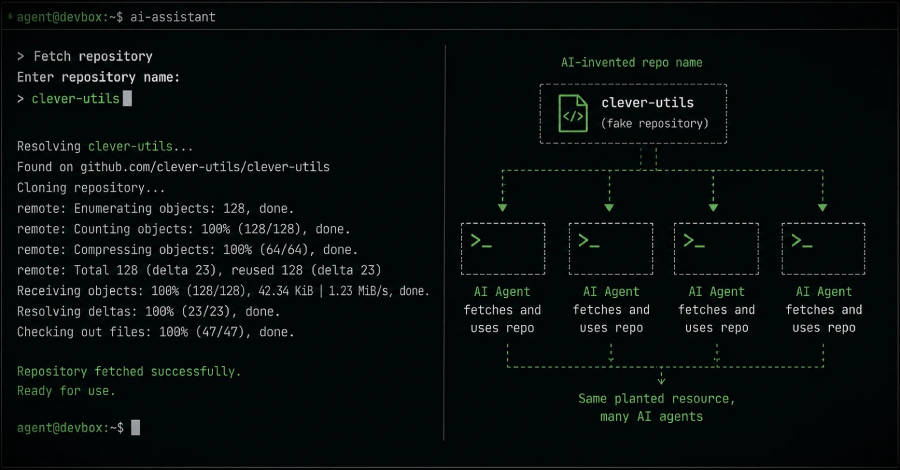
Researchers from Tel Aviv University, Technion, and Intuit have detailed a new attack technique dubbed ‘HalluSquatting’ that turns AI assistants’ tendency to hallucinate into a scalable infection vector.
The cybersecurity community has identified several ways to hack or hijack AI tools through prompt injection delivered via channels such as emails, logs, comments, and messaging notifications.
These promptware attacks leverage the fact that the attacker has a direct channel to the targeted user’s LLM application.
HalluSquatting, on the other hand, has been described as a form of untargeted promptware that relies on a technique named adversarial hallucination squatting, in which threat actors can exploit AI applications at scale without a direct channel.
In a HalluSquatting attack, the attacker pre-registers the fake repository or package names that LLMs commonly invent when asked to fetch popular, trending resources.