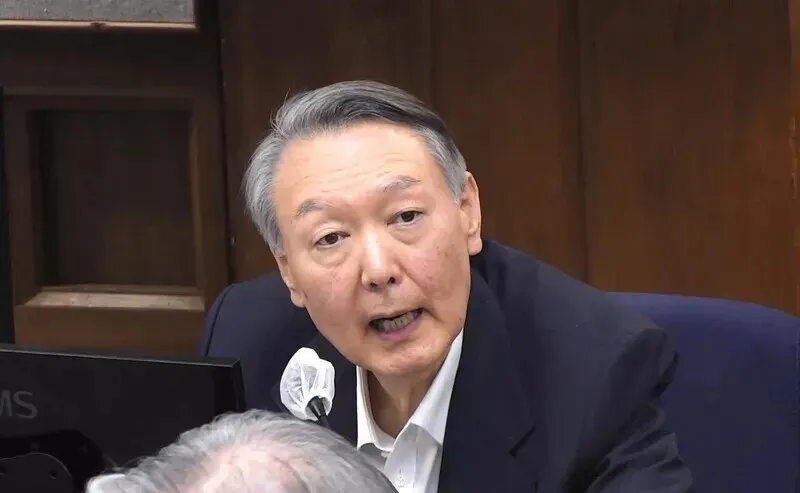
Former President Yoon Suk-yeol. (courtesy Seoul Central District Court)
An appeals court reviewing former Korean President Yoon Suk-yeol’s conviction for leading an insurrection has resumed hearings after a six-week hiatus. The trial resumed after the Supreme Court on June 12 rejected a petition for the judge’s recusal that Yoon had made one day before the first hearing in the trial.While Yoon has been dragging out the main trial, trials of senior military officers charged with playing instrumental roles in an insurrection through their connection with Yoon’s martial law declaration are winding down, with final hearings scheduled for the end of this month. Prosecutors want death sentence as Yoon’s main insurrection trial resumesOn June 25, Yoon was present for a hearing in the appeal of his conviction as insurrection mastermind at the Seoul High Court. The trial is in the hands of Judge Lee Seung-cheol, who is part of a new tribunal established for insurrection cases. Also present were Kim Yong-hyun, the former defense minister; Roh Sang-won, the former chief of the Defense Intelligence Command; and Col. Kim Yong-gun, the former provost marshal for the 3rd Army, who had joined Yoon in petitioning for the judge’s recusal.Following the Supreme Court’s final rejection of their arguments, Roh and the two Kims’ trials resumed as well.When Yoon’s trial resumed on Thursday, the first order of business was confirming the defendant’s identity since he had skipped the first hearing after his lawyers filed for the judge’s recusal. The first hearing in a Korean criminal trial is supposed to begin with official verification of the defendant. Afterward, the special counsel and the defendants took turns informing the court of their respective reasons for filing an appeal.While detailing the grounds for filing an appeal, insurrection probe special counsel Cho Eun-seok said that the district court had been too lenient when it gave Yoon a life sentence and requested the same sentence as he had requested in Yoon’s first trial: namely, capital punishment.The special counsel emphasized that Yoon had prepared for his martial law scheme for a substantial amount of time, citing a notebook by Roh Sang-won and a memo by Yeo In-hyeong, the former commander of the Defense Counterintelligence Command.“This scheme was very meticulously planned, with efforts to recruit members of the military going back a year. Considering that the defendant, Yoon Suk-yeol, ordered Lee Jin-woo, then commander of the Capital Defense Command, to break down the doors and use firearms loaded with live ammo, the district court was mistaken to regard the lack of a physical clash as an extenuating circumstance,” prosecutors under Cho argued, while emphasizing that the defendant’s lack of a criminal record and advanced age should not be considered when determining his sentence for leading an insurrection. On appeal, Yoon again claims martial law was supposed to be a warningAttorneys for Yoon have repeated their argument that Yoon was trying to alert the nation with his declaration of martial law.When a district court, with Judge Jee Kui-youn at the bench, convicted Yoon of leading the insurrection in the initial trial, it clearly stated that the purpose of Yoon’s martial law declaration had been to subvert the constitutional order by paralyzing the functions of the National Assembly.Courts that have tried Cabinet members — including former Prime Minister Han Duck-soo and former Interior Minister Lee Sang-min — on the charge of playing an instrumental role in the insurrection have reconfirmed that subversion of the constitutional order was the chief goal of the martial law scheme.Nevertheless, Yoon’s attorneys spent three full hours in the hearing detailing their argument that Yoon had “declared martial law with the intent of informing [the public] that the government’s gridlock and the despotic behavior of the main opposition party were wrecking the constitutional order.”According to Yoon’s attorneys, the former president hadn’t intended to keep martial law in place for very long and had only deployed a small number of troops to maintain order.“A high-level political decision to overcome a national crisis cannot be an insurrection,” Yoon’s attorneys argued while asking the court to acquit him on the charges.Because Yoon’s attorneys went over the allotted time in explaining their reasons for filing an appeal, initial statements by attorneys for Kim Yong-hyun and the other defendants had to be pushed back to a later date. Amid Yoon’s delaying tactics, military leaders’ trials near completionWhile Yoon’s insurrection trial was on pause, initial trials of senior military officials implicated in the martial law fiasco have been drawing to a close. These trials are divided into three main categories.The military commanders who were in direct communication with Yoon and Kim and who directed the operations — including Yeo In-hyeong, Lee Jin-woo and former Army chief of staff Park An-su (commander of the martial law troops) — are being tried by Judge Lee Hyeon-gyeong at the Seoul Central District Court.The lower-level military commanders accused of surrounding and infiltrating the National Assembly or organizing squads for arresting politicians under orders from the senior commanders in the previous category are being tried by Judge Jeong Su-yeong of the insurrection tribunal at the Seoul Central District Court. The defendants in this second category include Kim Hyeon-tae, the former leader of the 707 Special Mission Group, and Lee Sang-hyeon, the former commander of the 1st Special Forces Brigade.These two trials have been underway since they were transferred from military tribunals in March. The proceedings are winding down, with final hearings scheduled for the end of this month. The prosecutors are scheduled to make sentencing recommendations and the defendants to make final statements on July 24 for Yeo, Lee and Park and on July 28 for Kim and Lee.Witnesses are still being examined in the trials of Brig. Gen. Koo Sam-hoe, the former commander of the 2nd Armored Brigade, and Brig. Gen. Park Jeong-hwan, the former innovation strategist for the Ministry of National Defense, which began last month. The two are accused of having conspired in the insurrection in a meeting with Roh Sang-won at a Lotteria branch in Ansan, Gyeonggi Province, on the day that martial law was declared.By Kim Su-yeon, staff reporterPlease direct questions or comments to [english@hani.co.kr]