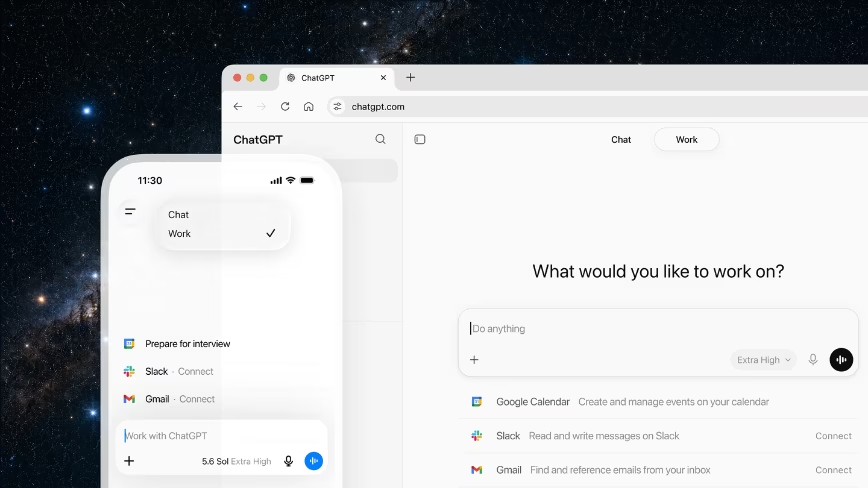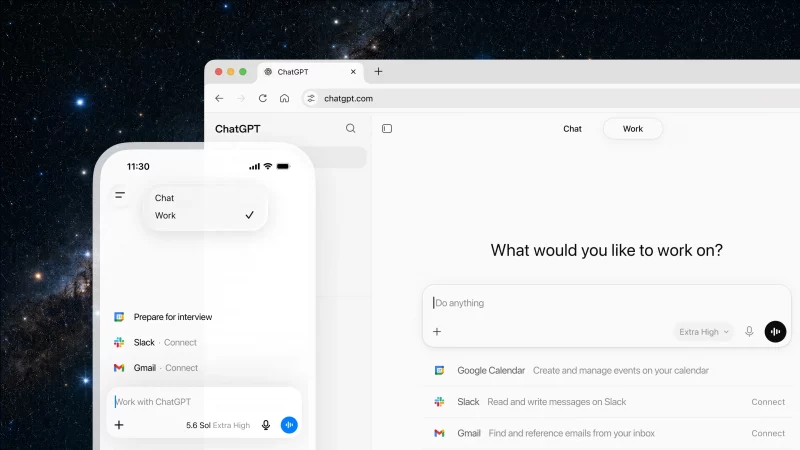
July 10, 2026 — 2:36pmOpenAI has released a turbocharged version of ChatGPT built to automate work tasks, analyse data and create documents, presentations and apps, schedule recurring tasks, and even tackle projects while you’re away from the desk.The new agent, called ChatGPT Work, is built to plug into users’ existing workflow and gather information across popular work apps Gmail, Slack, Teams, Google Drive, calendars, and more to create finished materials.OpenAI has made a new version of ChatGPT specifically to automate work tasks.BloombergUsers can go beyond refining prompts to producing reports, building campaign briefs, meeting agendas from Slack messages, and creating interactive dashboards, apps and websites.“For many folks around the world, for almost a billion users, it’s going to move beyond answering questions to actually getting real work done, and that’s a big shift in how people think about ChatGPT,” said OpenAI product marketing executive Sahil Punamia in a briefing call.The new AI agent integrates the technology of Codex (OpenAI’s tool made specifically for software developers and coders) into the consumer-friendly ChatGPT (which now has 10.5 million domestic users, according to Roy Morgan) to meet surging demand for a product that bridged the gap between the two as more Australians use AI for work.The tool is powered by its latest model, GPT-5.6, and runs across web, mobile, and desktop.A scheduling tool allows users to automate recurring work like weekly or monthly reports, and a desktop function called Computer Use gives the tool the power to “use your computer on your behalf to execute tasks in the background across your apps, tools, and browser – clicking, typing, and moving files where they need to go”, according to an OpenAI blog post.OpenAI has released a new version of ChatGPT that integrates Codex technology to help users automate and schedule work tasks.About 40 per cent of ChatGPT prompts from Australian user prompts are work-related, while more than 40 per cent of Codex requests are for non-coding tasks.Australia has caught the attention of AI companies as one of the biggest markets for AI use and is a top five market by weekly paying users. In three months between January and March, the number of Australians using Codex has skyrocketed sixfold. The new product comes amid fierce competition: Anthropic expanded its rival Claude Cowork agent to the web and mobile on July 7, and Google released an always-on agent, Spark, earlier this year.The platform is built to support workflows from specific industries including sales, finance, marketing, data analytics, engineering, and operations.To demonstrate how the new version of ChatGPT works, Punamia gave the example of a colleague who shoots a message to remind you to prepare for an upcoming meeting.“I took the Slack message link, pasted it in here, and then I said, ‘Remind me what I need to do for Casey to prep for influencer briefing call. Give me a complete outline with suggested topics.’ All I have to do is hit send. I don’t need to say ‘use Slack’,” Punamia said in the briefing call. “The model is smart enough to know.”In this example, ChatGPT Work pulled messages from Slack, extracted from a Google Document a colleague had put together, and looked at calendar invitations to create an outline.“This is work that would have taken me about half an hour or an hour to piece together myself, and it’s no fun. I’d rather just have the outline and start getting to think about what I want to say,” Punamia said.In an example provided by OpenAI, Virgin Atlantic’s head of digital products, Nathan Bolt, used ChatGPT Work to evaluate a passenger’s customer journey, assess it against competitors, and reduced weeks of data analysis into hours to help build the airline’s five-year plan.Australian Payments Plus, which operates payment infrastructure in Australia including Eftpos, BPAY payments, and real-time payments, has rolled out ChatGPT Work across the organisation.Chief operations officer Jackson Backhouse said the platform worked within the company’s security and identity access management guardrails and that there was no need for employees to turn to alternative, unapproved AI tools.“Rather than restricting our way to safety, we gave employees enterprise-grade tools with clear guidance and boundaries and let teams find their own use cases. We complement that approach with security controls designed to help prevent sensitive information from being shared through unapproved channels,” Backhouse said.Payment reconciliation issues are ultimately resolved by people, not AI, he added, but the technology can help technical teams trace data inconsistencies more quickly than doing it manually. “All findings were validated by our experts, and all operational processes, controls and sign-offs remain the responsibility of [our] employees,” said Backhouse.Artificial intelligence development company OpenAI launched ChatGPT in November 2022. It began as a non-profit organisation and moved to a for-profit structure in 2025. Worth US$852 billion ($1.2 trillion), it counts Amazon, Microsoft, and AI chip maker Nvidia as major investors, but was overtaken by Claude maker Anthropic as the world’s most valuable AI company, which in late May hit a US$965 billion valuation.Despite the widespread adoption of AI tools, people are still treating it with caution: OpenAI was named by Roy Morgan as one of Australia’s top 20 most distrusted brands amid suspicions about ethics and profit motives.The Business Briefing newsletter delivers major stories, exclusive coverage and expert opinion. Sign up to get it every weekday morning.Jessica Yun is a business reporter covering retail and food for The Sydney Morning Herald and The Age.Connect via X or email.From our partners
Runs your computer while you’re at lunch: ChatGPT for work just dropped
They’re calling it ChatGPT Work. If you were already scared about AI taking your job, look away.
905 words~4 min read