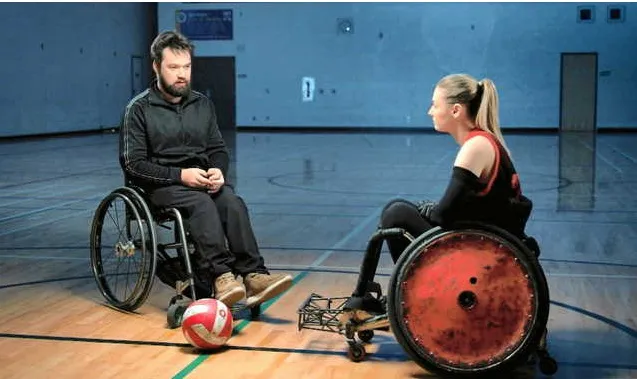
Skip to Content Subscribe Our Offers My Account Manage My Subscriptions FAQ Newsletters Canada Canadian True Crime Canadian Politics Health World Israel & Middle East Financial Post NP Comment Longreads Puzzmo Diversions Comics NP News Quiz New York Times Crossword Horoscopes Life Eating & Drinking Style Sponsored Play for Ontario Travel Travel Canada Travel USA Travel International Cruises Travel Essentials Culture Books Celebrity Movies Music Theatre Television Business Essentials Advice Lives Told Tails Told Shopping Buy Canadian Home Living Outdoor Living Kitchen & Dining Tech Style & Beauty Personal Care Entertainment & Hobbies Gift Guide Travel Guide Amazon Prime Day Deals Savings National Post Store More Sports Hockey Baseball Basketball Football Soccer Golf Tennis Driving Vehicle Research Reviews News Gear Guide Obituaries Place an Obituary Place an In Memoriam Classifieds Place an Ad Celebrations Working Business Ads Archives Healthing Epaper Manage Print Subscription Profile Settings My Subscriptions Saved Articles My Offers Newsletters Customer Service FAQ Newsletters Canada World Financial Post NP Comment Longreads Puzzmo Diversions Life Shopping Epaper Manage Print Subscription HomeTelevisionCanadian TV station groundbreaking for disability communityAMI-tv is the first network where every program has open-format described videoLast updated 29 minutes ago You can save this article by registering for free here. Or sign-in if you have an account.Journalist John Loeppky hangs out with Ashley Munro, who plays for the Calgary Inferno wheelchair rugby team. Photo by AMI-tvWe independently select everything we recommend. Buying through us may earn us a commission, which supports our work.The game is murderball — or, for those who clutch pearls at such a bloodthirsty term, wheelchair rugby.Enjoy the latest local, national and international news.Exclusive articles by Conrad Black, Barbara Kay and others. Plus, special edition NP Platformed and First Reading newsletters and virtual events.Unlimited online access to National Post.National Post ePaper, an electronic replica of the print edition to view on any device, share and comment on.Daily puzzles including the New York Times Crossword.Support local journalism.Enjoy the latest local, national and international news.Exclusive articles by Conrad Black, Barbara Kay and others. Plus, special edition NP Platformed and First Reading newsletters and virtual events.Unlimited online access to National Post.National Post ePaper, an electronic replica of the print edition to view on any device, share and comment on.Daily puzzles including the New York Times Crossword.Support local journalism.Create an account or sign in to continue with your reading experience.Access articles from across Canada with one account.Share your thoughts and join the conversation in the comments.Enjoy additional articles per month.Get email updates from your favourite authors.Create an account or sign in to continue with your reading experience.Access articles from across Canada with one accountShare your thoughts and join the conversation in the commentsEnjoy additional articles per monthGet email updates from your favourite authorsSign In or Create an AccountorJournalist John Loeppky trades his traditional wheelchair for a specialized one with a rounded front bumper and outward-tilted wheels. His gloves are taped to his hands, his feet are velcroed to his chair, and he mentally prepares to get banged up, sent skidding, or even knocked over.Ready to sample the made-in-Canada sport, Loeppky looks at the camera crew.“Tell my wife I love her,” he cracks.Loeppky hosts History in 60, an AMI-tv series that highlights the disability community in Canada. Other episodes focus on pioneers in fields including comedy, dance, and politics. It’s the kind of show that a few decades ago might have seemed like a pipe dream if not for the broadcaster.Launched in 2009, AMI-tv is the world’s first network where every program has open-format described video for viewers who are blind or partially sighted. It’s included free in basic cable packages and streams via the AMI+ app.“AMI exists because Canadian broadcasting had a huge gap, particularly as it related to blind and partially sighted viewers,” says Cara Nye, director of content development and production for AMI. She adds that those viewers couldn’t enjoy many shows because set-top boxes were inaccessible.“AMI bridged that access gap but, since then, we have evolved. Our audience has expanded to include Canadians of all abilities. What’s changed since then is our focus. We primarily aired other broadcasters’ shows with traditional post description added and presented it on AMI with open described video. There was no need to turn it on or off,” she says.“Now almost 100 per cent of our schedule is original production made by, and featuring, people with disabilities … To us, the true measure of impact isn’t that accessibility just exists on Canadian TV now. It’s that disabled Canadians are working in front of and behind the camera and showcasing their lived experience through compelling stories.”The docuseries Crip Trip, for example, follows a quadruple amputee and his best friend as they road trip from Edmonton to New York City. Underdog Inc. centres on four-foot-two Dale Kristensen, who defies expectations as a heavy-machinery operator, truck driver, and mechanic.And the upcoming series How We Do It features hosts who empower preschoolers: Carly (Allison Lang) has a limb difference, and Isaac (Donovan Whyte) is a paraplegic who uses a wheelchair. It premièred June 27.Combined with the rest of AMI-tv’s programming, the shows are uplifting a growing population. According to the 2022 Canadian Survey on Disability, 27 per cent of Canadians aged 15 and older — eight million people — had at least one disability that limited their daily activities. That’s up five per cent since 2017.Other Canadian networks seem to be taking note. Although none boast the breadth of AMI-tv’s programming by and for the disability community, they’re expanding their offerings.On CBC and CBC Gem, scripted series You’re My Hero focuses on an angsty 20-something man who has cerebral palsy. The Assembly features interviewers on the autism spectrum who ask celebrities questions. And short-form talk show Who Do You Think I Am? spotlights Madison Tevlin, who has Down syndrome, as she speaks with people who face prejudice.Over on CTV, the drama Sight Unseen (a co-production with U.S. network The CW) centred on a blind police consultant in Vancouver.There’s also progress behind the scenes. In August 2025, the Disability Screen Office and the National Screen Institute announced The Production Accessibility Role Initiative, which creates a managerial position that promotes accessibility on Canadian productions.For Loeppky, such advancements are welcome.“There has been a long history, in film and television, of either cripping up actors — meaning, casting nondisabled actors to play disabled characters — or casting disabled people as villains, something we touch on during the show,” he says. “I think media representation in spaces like journalism is improving, but there are still vast areas where improvement is necessary.”Nye agrees.“A lot of the able-bodied audience has never seen disability portrayed as ordinary, funny, or capable because mainstream media rarely shows that. It’s often shown as something to overcome. A hurdle or a setback — or an inspiration,” she says.“Watching AMI content demystifies and humanizes disability in a way that no lecture or media awareness campaign can … But let’s make no mistake — this is not the purpose of our content. It’s a nice side story. AMI is not here to educate. We’re here to entertain, inform, and empower.” Join the Conversation This website uses cookies to personalize your content (including ads), and allows us to analyze our traffic. Read more about cookies here. By continuing to use our site, you agree to our Terms of Use and Privacy Policy.
Canadian TV station groundbreaking for disability community
AMI-tv is the first network where every program has open-format described video
1,223 words~6 min read