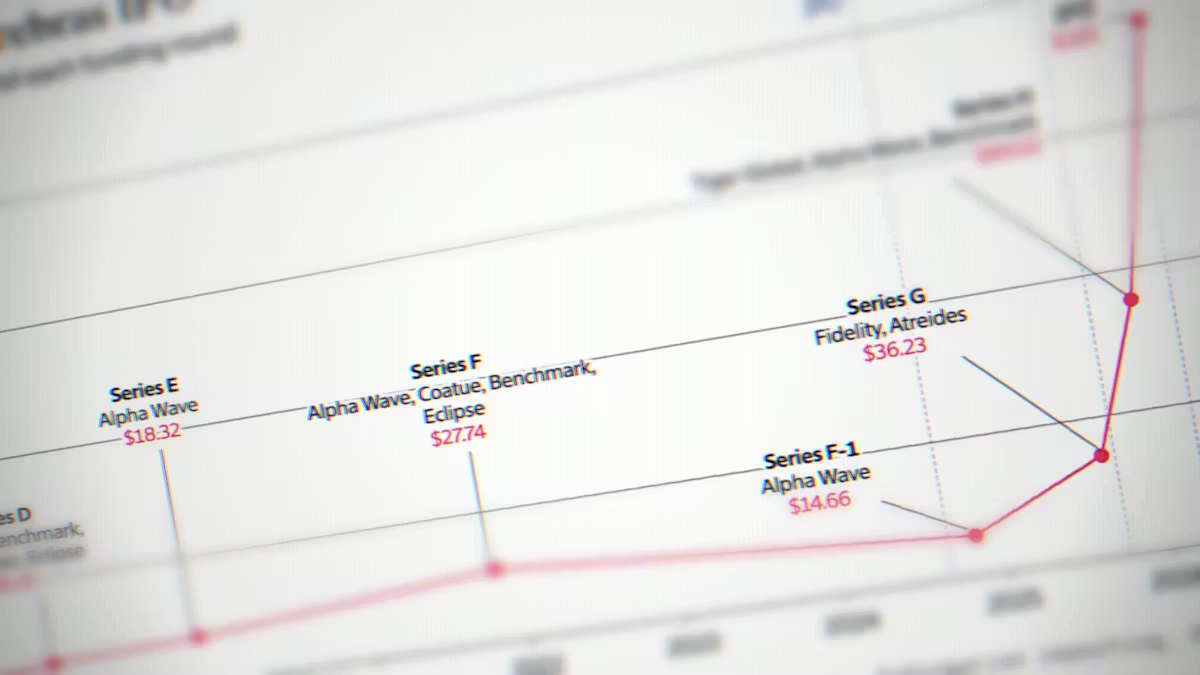
Updated: July 9, 2026Graphcore had plans for $120 million “brain-scale” supercomputers in 2024. In February 2024, PitchBook estimated a 97% probability that Graphcore would go public. Instead, the British AI chip company was acquired by SoftBank in July 2024, reportedly for roughly $500 million to $600 million – far below its former $2.8 billion valuation and less than the total capital it had raised. But the story did not end there. Graphcore is still in business as a wholly owned SoftBank subsidiary, and in 2026 SoftBank injected $457 million into the company to support its next phase. Graphcore has also opened a new AI engineering campus in Bengaluru, making it part of SoftBank’s broader AI infrastructure and Artificial Super Intelligence ambitions. So what happened to Graphcore, why did it fail to become “the British NVIDIA,” and what is SoftBank trying to build from the remains of one of Europe’s most promising AI chip startups?TL;DR: Graphcore failed to become a serious NVIDIA challenger because strong AI chip architecture was not enough. Its IPUs struggled against NVIDIA’s CUDA ecosystem, major enterprise deals collapsed, investors marked it down, and SoftBank acquired the company in 2024. In 2026, Graphcore is still alive, but as part of SoftBank’s broader AI infrastructure strategy.In today’s episode:How Graphcore Was Founded and Why They Bet on IPUsGraphcore's Early Struggles: Finding Investors Before the AI BoomGraphcore Funding: $684M and a $2.8B ValuationWhat went wrong? What did Graphcore build throughout the years?Graphcore's Good Computer: The $120M Brain-Scale Supercomputer PlaWhy Investors Wrote Off Graphcore: Microsoft Deal and Financial CollapseWhy SoftBank Acquired Graphcore and What Comes NextConclusionHow Graphcore Was Founded and Why They Bet on IPUsNigel Toon and Simon Knowles sold their company, Icera, to NVIDIA in 2011 for $435 million. Icera specialized in creating advanced 3G cellular modem chips, which played a crucial role in mobile communications technology. Following this successful sale, Toon and Knowles believed they could develop something that NVIDIA hadn’t yet achieved. In 2012, they started to discuss what they could build to beat NVIDIA. Knowles believed that the main obstacle in AI development was the inefficiency of computer chips, like CPUs and GPUs, which aren't designed to mimic human intuition. Instead of efficiently processing information, these chips analyze massive amounts of data, consuming vast amounts of energy. The two partners decided to design chips – Intelligence Processing Unit (IPU) – that think more like human brains to improve AI efficiency and reduce energy usage. At that time, they argued that overcoming the hardware limitations was more crucial for advancing AI than just focusing on complex software.“We wanted to build a very high-performance computer that manipulates numbers very imprecisely,” says Knowles. The founders assert that they recognized in 2012 that AI was going to be a huge thing. They understood it would need new types of processors. They believed that processors specifically designed for AI could outperform more general-purpose chips across a variety of ML tasks. “NVIDIA was still pretty small at the time. We thought we could compete with them,” says Toon. Toon explains that unlike traditional programming where machines follow step-by-step instructions, Graphcore's chips enable machines to learn autonomously. He likens this shift to the revolutionary emergence of microprocessors in the 1970s, suggesting that Graphcore is reinventing the approach to computing, much like Intel did back then.Herman Hauser (co-founder of Acorn Computers that later became ARM) believed in Toon and Knowles from the very beginning, hoping that they would unleash the third wave of computing (CPU in the 1970s being the first, GPU in the 1990s being the second). After such endorsement, it was hard not to start the company. In 2013, the Graphcore project began in stealth mode, with an official launch in 2016 in Bristol, UK. This place is sometimes called a “Deep Tech Powerhouse” and is part of the Silicon Gorge region. Companies innovating in Bristol traditionally receive financial support from the British government. Graphcore's Early Struggles: Finding Investors Before the AI BoomIf you’re not interested in AI infrastructure unicorns, check out these practical courses from our partners →But not in this case. The pre-launch of the company was tough. The founders started to test the waters with investors in 2015, but back then many VCs didn't yet see the potential of AI, nor the need for specialized chips. Often, they found an ally within VC firms, only to be dismissed at partner meetings where the question "What’s AI?" was still common. Investors were wary of the high capital intensity of chip development compared to software, which could be tested and scaled incrementally. Building a chip meant committing all resources upfront, making it a daunting proposition for many.In 2016 – boom! – Intel acquired the AI startup Nervana for $350 million, and Google announced its own AI chip development. After that, investor interest surged, and Graphcore suddenly received a windfall.Graphcore Funding: $684M and a $2.8B ValuationSequoia's partner, Matt Miller, was so convinced of Graphcore's potential that he pursued the investment despite the company not actively raising funds at the time. In 2019, Toon was recalling with a smile how Matt Miller from Sequoia, at his first board meeting, humorously warned other investors against talking about selling the company, emphasizing Sequoia's focus on building big, public companies. Back then Toon confirmed that Graphcore's goal is to go public, stating, "That’s the path we’re shooting for, absolutely."This marked a significant endorsement and a turning point for Graphcore. The company's valuation soared, reaching $1.7 billion after a $200 million Series D round in December 2018. In 2019, CEO Nigel Toon said that the company would make $1 billion in revenue by 2024. The company valuation reached $2.8 billion after a $222 million Series E in 2020. In total, according to the rounds announced on the company website, Graphcore raised $684 million over 6 rounds. But according to another page on the their company website, they raised over $710 million.Only to be sold just above $600 million (according to Financial Times) in July 2024. What went wrong? We talked to an AI researcher who has collaborated extensively with Graphcore (he asked not to quote him by his name). Here’s what he said:“I think Graphcore is a great company, and they have an interesting hardware architecture – IPU – that, in certain cases, is superior to NVIDIA. The main advantage of NVIDIA is all the software tools. It's much easier to develop software for NVIDIA GPUs than for Graphcore IPUs. NVIDIA is a juggernaut, and because they have been in this space for many years and captured most of the market, it's nearly impossible to compete with them.”According to former employees, as reported by Sifted, Graphcore’s issues stem from a mix of bad luck and poor strategy. Executives made poor decisions regarding commercial and tech strategies, leading to low morale and talent loss. Targeting big clients like Microsoft initially backfired, as the company found more success with startups but realized this too late. Confusion around market focus and inadequate software support further hampered progress. The software issues, particularly with usability and maintenance, led to the collapse of the Microsoft deal, further exacerbating the company’s struggles.Remember, from the beginning, the founders were saying that overcoming hardware limitations was more crucial? In 2024, they changed the narrative, stating that Graphcore is one of the companies still competing with NVIDIA “because it's not just about the hardware. It's actually also very much about the software as well.” Narrative is one thing; what you have in practice is another.Graphcore IPU and Bow: What the Company Actually Built Graphcore IPU Architecture: From GC200 to BowFirst, let’s start with describing what an Intelligence Processing Unit (IPU) is.IPUs leverage a parallel processing architecture that supports multiple instruction streams and multiple data streams, among other specialized features tailored for AI and machine learning.In 2020, Graphcore introduced Colossus™ MK2 GC200, with massively parallel, MIMD (Multiple Instruction, Multiple Data) architecture*: Cores: 1,472 independent processor cores Threads: Nearly 9,000 independent parallel program threads *MIMD is a type of parallel computing architecture in which multiple processors operate independently, executing different instructions on different sets of data simultaneously. This contrasts with other architectures like SIMD (Single Instruction, Multiple Data), where multiple processors execute the same instruction on different data sets at the same time. With 900 MB of in-processor memory (IPM) and up to 256 GB of streaming memory (external DRAM): Up to 256 GB.When it comes to performance, the MK2 GC200 delivers 560 TFLOPS FP8, 280 TFLOPS FP16, and 70 TFLOPS of FP32 performance at 185W. To put the numbers into context, NVIDIA's A100 delivers 312 FP16 TFLOPS without sparsity as well as 19.5 FP32 TFLOPS, whereas NVIDIA's H100 card offers 3,341 FP8 TFLOPS.But seriously, 2020 is more than a few centuries ago in AI chips years. Comparatively, NVIDIA's latest The NVIDIA GB200 Grace Blackwell Superchip, introduced in 2024, offers 1.4 exaflops of AI performance and includes 30TB of fast memory.Graphcore’s latest innovation was from 2022: Bow IPU.Bow IPU is based on a wafer-on-wafer design with TSMC's 7nm process, includes 1,472 independent cores and 900MB of on-chip memory with a 65TB/s access speed. This architecture allows the Bow IPU to achieve 350 peak teraflops of mixed-precision AI compute and 87.5 peak single-precision teraflops. It provides a 40% performance improvement and 16% better power efficiency compared to its predecessor. The IPU also features 10 IPU links, delivering a total inter-chip bandwidth of 320 GB/s. The Bow IPU integrates into Bow-2000 IPU Machines, supporting configurations that scale up to the Bow Pod1024, which offers 89.6 petaflops FP32 compute.Poplar SDK: Graphcore's Software Stack and Its LimitationsTo support all this hardware, Graphcore developed Poplar SDK – the software development kit for programming and optimizing IPU applications, supporting popular machine learning frameworks like TensorFlow and PyTorch.Poplar SDK is quite good within its niche, but it is not as widely used or as popular as CUDA (specialized software platform for GPUs). Poplar SDK’s adoption is largely tied to the use of Graphcore’s IPUs, which are less common than NVIDIA GPUs.Graphcore's Good Computer: The $120M Brain-Scale Supercomputer PlaIn 2022, Graphcore promised to introduce the "Good Computer" by 2024, aiming to deliver 10^19 calculations per second, making it 100 million times faster than an average laptop. Named after codebreaker Jack Good, it was supposed to feature 4 PB of memory and cost $120 million. Utilizing 3D wafer stacking technology, it would accommodate up to 500 trillion parameters, positioning itself as a significant advancement in AI and high-performance computing. It was supposed to dwarf leading models like OpenAI’s GPT-3, which had 175 billion parameters at that time. Little did they know about the rapid advancements in AI in 2023 and 2024.Why Investors Wrote Off Graphcore: Microsoft Deal and Financial CollapseAfter Graphcore’s GC200 launch in 2020, questions were raised about the lack of major customer announcements, and therefore, about market adoption. Despite impressive technical specs, the absence of endorsements from key investors like Microsoft and Dell EMC, and the limited deployment statements from listed customers, suggest potential issues in securing large-scale commitments. This is particularly surprising given their significant funding and high-profile backers.After losing a key deal with Microsoft in 2022, Graphcore has faced significant financial challenges. In June 2024, Molten Ventures reduced its stake's value by 45%, marking the second consecutive year of such a decrease. Baillie Gifford cut its stake by half, and Schroders reduced its valuation by 25%. Sequoia has written off its investment completely. Though founded in Bristol, the town didn’t bring Graphcore any luck. Despite the UK government's significant investment in AI supercomputing, it did not support Graphcore's ambitious Good AI supercomputer project, leaving the company with limited options. Graphcore’s plans for showcasing their advanced IPUs were stymied by the lack of financial backing. Facing financial difficulties and investor reluctance, Graphcore started to look for a buyer for its ambitious projects.Why SoftBank Acquired Graphcore and What Comes NextMasayoshi Son, the CEO of SoftBank, has laid out an ambitious plan that positions AI and AGI (Artificial General Intelligence) at the center of his vision for the future. He envisions a world where AI systems far surpass human intelligence. His vision includes AGI transforming industries such as manufacturing, finance, and logistics, and he believes that companies that embrace this technology will lead the future of humanity.Beyond AGI, Son is also focused on the development of Artificial Super Intelligence (ASI), which he predicts could emerge by 2030. ASI, according to Son, would be vastly superior to AGI, potentially becoming up to 10,000 times smarter than humans by 2035. He actually said “he was put on Earth to create ASI,” just saying.Image Credit: BloombergThe question is: where will the compute for that come from?Too much for NVIDIA to have it all! In 2016, SoftBank acquired Arm for $32 billion. In February 2024, it became known that SoftBank was working on a project called “Izanagi,” a $100 billion AI chip venture intended to compete with industry giants. This project, named after the Japanese god of creation, speaks to the seriousness of Son’s ambitions. Son’s drive toward AI is not just business-focused; he sees it as a personal mission, believing that his purpose is to bring ASI to reality.The Graphcore acquisition also looks more logical in 2026 than it did in 2024. SoftBank is assembling an AI infrastructure portfolio around compute, chips, Arm, data centers, and AGI/ASI ambitions. Graphcore gives it a specialist AI accelerator team and IPU architecture; Ampere gives it cloud CPU infrastructure; Arm remains the strategic center of gravity. Graphcore alone is not a NVIDIA killer. But inside SoftBank’s portfolio, it can become one piece of a much larger compute stack.That is the real “what comes next.” Graphcore’s IPUs, designed for AI workloads, could complement Arm’s architecture and SoftBank’s broader compute ambitions, especially if the company can turn Graphcore’s hardware ideas into something easier to deploy at scale. The details are still unfolding, but SoftBank’s $457 million injection into Graphcore after the acquisition makes one thing clear: this was not just a talent acqui-hire or a quiet ending. SoftBank is still putting money behind the bet.What happened to Graphcore after the acquisition?After the SoftBank acquisition, Graphcore did not disappear. It became a wholly owned subsidiary of SoftBank Group and continued to operate under the Graphcore name, with its headquarters in Bristol. The important shift is that Graphcore is no longer a venture-backed AI chip startup trying to survive the NVIDIA war on its own. It is now part of SoftBank’s larger AI infrastructure strategy.The clearest sign came in 2026, when SoftBank injected $457 million into Graphcore through a single share issue filed on April 10, according to Companies House filings reported by CNBC. Graphcore confirmed that the money came from SoftBank. Graphcore’s original problem was not only technical. It was also financial: chip companies need enormous capital, long sales cycles, deep software ecosystems, and enough time to survive failed enterprise deals. SoftBank gives Graphcore the one thing it had almost run out of: runway.Graphcore also started expanding again. In May 2026, the company officially inaugurated its AI Engineering Campus in Bengaluru, which it says will help build the next generation of AI compute and support SoftBank’s Artificial Super Intelligence vision. The company has also framed its work as part of the wider SoftBank AI ecosystem rather than as a standalone NVIDIA challenger.Still, this is not a simple comeback story. In 2025, co-founder Simon Knowles exited the company, one year after the acquisition, a reminder that Graphcore’s post-SoftBank phase is also a restructuring phase. The new Graphcore is alive, funded, and strategically useful to SoftBank. But it is no longer the same company investors once expected to take public.Graphcore vs NVIDIA: Why Software Matters More Than HardwareInitially aiming to outshine NVIDIA with its innovative IPUs, Graphcore struggled because strong hardware was not enough. The company had the foresight to bet on AI acceleration early, but it underestimated how much the market would depend on software, developer adoption, and ecosystem gravity. NVIDIA did not win only because of GPUs. It won because CUDA became the default language of accelerated AI.Graphcore’s failed Microsoft deal, weak commercial traction, investor write-downs, and abandoned IPO path turned a once-promising British AI chip unicorn into an acquisition target. SoftBank’s purchase did not erase those problems, but it changed the context. Graphcore no longer has to survive alone as an independent NVIDIA challenger. It now sits inside SoftBank’s larger AI infrastructure strategy, alongside Arm and other compute bets.That does not make Graphcore a comeback story yet. But it does make it more than a failure story. In 2026, Graphcore is still alive, newly funded, and potentially useful in SoftBank’s long AI compute game. The lesson is brutal but useful: in AI chips, architecture matters, but software ecosystem, timing, and capital matter even more.FAQIs Graphcore still in business?Yes. Graphcore is still in business, but it is no longer an independent startup. In July 2024, SoftBank acquired Graphcore and made it a wholly owned subsidiary. The company continues to operate under the Graphcore name, with its original base in Bristol and new expansion in India.How much did SoftBank buy Graphcore for?The official acquisition price was not disclosed. Reports put the deal at roughly $500 million to more than $600 million. Either way, the sale price was far below Graphcore’s peak valuation of $2.8 billion and below the total amount the company had raised from investors.How much is Graphcore worth?Graphcore’s current standalone valuation is not publicly disclosed because it is now a wholly owned SoftBank subsidiary. At its peak, Graphcore was valued at $2.8 billion after its 2020 funding round. The 2024 SoftBank acquisition was reportedly around $500 million to more than $600 million, far below that peak valuation. In 2026, SoftBank injected another $457 million into the company, but that funding does not necessarily represent Graphcore’s market valuation.Why did SoftBank acquire Graphcore?SoftBank acquired Graphcore to strengthen its position in AI compute. Graphcore had built Intelligence Processing Units, or IPUs, specifically for AI workloads, but struggled commercially against NVIDIA’s hardware and CUDA software ecosystem. For SoftBank, Graphcore offers AI chip talent, IPU technology, and a possible role inside a larger AI infrastructure portfolio connected to Arm, data centers, and SoftBank’s AGI/ASI ambitions.Is Graphcore doing well?Graphcore is doing better than it was before the SoftBank acquisition, but it is not back to its old unicorn glory. Before the sale, the company was under severe financial pressure, investors had marked down their stakes, and its path to an IPO had effectively collapsed. After SoftBank acquired Graphcore in 2024, the company stayed alive as a wholly owned subsidiary, received a $457 million investment from SoftBank in 2026, and expanded with a new AI Engineering Campus in Bengaluru. So yes, Graphcore is still operating and has fresh backing. But it is now part of SoftBank’s AI infrastructure strategy, not an independent challenger racing NVIDIA on its own.Will Graphcore go public?A Graphcore IPO is very unlikely in its current form. Before the acquisition, Graphcore had been seen as a potential IPO candidate, and PitchBook reportedly estimated a high probability of an IPO in early 2024. But after the July 2024 acquisition, Graphcore became a wholly owned SoftBank subsidiary. Unless SoftBank later spins it out or lists part of the business, Graphcore is no longer on a normal independent startup IPO path.What happened to Graphcore after SoftBank acquired it?After the acquisition, Graphcore continued operating under its own name, but as part of SoftBank. In 2026, SoftBank injected $457 million into the company, and Graphcore opened an AI Engineering Campus in Bengaluru. The company is now positioned less as an independent NVIDIA challenger and more as one piece of SoftBank’s broader AI compute strategy.Thank you for reading, please feel free to share with your friends and colleagues. 🤍
Graphcore: From $2.8B AI Chip Unicorn to SoftBank Acquisition – 2026 Update
How Graphcore went from a $2.8B AI chip unicorn to a SoftBank acquisition — IPU technology, failed Microsoft deal, investor write-offs, and what comes next
3,281 words~15 min read