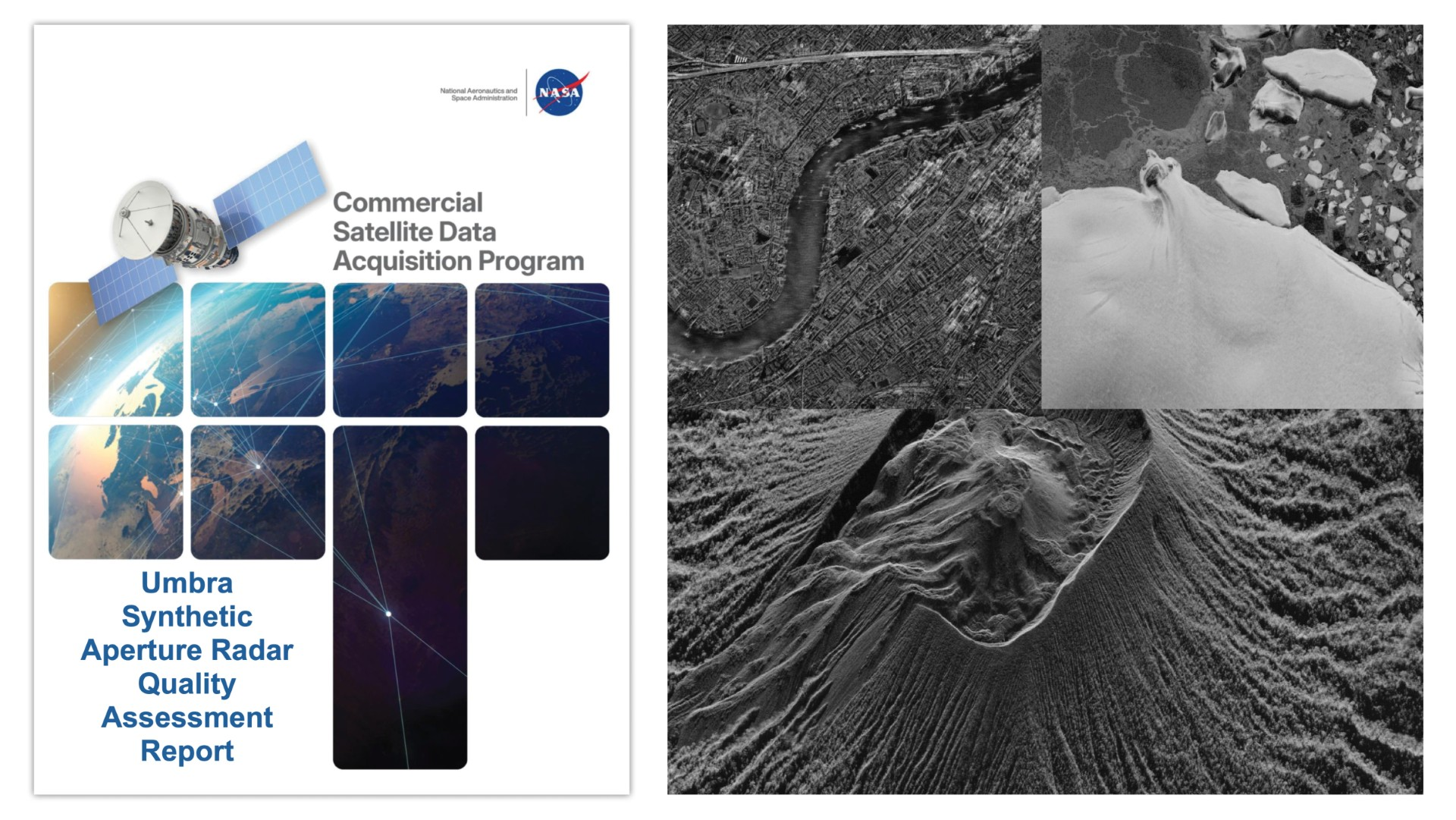
Two new reports from NASA’s Commercial Satellite Data Acquisition (CSDA) program evaluate data from the Umbra X-band Synthetic Aperture Radar (SAR) satellite constellation for the NASA Earth science research and applications community. The results of these evaluations help to inform NASA program management and the user community about the quality of these commercial data for use in NASA science.
The CSDA Umbra Synthetic Aperture Radar Umbra SAR Principal Investigator Evaluation Summary documents the findings of evaluation teams. The teams were given access to the Umbra archive as well as the ability to task the Umbra constellation for new acquisitions. The tasking capability allowed evaluation teams to test the utility of Umbra data in time-sensitive workflows and to monitor areas experiencing rapid change and/or emergent environmental conditions, such as harmful algal blooms.
Although the Principal Investigator Evaluation Summary supports the use of Umbra SAR data for NASA Earth science research and applications overall, it noted several strengths and weaknesses of the Umbra X-band data. Strengths included access to a very high spatial resolution X-band SAR satellite constellation; taskable access to high temporal repeat opportunities with quick turnaround; imaging flexibility with a range of azimuth and incidence angles; and the company’s Open Data Program. Conversely, the PI teams reported weaknesses, including issues with Umbra geolocation (noting large and small geolocation errors), limited software compatibility, metadata, and some missing technical documentation.