Story audio is generated using AI
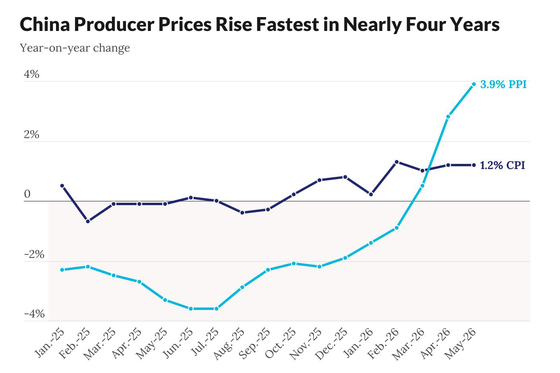
Beijing — Producer price inflation in China surged to the highest level in four years in June, piling pressure on manufacturers’ profit margins as weak domestic demand limits their pricing power.China’s economy is developing a two-track dynamic as a global AI-fuelled export surge lifts advanced manufacturing, while weak household spending, lacklustre investment and the property downturn continue to restrain domestic activity.The producer price index (PPI) rose 4.1% year on year, the highest rate since July 2022, according to data published by the National Bureau of Statistics (NBS) on Thursday, matching the median forecast in a Reuters survey and up for the fourth straight month. The gauge, which logged a 3.9% gain in May, had snapped a years-long deflationary streak in March as energy prices soared in the wake of the Iran war.Read: More money, less of the economy and ‘construction mafia’: this is SA constructionThe faster growth in factory-gate prices was partly the result of a low base of comparison a year earlier, though analysts said soft domestic demand meant deflationary pressures had yet to ease meaningfully.“The latest escalation in US-Iran tensions could deliver some renewed upward pressure on inflation in the near term,” said Julian Evans-Pritchard, head of China economics at Capital Economics. “But this will remain limited to a few narrow areas, and inflation still looks set to return to near-zero once energy supply normalises.”Higher prices in coal mining, electrical machinery, electronics and ferrous metals were among the main factors contributing to the rise in producer prices, according to the NBS, though they declined in sectors including alcoholic beverages and automobile manufacturing.Compared with the previous month, PPI fell 0.3% in June after a sharp drop in global oil prices following the US-Iran ceasefire memorandum. In contrast, some high-tech and green-transition industries, such as virtual reality equipment, wearables and carbon-based nanomaterials, recorded month-on-month price gains.Markets hardly budged on the data, with stocks holding steady and the yuan strengthening up slightly.Domestic squeezeThough firmer prices have boosted profits in some upstream and high-tech sectors, manufacturers more reliant on the home market are struggling to pass higher costs on to consumers. That backdrop highlights the headwinds policymakers face in their efforts to support the job market and bolster still-soft domestic demand.Evidence of subdued domestic demand was underscored by China’s auto sales, which fell for a ninth consecutive month in June, prompting carmakers to turn to external markets.Data on consumer prices, which was released alongside PPI, showed some moderation. The annual consumer price index (CPI) climbed 1.0% last month, slowing from a 1.2% increase in May and below an expected 1.1% rise, as price increases for industrial consumer goods eased, including those for gold jewellery and petrol.On a monthly basis, CPI was 0.3% lower, compared with an expected 0.2% drop and a 0.1% dip in May.Core CPI, which excludes volatile food and energy costs, rose 1.0%, the slowest pace since January. Food prices dropped 1.6% year on year.“The data is moving from near-deflation to low positive inflation,” said Lynn Song, ING’s chief economist for Greater China. “This sort of inflation level is not likely to impede the People’s Bank of China from monetary policy action, should it deem that necessary.”China’s market regulator has renewed its crackdown on “involution-style” competition, pressing ahead with a campaign to rein in cut-throat price wars that have fuelled deflationary pressures.Excessive competition has led to shrinking corporate profit margins across multiple sectors, including electric vehicles, solar panels, lithium batteries, steel, cement and food delivery.Analysts say stronger policy intervention is essential to rebalance an economy marked by excess production capacity and weak domestic demand. The export boom has allowed policymakers to postpone more decisive stimulus measures.“The anti-involution campaign and low base effects would boost inflation again in the first quarter of 2027,” said Zhaopeng Xing, ANZ’s senior China strategist. “The inflation outlook allows policymakers to remain patient and keep interest rate cuts on hold in 2026.”