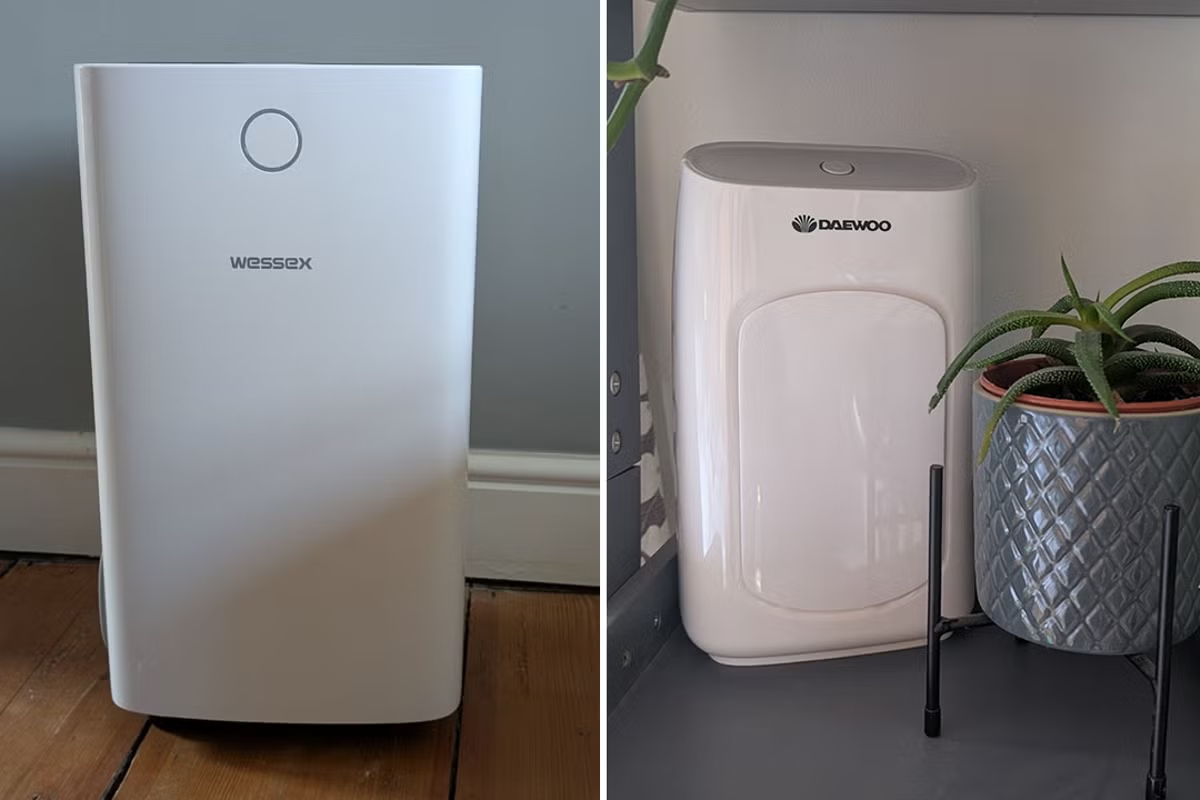
Your questions about dehumidifiers answeredWhat is the best dehumidifier?From my extensive testing, I found the best dehumidifier to be the Duux bora smart 30l dehumidifier. It’s effective, quiet, and packed with bonus features. If you still want to save some money, the Daewoo 700ml dehumidifier is the best budget dehumidifier, as it costs six times less than my top pick. Finally, if you want a dehumidifier to help with your laundry, the Daewoo 16l dehumidifier was the fastest I tested. How I tested dehumidifiersI tested 20 different dehumidifiers in different-sized rooms around my house (as my home is prone to getting damp, it’s the ideal testing ground). I tried all the modes, including the night and laundry functions, to check that every setting worked as the brand claims it does. No one wants the sound of their dehumidifier overpowering their TV, so I also measured noise levels (using a decibel metre) to see how quiet each unit was. If a dehumidifier had an app, I tested whether it was easy to use. I used a humidity metre to confirm that each unit removed moisture from the air, and if so, exactly how much. Similarly, I used an air particle metre to note if the dehumidifier improved air quality – those that didn’t weren’t included. I also considered cost-per-use, calculating energy consumption.As with every IndyBest review, I tested and reviewed each dehumidifier using a strict criteria:Noise: I used a decibel metre to assess noise levels, checking to see if each dehumidifier was quiet enough to run when working from home or watching TV nearby. I favoured the models that were barely noticeable. Humidity levels: Using a humidity metre, I confirmed that these appliances removed moisture from the air, and if so, exactly how much. I also timed how long it took to reduce the humidity in different rooms. If a model took a long time to reduce humidity, I didn’t include it in this review. Change in air quality: I used an air particle metre to see if each dehumidifier improved air quality. If it didn’t, then I didn’t include it in this round-up. Laundry drying abilities: I timed how long the laundry functions took to dry full loads of laundry, assessing whether or not it was quicker than air drying. Cost-per-hour to run: I calculated these appliances’ energy consumption and how much it costs to run them by the hour. I favoured those that were cheap to run, and have listed the price per model next to each one. What does a dehumidifier do?A unit sucks in moist air with a fan, then draws it over refrigerated coils. These cold coils condense moisture in the air into liquid water, which is then collected in a tank or drawn away by a hose. The dehumidifier then expels warm air with a lower moisture level. As well as being good at reducing mould, they are also effective at drying laundry – with money-saving expert Martin Lewis encouraging the switch from a tumble dryer to a dehumidifier. My colleague Daisy Lester consulted experts on exactly what a dehumidifier does and how it works.How to use a dehumidifierFirst, choose a dehumidifier that suits the size of your room. Most models list their capacity in square metres, making it easier to find the right fit. Once you’ve picked one, position it close to the source of moisture. For example, in a laundry room, beside wet clothes, or in the kitchen near a dishwasher. If you’re tackling damp, place it where condensation tends to build up, such as near windows.However, make sure that there is a gap of at least six inches between a dehumidifier and a wall to ensure free air flow. When the placement is sorted, pick your mode. Most dehumidifiers have a standard, laundry, and quiet mode – the right option depends on what you’re trying to achieve. Do dehumidifiers use a lot of electricity?Electricity use depends on the model and the conditions in your home, but they’re generally efficient appliances. How much do dehumidifiers cost to run?Cost per hour varies depending on use, room temperature, and many other variables. However, a general rule is that a good dehumidifier will cost less than 10p per hour, even for the largest models. “On average, a dehumidifier might be used for four to six hours daily, especially during colder months or in damp environments. In particularly humid conditions or larger spaces, it could be used for longer,” explains Katie Lilywhite, air treatment expert at AO. “The exact cost depends on how often they’re used and how energy-efficient the model is.” Chris Michael, founder and chair of leading dehumidifier company Meaco, elaborates: “Choosing an energy-efficient model is key; regardless of size, as a cheaper model with high energy consumption is a false economy.”However, size can be a factor. “Smaller models, which are ideal for flats or smaller homes, can cost as little as 4p per hour to run, while larger models, suited to bigger or damper properties, may cost up to 15p per hour,” Michaels says.My colleague Daisy Lester has written an expert guide on how much dehumidifiers cost to run.Do dehumidifiers dry clothes?Dehumidifiers draw moisture out of the air, so they can be a great help for drying laundry. They’re most effective alongside a heated clothes airer, and much faster than air drying. Depending on the weather, line drying outside takes a few hours, and if you don’t have any outdoor space, it might take a day or more. In this guide alone, I used a dehumidifier to dry clothes in around four hours. On top of that, they can be a better choice than a tumble dryer – they’re often cheaper to run, and there is none of the shrinking, fading, and pilling you might find with a tumble dryer. Michaels from Meaco agrees, adding that they “offer a low-cost alternative to dry wet washing indoors instead of electricity-guzzling tumble driers”. If you’re keen to know more about dehumidifiers and drying clothes, read our expert-led guide. Why you can trust IndyBest reviewsJoanne Lewsley has particular expertise in finding the best dehumidifiers and best air purifiers. She has tested dozens of dehumidifiers over the last five years. She also lives in a home that is prone to damp, mould, condensation, and musty smells, making her the perfect candidate for this test. Where relevant, she also called on other testers to verify her claims. She has consulted experts in the industry to corroborate details and the technology behind them. Whether you’re looking for a diffuser to get rid of unwanted odours or you need more moisture in the air thanks to a humidifier, the IndyBest team provides solid advice and honest reviews. Meet the expertDr Rebecca Drummond: Associate professor in the Institute of Immunology and Immunotherapy at the University of BirminghamFor a breath of fresh air, take a look at the best air purifiers to remove pollen, dust and bacteria
11 best dehumidifiers for tackling damp and mould at home, tested by an expert
Dry out your damp basement or bathroom with one of the best dehumidifiers
1,154 words~5 min read