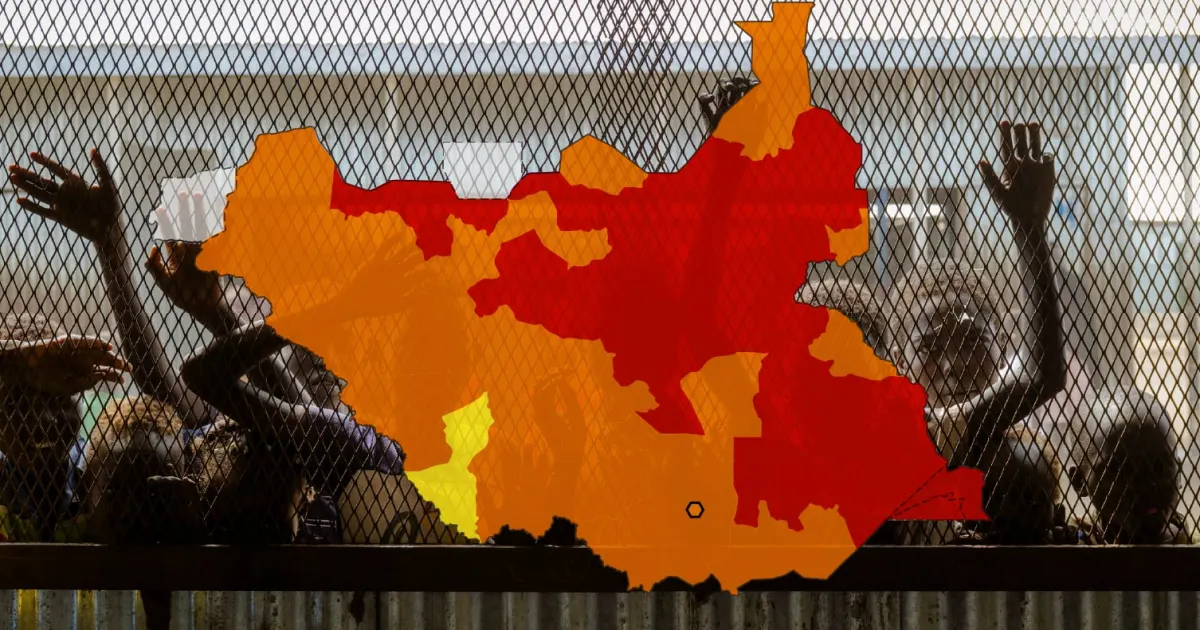
South Sudan became the world’s newest country in July 2011 after nearly 99 percent of voters chose independence from Sudan.Fifteen years later, most of the major promises that came with independence remain unfulfilled.Recommended Stories list of 4 itemslist 1 of 4Fears of new massacre in Sudan’s el-Obeid: What do we know?list 2 of 4El-Obeid is surrounded by the RSF: Could it be the next el-Fasher?list 3 of 4How the US-Iran conflict is reshaping Africa’s geopolitical opportunitieslist 4 of 4South Sudan, 15 years on: Still fighting for peaceend of listSouth Sudan remains one of the world’s most fragile states.Oil finances nearly 90 percent of the government’s revenue, but the country remains wracked by deep inequality and violence: 82 percent of the population lives below the poverty line, and political jostling between rival groups has left the young nation in a perpetual state of conflict.A woman poses with her three-year-old daughter in their house which is made out of straw, bamboo and plastic sheeting at the Protection of Civilian site (PoC) in Bentiu, South Sudan, on February 15, 2018 [File: Stefanie Glinski/AFP]Elections have never been held since independence, millions remain displaced, and the country’s economy depends on pipelines running through Sudan, the very nation it fought to leave.‘A failed promise’Jok Madut Jok, 57, a professor and director of graduate studies at Syracuse University, is from Warrap, South Sudan, and still has family in both rural and urban parts of the country.Jok says he recalls the joy of the time when South Sudan broke away to establish a new beginning. It was a moment of hope. Today, though, he feels as though he has been denied all that was promised at the time.“South Sudan at the moment is a failed promise,” he says. “South Sudanese who had lived under brutal regimes in Sudan and had been excluded from money and development programmes, and were victims of security operations in the southern part, had hung their hopes on independence.”Jok says people are now looking towards possibilities of political transitions to hold their government accountable.Who controls what in South Sudan?The country is technically governed by a transitional unity government created under the 2018 peace agreement.But that peace remains fragile.Violence continues across Jonglei, Upper Nile, Unity and Equatoria states with clashes involving government forces, opposition fighters and other armed groups.Elections scheduled several times since independence have again been delayed, with the latest vote planned for late 2026.Main political and armed groups:Sudan People’s Liberation Movement (SPLM)The ruling party which led the independence movement.Sudan People’s Liberation Movement-in-Opposition (SPLM-IO)Led by Riek Machar, it is part of the unity government. It still maintains armed forces in parts of the country.South Sudan People’s Defence Forces (SSPDF)The national army, formerly known as the SPLA, it is loyal to President Salva Kiir.White ArmyA loose network of armed youth, mainly from the Nuer ethnic group.National Salvation Front (NAS)It remains active, mainly in Equatoria province. The NAS never fully joined the peace agreement.A South Sudanese military police officer sits on a pickup truck while monitoring the area as troops belonging to the South Sudanese Unified Forces take part in a deployment ceremony at the Luri Military Training Centre in Juba on November 15, 2023 [File: Peter Louis Gume/AFP]Who runs the government?Salva Kiir – President since independence.
In maps and charts: South Sudan’s 15 years of independence
AJLabs breaks down the 15 years of liberation from Khartoum and the impact on 12 million people.
1,167 words~5 min read