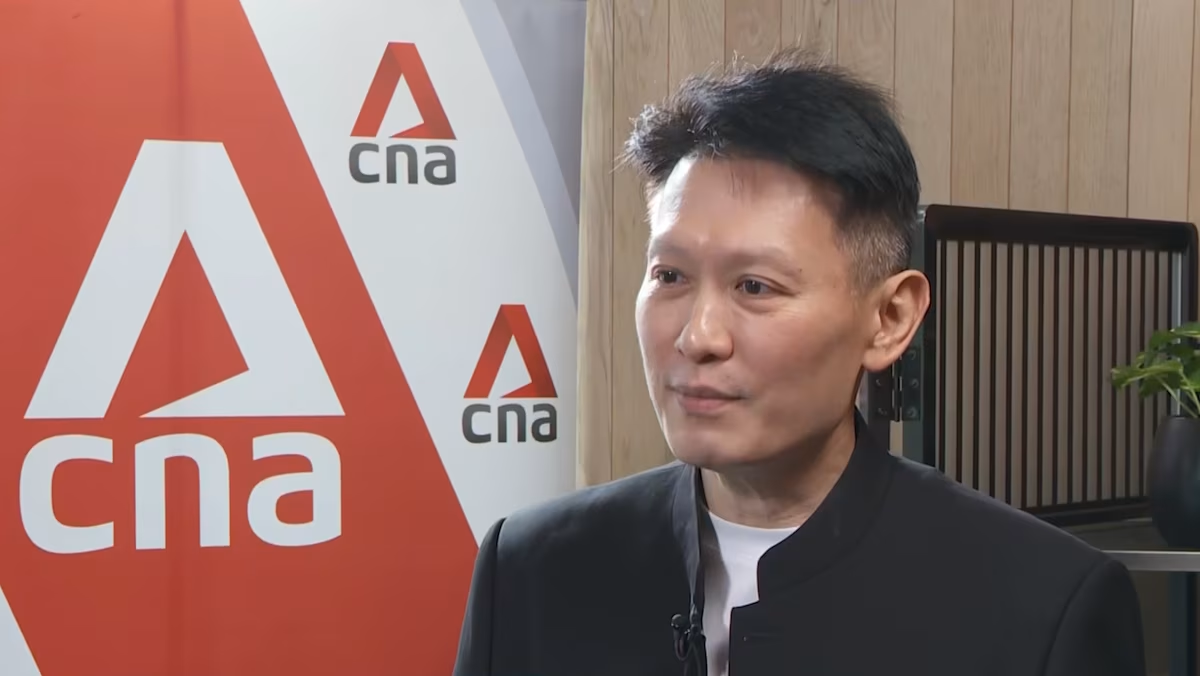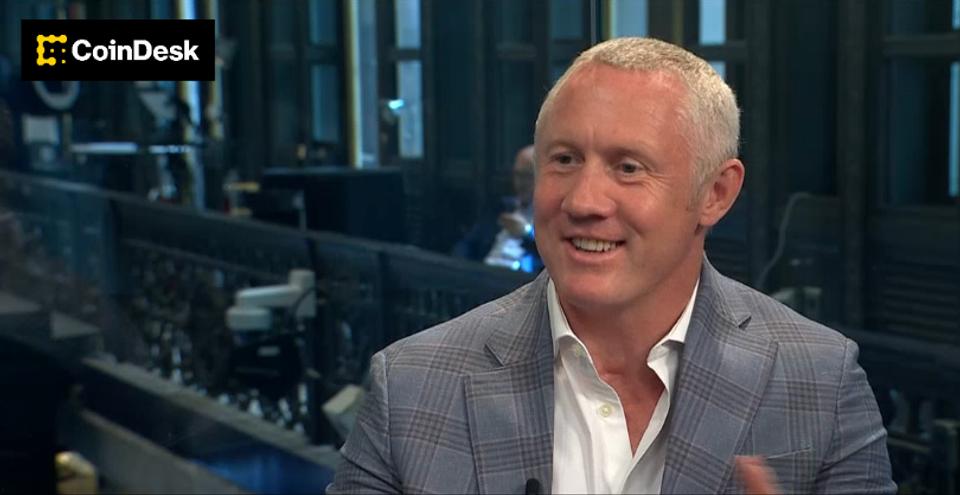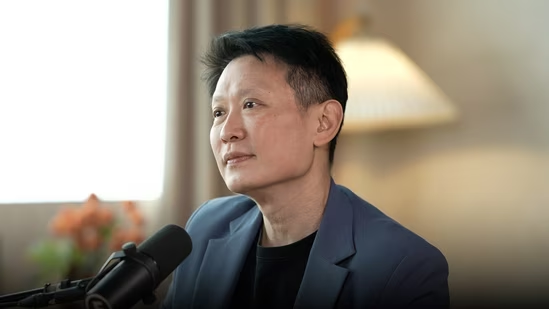
Crypto rarely gets discussed without someone bringing up prices. One day it's about a rally, the next it's about a correction. Somewhere in between, conversations about the technology itself often get drowned out by headlines tracking market movements.Binance Co-CEO Richard Teng. (Binance)That is what made Richard Teng's recent appearance on Raj Shamani's Figuring Out">Figuring Out podcast particularly interesting. The Binance">Binance co-chief executive officer spent much of the conversation discussing a bigger picture. His focus was on how blockchain could gradually reshape financial infrastructure, why access to financial services remains uneven across the world, and why education and regulation will ultimately matter just as much as innovation.Drawing on more than three decades in financial services and his experience as a former regulator, Teng spoke about the financial system through a wider lens. What if today's financial system were built from scratch?Teng explained that his own perspective changed as he spent more time understanding blockchain after first discovering it in 2017. The more he explored the technology, the more he began to see possibilities that extended well beyond digital assets themselves.As he put it, "If you rethink the future of financial services with the usage of blockchain and AI, the future of how a bank provider, a payment provider, and an exchange look will be totally different.”According to Teng, technologies such as blockchain and artificial intelligence (AI) offer opportunities to rethink some of these long-standing processes. He spoke about the possibility of financial systems operating around the clock, supporting instant settlement and improving capital efficiency in ways that existing infrastructure often struggles to achieve.Seen this way, blockchain becomes part of a much larger discussion. It is no longer only about a new category of technology but about how financial infrastructure itself could continue evolving as new tools become available. That broader vision also shapes Binance's own direction.Teng also described the company's ambition to develop a financial ‘super app’">financial ‘super app’ that goes beyond crypto. Alongside crypto-related offerings, he said Binance continues expanding access to products that include commodities, petrochemicals, precious metals, US stocks and pre-IPO opportunities as it works towards serving a wider range of users' financial needs. Please note that product availability varies by region.A problem finance has been trying to solveTechnology may evolve quickly, but one of the challenges Teng returned to throughout the conversation has existed for much longer. Financial inclusion.For decades, expanding access to financial services has been a priority across governments, regulators and financial institutions. Yet Teng pointed out that around 1.4 billion people globally still do not have access to proper banking or payment systems. In his view, one of the biggest reasons is straightforward: for many people, financial services remain too expensive or too difficult to access. Cross-border payments illustrate that challenge clearly.International transfers can take several days to reach their destination. At the same time, fees can reach six to seven percent, reducing the amount that eventually reaches families, businesses or loved ones.Teng suggested that reducing those inefficiencies could make a meaningful difference by allowing more value to remain with the people sending and receiving money rather than being absorbed by transaction costs.From that perspective, blockchain is increasingly being discussed as infrastructure that may help reduce some of those barriers. The conversation was less about replacing existing financial systems and more about exploring how technology could improve access where traditional processes continue to create friction.He also explained that Binance's long-term direction reflects a broader ambition to support users across a wider spectrum of financial services rather than remaining focused on a single category of products.Technology cannot replace judgementOne of the more practical parts of the discussion centred on scams. Teng made it clear that fraud is not unique to crypto. Every part of the financial system faces similar challenges, particularly as artificial intelligence gives scammers increasingly sophisticated tools.Technology may have changed how scams operate, but human behaviour often remains the biggest vulnerability. Many scams succeed because they create urgency. People are pressured into acting immediately, convinced something terrible will happen unless they respond, or persuaded to hand over information before taking the time to think. For Teng, that is precisely why education deserves as much attention as innovation.Rather than accepting information simply because it appears convincing, he encouraged people to question what they hear, verify information independently and understand the products they engage with before making financial decisions. His advice throughout the conversation remained remarkably simple: "Do your own research. It's actually really important."Although discussed in the context of crypto, the principle reflects a broader approach to making informed financial decisions. Understanding both the opportunities and the risks before making financial decisions remains important regardless of the asset or technology involved.Teng also encouraged newcomers to approach emerging technologies patiently. Instead of rushing into participation, he suggested building knowledge gradually, starting small and taking time to understand both the potential benefits and the potential pitfalls.Alongside individual responsibility, he highlighted Binance's AI-powered anti-fraud systems, which help users avoid billions in potential losses. At the same time, he stressed that technology alone cannot eliminate fraud entirely. Independent thinking and caution remain essential.Regulation and innovation are not opposing ideasFew people have experienced both sides of the regulatory conversation the way Richard Teng has. Before leading one of the world's largest crypto exchanges, he spent decades working as a regulator. That background shaped much of his thinking during the discussion.Rather than portraying regulation as something that slows innovation, Teng argued that the industry's long-term growth depends on getting regulation right. As he explained, "We want proper regulations. Our interests are aligned with users and aligned with regulators. We want a responsible ecosystem in place that's properly regulated for the benefit of everybody."His point was not simply that regulation is necessary, but that it should evolve alongside technology. In his view, regulation works best when it protects users without preventing innovation from developing responsibly. That philosophy also influences how Binance approaches compliance. Teng said the company has invested significantly in compliance and continues working with regulators across different jurisdictions as the regulatory landscape evolves.Transparency formed another important part of that discussion. He pointed to Binance's Proof of Reserves initiative as one example of measures intended to improve transparency and strengthen confidence within the ecosystem. Rather than treating compliance as a regulatory obligation alone, Teng suggested it should be viewed as part of building a more responsible environment for users over the long term.He also spoke about the importance of embracing new technologies instead of resisting them. In his view, bringing innovation into an appropriate regulatory framework creates better oversight than ignoring technological change altogether.A changing conversationThe discussion also touched on how perceptions of blockchain have gradually shifted within traditional finance. Teng acknowledged that scepticism has existed for years. At the same time, he observed that more established financial institutions, including BlackRock and JP Morgan, have increasingly begun engaging with blockchain technology as they have developed a deeper understanding of its potential. That shift, he suggested, reflects a broader change in how the technology is being viewed. Conversations are increasingly moving beyond initial scepticism towards exploring where blockchain can create meaningful value.For Teng, however, the technology itself is only one part of the equation. Speaking to entrepreneurs and future builders, he encouraged them to spend time understanding the technology landscape properly before building new solutions. More importantly, he urged them to focus on developing sustainable use cases capable of solving real-world problems and creating lasting value.That advice neatly brought together the different themes discussed throughout the podcast. The conversation explored financial infrastructure, financial inclusion, education, and smart regulation, with responsible innovation running throughout. Each topic pointed towards the same conclusion: technology may create new possibilities, but its long-term impact will depend on how responsibly it is developed, understood and adopted.In many ways, that may have been the most interesting takeaway from the discussion. Despite leading one of the world's largest crypto exchanges, Teng spent little time talking about markets. Instead, he spoke about infrastructure, accessibility, education, transparency and collaboration – areas that rarely dominate headlines but may ultimately play a much bigger role in determining how financial systems continue to evolve.Whether blockchain reaches that potential remains to be seen. But if the conversation on the podcast is any indication, the industry's focus is gradually broadening beyond price movements towards questions that may prove far more important over the long term: how financial systems can become more efficient, how more people can participate in them responsibly, and how innovation and regulation can progress together.Note to the Reader: Readers are advised that crypto products and NFTs are unregulated and involve significant risks. There may be no regulatory recourse for losses arising from such transactions.Hindustan Times/HTDS shall not, in any manner, be responsible or liable for the content of the article or advertisement, including the views, opinions, announcements, declarations, or affirmations expressed therein, and is absolved from any legal action or enforceable claims. This content is for informational and awareness purposes only and does not constitute financial advice.
Binance co-CEO on why infrastructure, education, and regulation matter in crypto
Binance Co-CEO Richard Teng discusses how blockchain, financial inclusion, responsible innovation and smart regulation could shape the future of finance.
1,494 words~7 min read