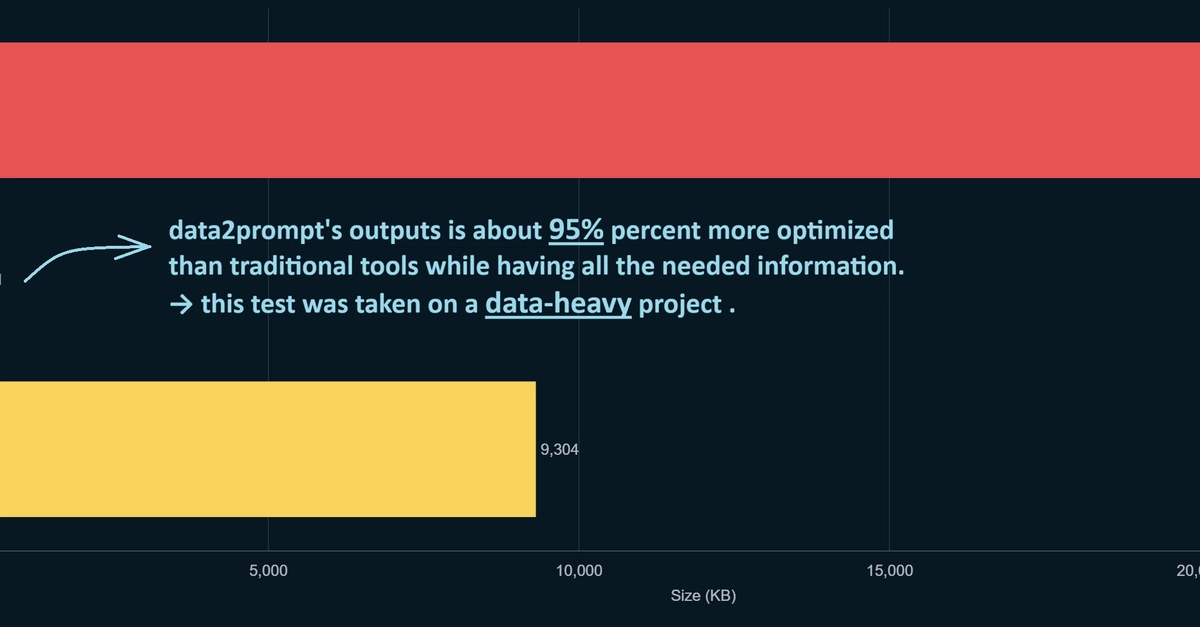
I've been building data2prompt for a few months now. It takes a data-heavy project (CSVs, SQL dumps, notebooks, Excel files) and turns it into a single file an LLM can read, instead of the model choking on raw 200MB CSVs or a generic repo-packager just skipping them. This week I shipped v0.5.0, and the real work in that release wasn't a new parser or a flag. It was a document I wrote called docs/output-contract.md, and writing it forced me to think about a failure mode I'd been quietly ignoring for months.
Here's the problem. To fit a large table into a context window, data2prompt samples it, say, 15 random rows out of 1.2 million. That's necessary and fine. But once you hand that sample to an LLM without being extremely explicit about what it's looking at, the model will happily treat 15 rows as the dataset. It'll compute an "average" from them. It'll describe a "trend." It'll answer "how many customers churned" using a number that only exists because of your random seed. The sample doesn't just lose information, it actively invites the model to hallucinate as if it had everything.
That's the actual design problem behind data2prompt: the output isn't documentation for a person, it's an input for a model, and models fail differently than people do. A person skimming a CSV preview instinctively knows it's a preview. A model doesn't have that instinct unless you build it in.