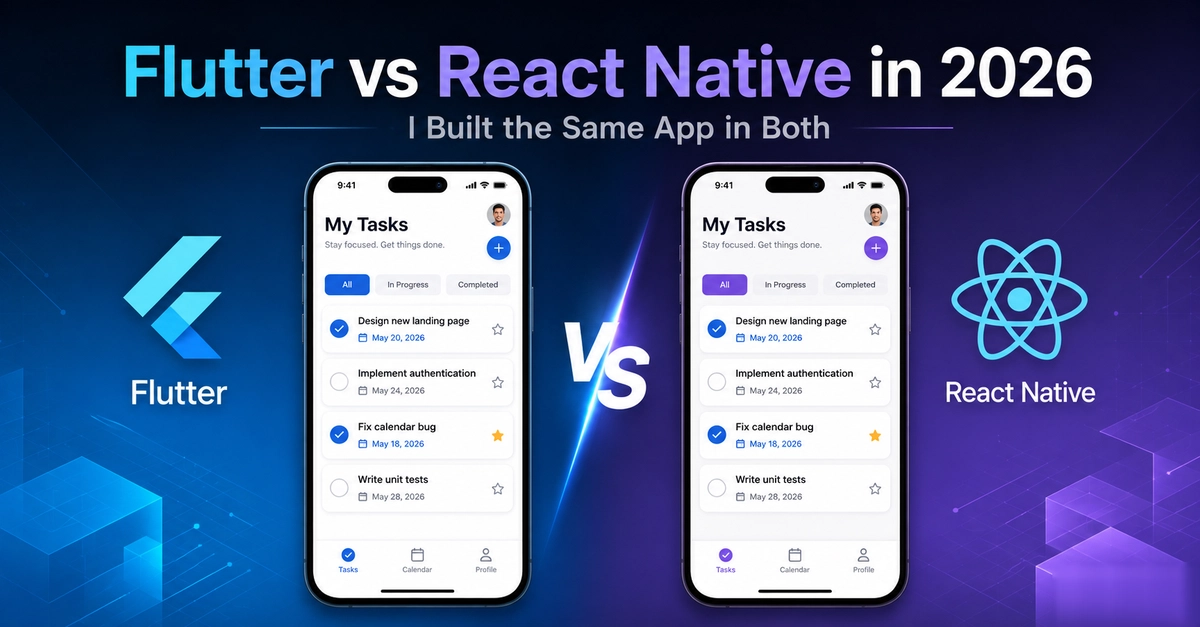
Both React Native and Flutter let you build iOS and Android apps from one codebase, and both are mature enough to power apps used by millions. The choice rarely comes down to raw capability — either can build almost any app you'd want. It comes down to your team, your ecosystem, and how each framework renders the UI. After shipping production apps in both, here's the honest comparison, without the framework tribalism.
The core technical difference
The frameworks take opposite approaches to drawing the screen, and almost every other trade-off flows from this one decision:
React Native renders using the platform's real native UI components. Your JavaScript describes the UI, and the new architecture (JSI and Fabric, replacing the old asynchronous bridge) maps it to native widgets. Apps feel native because they are native components — a switch, a scroll view, a date picker is the real one the OS provides.
Flutter ships its own rendering engine (Impeller, which replaced Skia as the default) and draws every pixel itself onto a canvas. It doesn't use native widgets — it paints its own. This gives pixel-perfect consistency across platforms but means the UI is Flutter's, not the OS's.