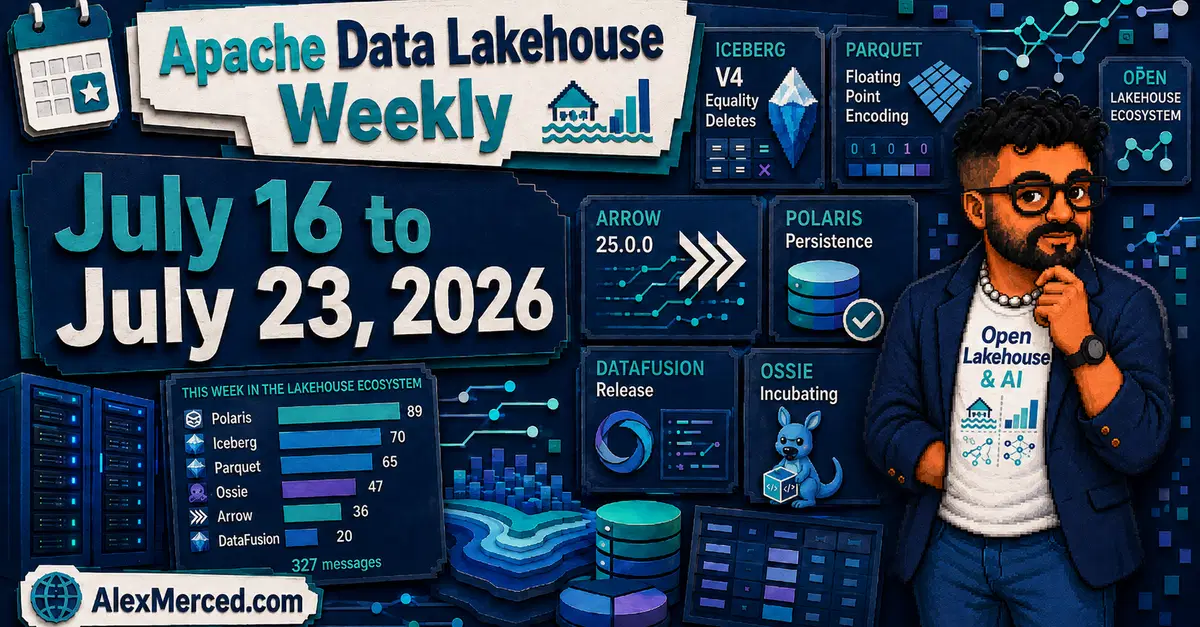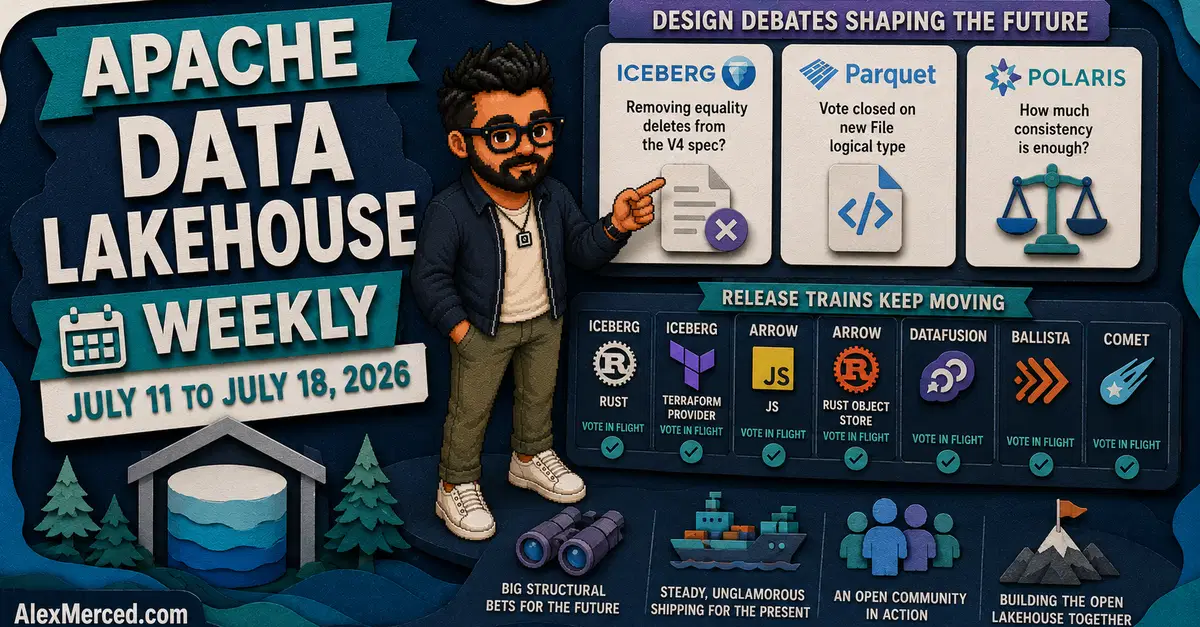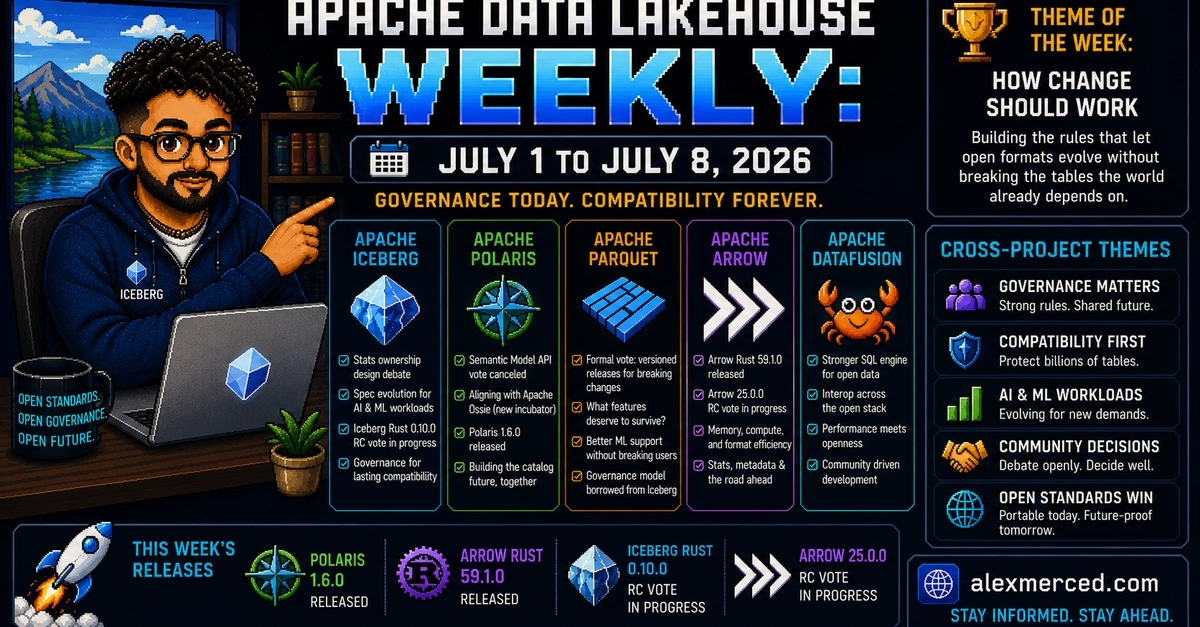
The lakehouse community spent this week deciding how change itself should work. Apache Parquet opened a formal vote to adopt versioned releases for breaking changes, borrowing a governance model that Iceberg refined over years. Apache Polaris canceled a vote on its semantic model API so it can align with Apache Ossie, the freshly incubating semantics project that opened its dev list this week. And across Iceberg, Arrow, and Parquet, contributors debated who owns statistics, which format features deserve to survive, and how far the specs should bend to serve AI and machine learning workloads. The connective tissue this week is governance. These communities are building the rules for evolving open formats without breaking the millions of tables that already depend on them. That work is invisible when it goes well, which is exactly why it deserves a close read while it happens. Releases also kept pace with the design debates: Polaris shipped 1.6.0, Arrow Rust shipped 59.1.0, and both Iceberg Rust 0.10.0 and Arrow 25.0.0 entered their final voting rounds.
Apache Iceberg
The Rust implementation dominated release activity this week, and the path was not smooth. For readers who mostly touch Iceberg through Spark or a query engine, iceberg-rust deserves a moment of framing. The Java implementation remains the reference, but the Rust library has become the foundation for a second generation of tooling: pyiceberg-core binds it into Python, DataFusion integrates it for query processing, and a wave of lightweight services use it to read and write tables without a JVM. When this library ships a bug, the blast radius crosses language ecosystems, which explains the ceremony you are about to read. Danny Jones and Shawn Chang opened the vote for Iceberg Rust 0.10.0 RC2 on July 1, drawing verification from L. C. Hsieh, Matt Butrovich, Neelesh Salian, Renjie Liu, and Xin Huang across a twelve message thread. Issues surfaced during verification, and by July 8 Jones was back with a vote on RC3. The willingness to cut a third candidate rather than wave through a flawed second one says something about how seriously the Rust community takes its release checklist, which covers everything from ASF license headers to a clean build of the pyiceberg-core bindings. The Rust library now sits underneath a growing stack of Python and query engine integrations, so the caution pays forward.