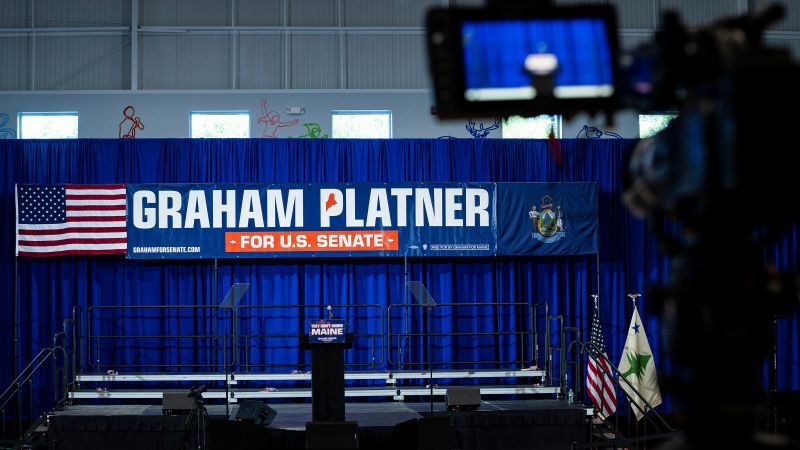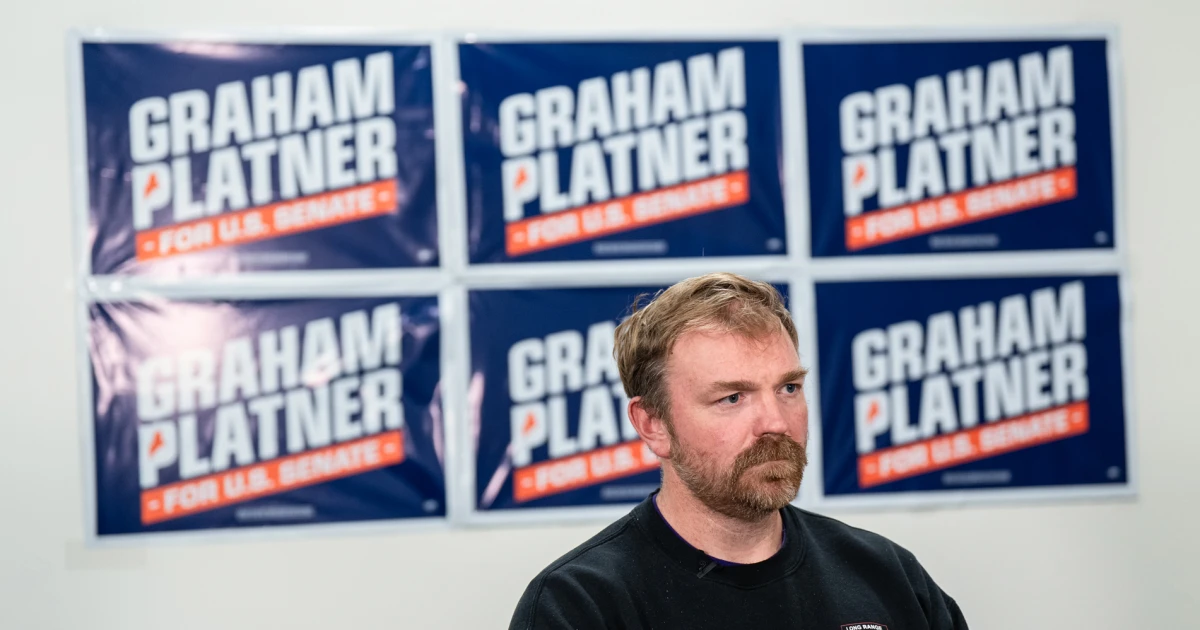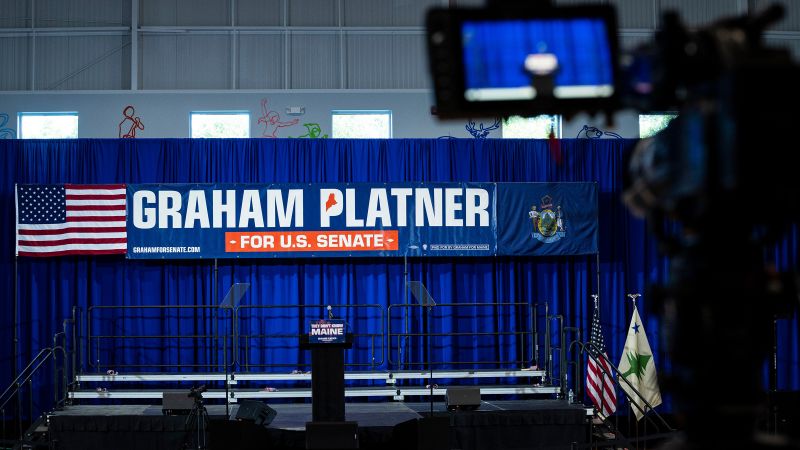
Platner alluded to reassessing the campaign in a decision that could come as early as the afternoon of Wednesday, July 8.Show Caption
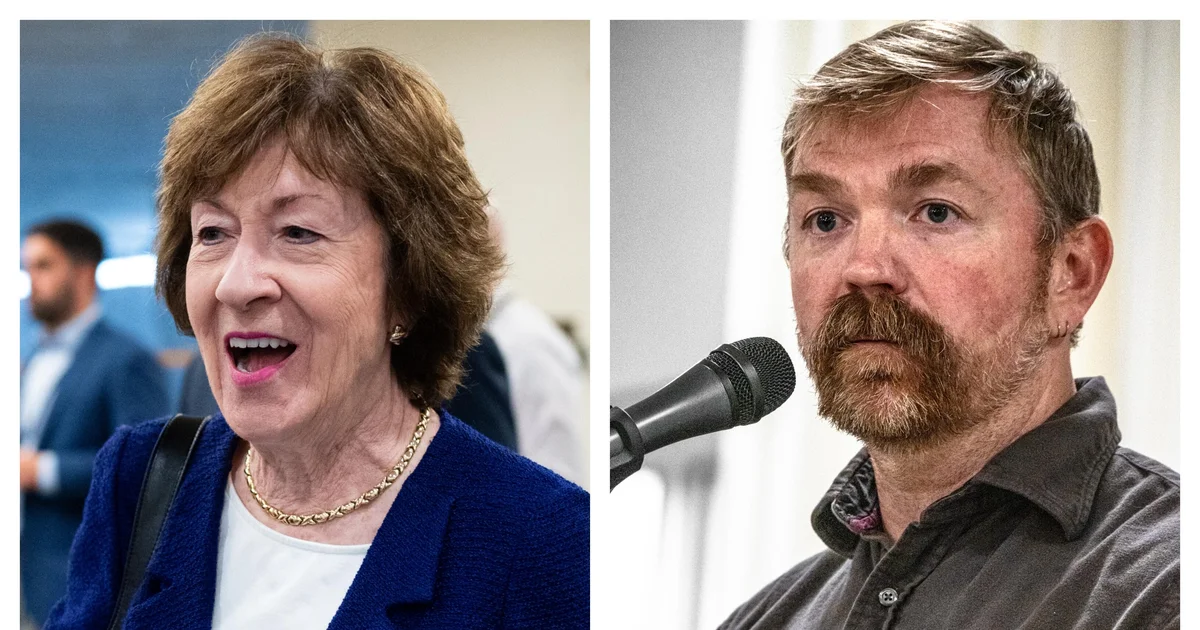
Democrats are racing for the reset button in the pivotal U.S. Senate battle in Maine, where progressive Graham Platner is once again engulfed in controversy in his bid to unseat Republican incumbent Susan Collins this fall.The 41-year-old oyster farmer and retired Marine faces a broad chorus of calls from fellow Democrats for him to exit the race, following a new allegation that he sexually assaulted an ex-girlfriend almost five years ago. Platner has denied the accusation, saying any claims about "non-consensual behavior" are "categorically untrue."But he alluded to reassessing the campaign in a decision that could come as early as the afternoon of Wednesday, July 8.That hasn't stopped the finger-pointing among Democratic factions as they scramble to find a new nominee in a short window to replace him by the end of business on July 13.The urgency by Maine Democrats and others, experts and operatives say, reflects the political reality of how difficult it will be for the party to retake the U.S. Senate this year. Many who spoke with USA TODAY said the quest becomes an almost impossible task if the Pine Tree State remains in GOP hands."This Maine Senate seat was the top of the list that Democrats had when they were looking at red seats that they should be able to flip," said Kate DeGruyter, a spokeswoman for Third Way, a centrist Democratic think tank."Getting a candidate who can win there is an absolute priority for the Democratic Party," she added. "It is a massive problem for Democrats because the evidence has been there all along that Platner had enormous liabilities and character flaws that were bound to be weaponized and make it impossible to flip that Senate seat."'Elongated train wreck' could spell doom for Senate Democrats in 2026Republicans hold a 53-47 majority in the Senate, meaning Democrats would have to flip at least four seats to take control, given that GOP Vice President JD Vance holds the tie-breaking vote.Speaking with USA TODAY earlier this year, Senate Minority Leader Chuck Schumer, D-New York, made clear that Maine — along with Alaska, Ohio and North Carolina — was a vital patch in completing that midterm quilt."We have to keep our Democratic states. We're doing a good job of that, and we have to win the four battleground states," Schumer said in a one-on-one interview with USA TODAY in January. "I believe we will win Maine."Collins, a more centrist Republican, is a five-term incumbent who has survived forecasted "blue wave" elections in the past. In 2020, she defeated Maine House Speaker Sara Gideon, the candidate Schumer handpicked, by about 8 percentage points. That same year, President Donald Trump lost the state by roughly 7 percentage points.Despite Collins's formidable reputation, Democrats note that she is the only Senate GOP incumbent seeking reelection in a state former Vice President Kamala Harris carried in the 2024 presidential race.Maine is rated as a competitive election within reach for Democrats by political forecasters, but that could quickly change if scandal-plagued Platner remains in the race. The nonpartisan Cook Political Report, for instance, said it would shift its prediction from "toss-up" to "lean" Republican if he remains beyond next week's deadline.David McCuan, a political science professor at Sonoma State University in California, said that will put more pressure on the three other states identified as mandatory flips, such as North Carolina, which Trump won by about 3 percentage points.Polls show former Democratic Gov. Roy Cooper with a strong lead in the Tar Heel State over former Republican National Committee Chair Mike Whatley. But a change in Maine's forecast will make it essential for Democrats to win while also putting a spotlight on more conservative-leaning states with competitive elections, such as Iowa and Texas, where Trump easily won."This whole episode and elongated train wreck may have put the Senate out of reach for the Dems this cycle," McCuan said. "It is that consequential." J. Miles Coleman is an associate editor of Sabato's Crystal Ball, a nonpartisan election forecast newsletter at the University of Virginia’s Center for Politics, which also has the Maine race rated as a "toss-up" in its predictions.He noted that before the latest scandal dropped, when Platner was winning by a tiny bit in the polls, it was "quite startling.""Maybe Platner would've been able to get the job done, as Maine was a must-win state for Democrats," Coleman said, but now he's more of a liability. "Now I’m sure they’re probably thinking that it is more of a risk than it needs to be."Democrats' unresolved squabble over how far to center or left to runMonths before Platner's controversies ripped open the Maine election, the animosity between the party establishment and progressive base had been brewing.Schumer's 2026 recruitment class had selected Maine Gov. Janet Mills over Platner, a political newcomer backed by Sen. Bernie Sanders of Vermont, and a constellation of progressive groups and lawmakers.That primary became one of the loudest examples of an ongoing party divide marked by the base's growing frustration with Democratic leaders, particularly in Washington. In multiple elections, that dissatisfaction fueled the rise of several younger, more progressive candidates or contenders aligned with democratic socialists since Trump returned to power."Fundamentally, the Democratic Party has an unresolved direction — a future sense of the party and where it heads still — as a hangover from losing the presidential election in November 2024," McCuan said. "As a result, there is this unresolved family conflict of how far left, how far to the middle – and when (regarding the timing) with voters."Chief among those bolder candidates is Platner, whose working-class everyman image, support for policy prescriptions, such as Medicare for All, and vow to oppose Schumer's continued leadership were highlighted in progressive groups' endorsements.Adam Green, co-Founder of Progressive Change Campaign Committee, or PCCC, which supported Platner until recently, described the Senate's Democratic leader in a January statement to USA TODAY as a "creature of the system voters despise." He added that Schumer was "not equipped to recognize the shake-up-the-system" candidates the voters wanted to elect.The blue deluge within the party swept more moderate Democrat Mills from the race in April before the first ballot was cast, but now centrist figures of her ilk cast blame on progressives for failing to heed Platner's problems.Reports had begun to surface as early as October 2025 about the political newcomer's controversial posts on Reddit forums, and later about a tattoo he had that is widely regarded as a Nazi symbol.Those concerns escalated in May when The Wall Street Journal reported that Platner’s wife told campaign aides that he had sent sexually explicit texts to several women early in their marriage. A month later, The New York Times reported that three of Platner's former girlfriends alleged "toxic" or volatile behavior during those relationships."Dating back to the early days of this campaign, the vetting that we expect to ensure that we have a candidate who meets the public's expectations — not just in terms of their policy and their experience — but in their character and in their leadership is an essential part of having the right kind of talent and leadership to meet this moment, and this was a catastrophic failure of the left," said DeGruyter, from the centrist Democratic think tank.Will Dems opt for transparency in a pivotal moment?Before the latest scandal dropped, a New York Times/Siena poll released June 29 showed the multiple controversies were beginning to erode Platner's base.The survey found about 28% of his supporters admitted that those scandals mean they "cannot support" his Senate campaign. Another 24% said it makes them question whether they could back him.Despite the intense and continuous national and state Democratic Party pleas for Platner to step aside, he might not be so willing to do so, Coleman said.With Maine being a state that "likes to do its own thing," Coleman said Platner could still try to tap into voters' unpredictability. Coleman cites Collins, Platner’s opponent, as the resilient Republican who doesn’t always toe the party line, keeping her constituency more in mind in her decision-making.If Platner bows out and the Democrats put forth a new Senate nominee that turns off the progressive base, Coleman said that could change the tide of the general election, too.As the clock continues to tick toward a pivotal moment for Platner's candidacy, former progressive allies and the state Democratic Party are fighting over the potential nomination process to replace him.In a July 7 video posted on social media, Devon Murphy-Anderson, the state Democratic Party's executive director, accused the Platner campaign of trying to "put their thumb on the scale" in selecting a new nominee."We have repeatedly reiterated to Graham Platner's team that they have no role in determining our U.S. Senate nominee, nor in determining what this process looks like," she said.The Platner campaign said in a statement it contacted the state party to "try and understand what this process would look like," but denied that he is trying to influence the outcome. Former allies are also pushing back against the state party's assertion, arguing that it is creating more problems as it considers a range of options from a caucus to a pop-up convention.Green with the PCCC said in an interview this week with CBS that "everybody wants" Platner out of this race, but slammed the "incompetence and arrogance" of the state party, which he said is launching a "secret plan to choose a nominee" that it is withholding until the current nominee drops out."There are many people who can beat Susan Collins," Green said. "First and foremost, there should be a fair process that is seen as legitimate by the entirety of Maine Democrats, so that there is full support for the eventual nominee – not a creeping sense that the Democratic Party insiders chose someone."Given how Platner has been campaigning, experts say there’s a slight chance he might stay in the race, believing the controversies might die down in the coming weeks."That’s really one of the conundrums. He’s the Democratic nominee with more than 70% of the primary vote, and by the time they had it, he didn’t have much opposition," Coleman said. "The ball is still entirely in his court, until he decides it isn’t."