Disclosure: Bun was acquired by Anthropic in December 2025. I and others on the Bun team work at Anthropic. I used a pre-release version of Claude Fable 5 for much of the Rust rewrite.Bun started as a line-for-line port of esbuild's JavaScript & TypeScript transpiler from Go to Zig. I wrote my first line of Zig on April 16, 2021. I bet on Zig after seeing the single-page Zig Language Reference on Hacker News and getting really excited about the low-level control and care for performance.From the start, Bun's scope was massive:JavaScript, TypeScript, and CSS transpiler, minifier, and bundlernpm-compatible package managerJest-like test runnerNode.js & TypeScript-compatible module resolutionHTTP/1.1 & WebSocket clientNode.js API implementations like fs, net, tls, and dozens of other modulesThe initial version of Bun was written by me in 1 year, in a cramped Oakland apartment, pre-LLM, in Zig. The default outcome for ambitiously-scoped projects like Bun is joining the graveyard of dead side projects on a GitHub profile page. Zig made Bun possible. I would never have been able to build this much in 1 year if it wasn't for Zig.Nowadays, Bun's CLI gets over 22 million monthly downloads. Popular tools like Claude Code and OpenCode bet on Bun as their runtime. Vercel, Railway, DigitalOcean and more have 1st-party support for Bun.Bun's scope has also been a challenge for stability. Here's a small sample of bugs we fixed in Bun v1.3.14:heap-use-after-free crash in node:zlib when calling .reset() on a zlib, Brotli, or Zstd stream while an async .write() is still in progress on the threadpooluse-after-free crash in node:zlib when an onerror callback issued a re-entrant write() followed by close() on native handlesuse-after-free crashes in node:http2 when re-entrant JS callbacks (e.g. session.request() inside a timeout listener, an options getter, or a write callback) triggered a hashmap rehash, invalidating internal stream pointersuse-after-free in UDPSocket.send() and sendMany() where user code in valueOf() or toString() callbacks could detach an ArrayBuffer between payload capture and the actual sendcrash and out-of-bounds read in Buffer#copy and Buffer#fill when a valueOf callback detaches or resizes the underlying ArrayBuffer during argument coercionheap out-of-bounds write in UDPSocket.sendMany() when the socket's connection state changed mid-iteration via user JS callbacksmemory leak in crypto.scrypt where the callback and protected password/salt buffers were never released when the output buffer allocation failedSSLWrapper.init leaked the strdup'd passphrase on error pathsmemory leak in tlsSocket.setSession() where each call leaked one SSL_SESSION (~6.5 KB per call) due to a missing SSL_SESSION_free after d2i_SSL_SESSIONmemory leak where fs.watch() watchers were never garbage collected after .close(), caused by a reference count underflow that permanently pinned each watcher as a GC rootdouble-free crash in the CSS parser when background-clip had vendor prefixes and multi-layer backgroundsDuplexUpgradeContext was never freed — a full leak per tls.connect({ socket: duplex })race condition crash in MessageEvent where the GC marker thread could observe a torn variant in m_data during concurrent access from a BroadcastChannel or MessagePortWe could have kept fixing these kinds of bugs one-off in perpetuity, but we owe it to our users counting on us to do better than that, and systematically prevent these kinds of bugs from recurring.What we were already doingWe patched the Zig compiler to add Address Sanitizer support. We run our test suite with ASAN on every commit.We ship Zig safety-checked ReleaseSafe builds on WindowsWe fuzz Bun's runtime APIs 24/7 using Fuzzilli, the JavaScript engine fuzzer used by V8 & JavaScriptCoreWe have a whole lot of end-to-end memory leak testsThis is more than many projects do.Just be really smart and don't make mistakes?Our bugfix list felt bad and I was tired of going to sleep worrying about crashes in Bun. I don't blame Zig for that - other users of Zig don't have the bugs we had, and mixing GC with manually-managed memory is an uncommon enough thing for software to need that no language really designs for it. We wouldn't have gotten this far if not for Zig, and I'll always be grateful. Until very recently, programming language choice was a one-way decision for a project like Bun.JavaScript is a garbage-collected language and modern JavaScript engines like JavaScriptCore (and V8) have strict rules around exception handling and the garbage collector. Zig, like C, doesn't manage memory for you and this is a tradeoff that for many projects is a great reason to use Zig. Zig does not have constructors/destructors, and most cleanup is expected to be written out explicitly at each call site with defer.For Bun, correctly handling the lifetimes of garbage-collected values and manually-managed values has been a major source of stability issues - most often small memory leaks and occasionally, crashes. Every memory allocation has to be meticulously reviewed. Where do these bytes get freed? How do we ensure it only gets freed once? Did we check for JavaScript exceptions properly? Is this garbage-collected pointer visible to the conservative stack scanner? Is this garbage collected memory or manually managed memory?For stability issues, knowing as early as possible is best. Fuzzing happens after code is merged. CI happens when code is pushed. Runtime safety checks & address sanitizer happens when code is run (hopefully in development, before CI).One common way to reduce this class of issue is to ensure cleanup code is always run exactly once for code that needs it. Zig is designed to be a simple language with no hidden control flow, and so it prefers the explicit defer keyword to run code at the end of a scope over C++'s implicit ~Destructor or Rust's implicit Drop.LanguageCleanupZigdefer, errdeferC++~Destructor, &&MoveRustDropFor Zig code, when exactly should we be running the cleanup code? If we're passing the same *T to many different functions, how do we know when it's no longer accessible and can be cleaned up? How does it work when some functions need to continue to reference the memory after the function is called? Our current approach is a mix of:arena lifetimes, where the scope of when it's accessible is clear (parser state doesn't escape the calling function and so AST nodes are a good choice there)reference-countingpay really close attentionMany projects opt to answer these kinds of questions through a style guide. TigerBeetle's TigerStyle is an example in Zig and Google's 31,000 word C++ style guide is another. The challenge with style guides is enforcement. How do you make sure the style guide is followed? Historically, code review was the answer with best-effort enforcement via linters & static analyzers.Having a rigid style guide with clear ownership expectations explicitly spelled out in the type system was a real option for Bun. Since Zig has no operator overloading, we would likely end up with a lot of code looking something like this:fn foo(a_ptr: SharedPtr(TCPSocket)) !void {
Other newsrooms on this story
· 5 sources
the-decoder.com·
Bun ditches Zig for Rust with help from Claude Fable 5, writes over a million lines of code in 11 days

dev.to·
What Bun’s Rust Rewrite Tells Us About Rebuilding the AI Infrastructure Layer in C#
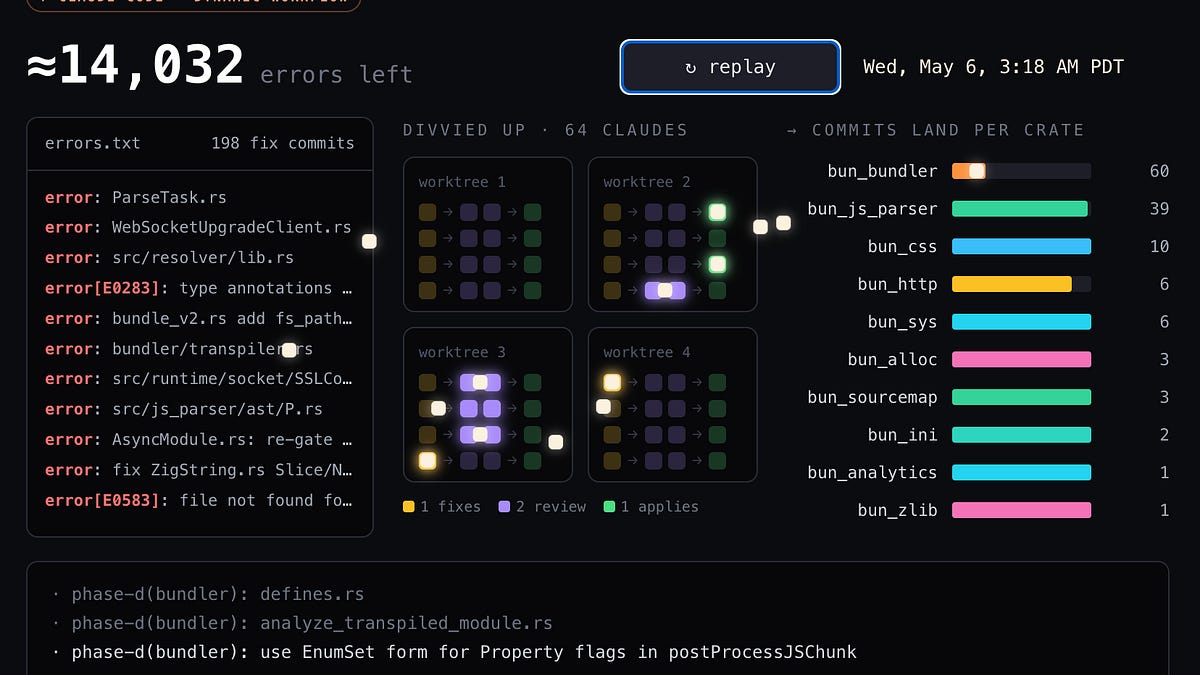
newsletter.pragmaticengineer.com·
The Pulse: What can we learn from Bun’s rapid Rust rewrite with AI?
Rebuilding my C Redis clone in Rust taught me more Rust than any tutorial
Bun v1.3.14: The Update That Brings Speed and Power to the Table