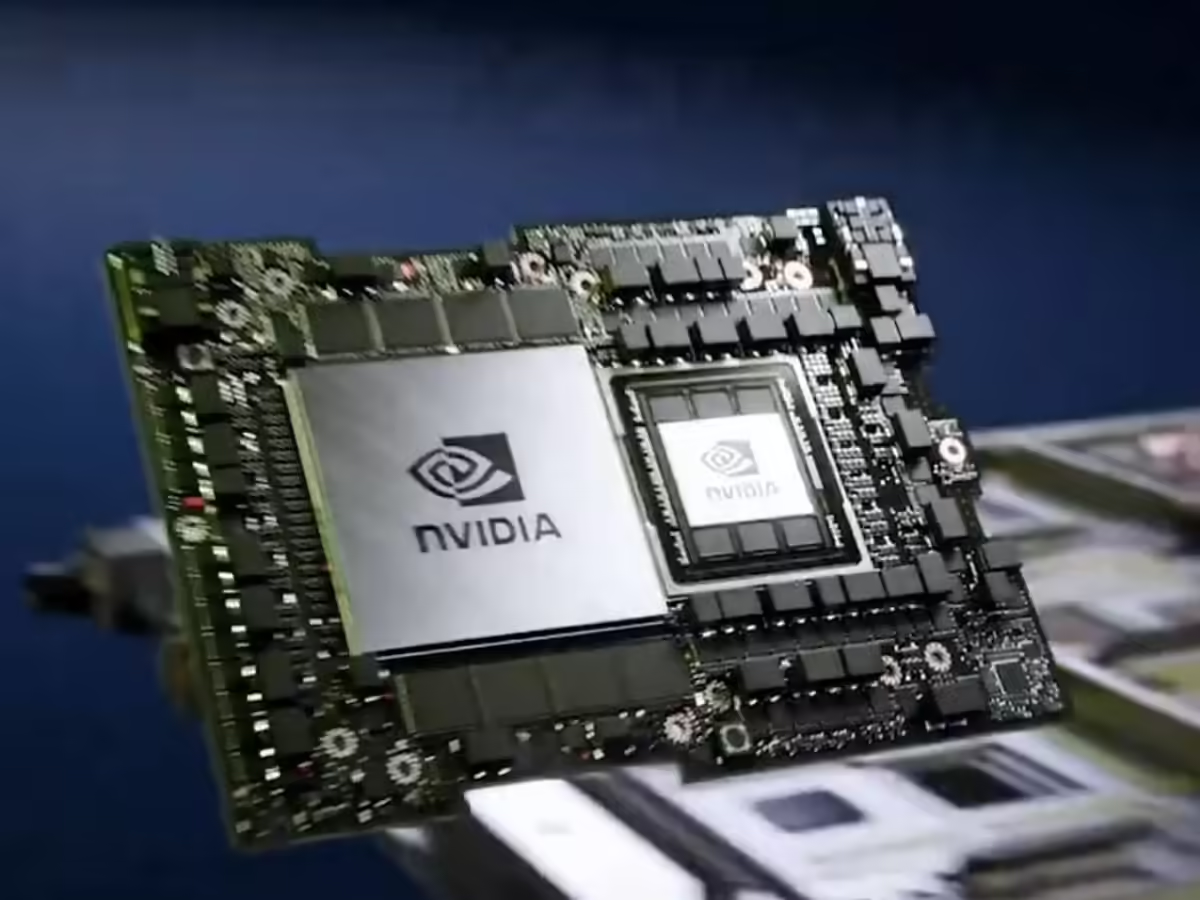
Nearly every major AI company is either making or considering making homegrown chips to reduce their reliance on Nvidia and cut costs. Yes, but: Designing a chip is one thing. Securing the manufacturing capacity, memory and packaging needed to produce it at scale is much harder.Driving the news: China's DeepSeek is the latest company reportedly working on its own AI chips, per Reuters.Microsoft, Google, Amazon and Meta all have custom-chip efforts, while OpenAI recently unveiled its first custom inference chip with Broadcom. Anthropic is said to be in talks with Samsung on its own chip, too.Apple already makes its own chips for phones, tablets and Macs and is reported by Bloomberg to be developing separate chips for AI servers.Zoom in: Custom chips lower costs and help companies diversify their supply chains."I want something in my pocket when I'm sitting across the table from Jensen negotiating," Stacy Rasgon, analyst at Bernstein, told Axios, referring to Nvidia CEO Jensen Huang. Custom chips can also be tailored to specific workloads, potentially making them more efficient and less expensive to operate.Zoom out: Designing chips is just the first step, and AI has made this easier. But turning design into a physical product requires access to a semiconductor supply chain that is already stretched thin.TSMC handles the majority of cutting-edge chip manufacturing, and while it is investing tens of billions of dollars to expand capacity, executives have repeatedly said demand outpaces supply.Samsung makes leading-edge chips for itself and others. Intel is also aiming to be a so-called foundry, but its manufacturing processes have lagged in recent years. Those factories also depend on lithography machines from Dutch company ASML, which is the only company that makes the most advanced tools needed to manufacture AI chips.Between the lines: Everyone is rushing to make chips while the supply chain needed to service that demand is limited, and shortages abound. Companies trying to reduce their reliance on Nvidia are still competing for many of the same scarce resources: leading-edge foundry capacity, advanced packaging, high-bandwidth memory and lithography equipment.And the process moves slowly. "If you're just starting to design a chip right now, you won't see silicon for three years," Rasgon said.Even companies developing custom chips continue buying Nvidia GPUs for many workloads because Nvidia's hardware, networking and software ecosystem remain difficult to replicate.The big picture: The rush to develop custom chips reflects a widespread belief that demand for AI computing will continue rising rapidly.Nvidia suggested it would do $1 trillion in cumulative revenue from 2025-2027. If a competitor gets to tap into a small percentage of that pie, "it could still be tens of billions of dollars," Rasgon said. A rising tide of demand can also lift all boats: Most of the companies working on their own chips still use Nvidia GPUs too, in part because the total cost of ownership can still be lower when using Nvidia chips given how powerful they are.The bottom line: Building a custom AI chip can reduce dependence on Nvidia. It doesn't reduce dependence on the handful of companies capable of manufacturing the world's most advanced semiconductors.
The AI chip rush is crowding the same narrow pipeline
Designing a chip is one thing. Securing the manufacturing capacity, memory and packaging needed to produce it at scale is much harder.
514 words~2 min read