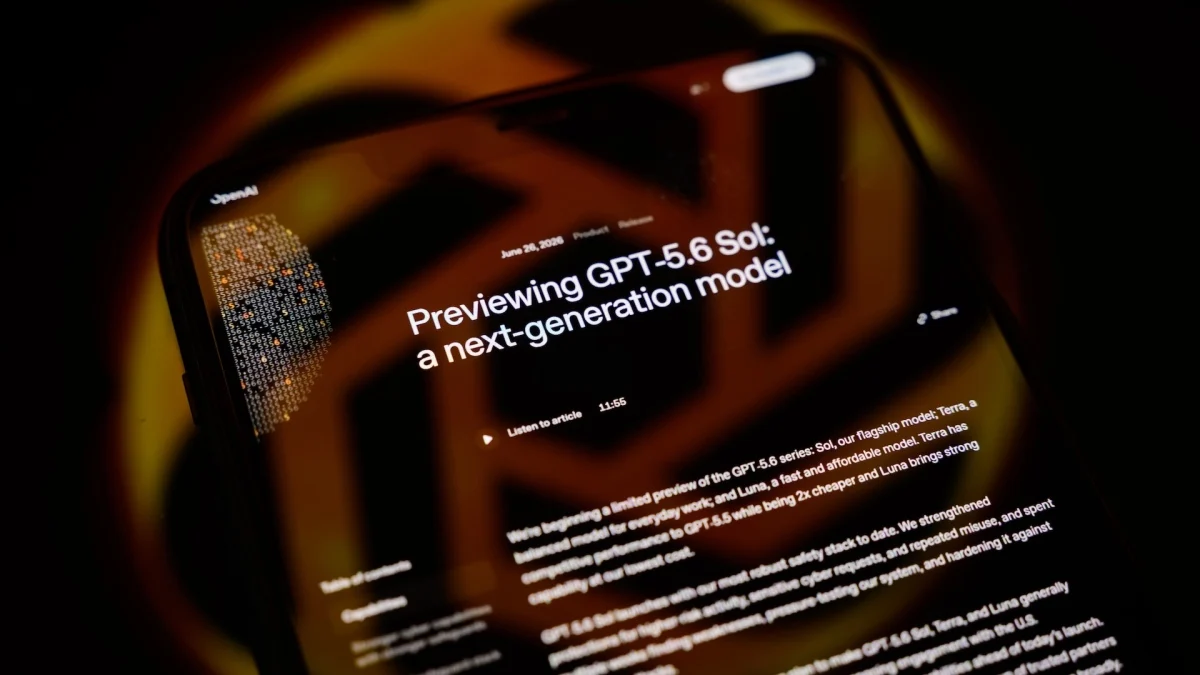
OpenAI is preparing to make GPT-5.6 more widely available this week after a delayed rollout requested by the US government over national security concerns.The company is expected to release its most advanced GPT-5.6 model, called Sol, alongside two lower-cost versions named Terra and Luna. Reuters reported that OpenAI said the models would launch on Thursday after the Trump administration approved a broader release following additional testing and meetings between the company and government officials.This is not a routine model update. The delay shows how the release of powerful AI systems is now moving into the same policy space as cybersecurity, export controls and national security. Governments are increasingly worried that advanced models could help users find software flaws faster than companies can fix them.For OpenAI, the launch is important for another reason. GPT-5.6 is being positioned as its most capable model family yet, with stronger reasoning, coding and cybersecurity performance. For users, developers and companies, the real question is simple: how quickly will they get access, what will it cost, and what will the new models actually do better?Why GPT-5.6 Was Restricted Before LaunchOpenAI had initially limited GPT-5.6 to a small group of vetted partners after the US government requested a delayed rollout. Reuters reported that the partners’ details were shared with authorities as part of the review process.The concern was not that GPT-5.6 is a chatbot with better writing skills. The issue was cybersecurity.Advanced AI models are becoming better at reading code, identifying bugs, finding weaknesses in software systems and suggesting fixes. That is useful for developers and cyber defenders. It can also be dangerous if the same capability is used by attackers looking for vulnerabilities to exploit.The Guardian reported earlier that OpenAI had said it was beginning with a limited preview at the government’s request before releasing the model more broadly. OpenAI also said it did not want this kind of government access process to become the long-term default for future model launches.That is the tension at the centre of the GPT-5.6 release. OpenAI wants to move fast and put new tools in the hands of users. Washington wants more time to understand whether powerful models could create security risks before they are opened more widely.How The US Government Cleared The Wider RolloutAccording to Reuters, Axios first reported that the Trump administration had approved a broad launch of GPT-5.6 after additional testing and discussions between OpenAI and US government officials. Reuters also said the White House and the US Department of Commerce did not respond to its request for comment outside regular business hours.The review sits within a wider shift in US AI policy. Reuters reported that President Donald Trump had signed an executive order creating a voluntary framework under which AI developers could provide “covered frontier models” to the US government for up to 30 days before releasing them to trusted partners.That framework matters because it gives the government a more formal path to examine frontier models before public release. It also creates a new launch pattern for AI companies: preview, restrict, test, then release.For developers and businesses, this means future model launches may not be as simple as a company announcing a model and switching it on globally the same day.What Are GPT-5.6 Sol, Terra And Luna?GPT-5.6 is being released as a family of models rather than a single model.GPT-5.6 Sol is the top-end version. It is meant for complex tasks such as advanced coding, research, long reasoning tasks and cybersecurity work.GPT-5.6 Terra is the middle option. The Economic Times reported that Terra is aimed at everyday work such as writing, document analysis, brainstorming and coding, and is expected to offer GPT-5.5-level performance at about half the cost.GPT-5.6 Luna is the fastest and cheapest version. It is designed for quick responses, summaries, routine conversations and lighter tasks where users may not need the most powerful model.This three-model strategy matters because OpenAI is trying to solve two problems at once. The company needs a flagship model that can compete at the top end of the AI market. It also needs cheaper models that developers can use at scale without costs spiralling.Why GPT-5.6 Matters For Coding And CybersecurityThe most sensitive part of the GPT-5.6 launch is its ability to work with software.OpenAI and other frontier AI companies are building models that can understand large codebases, spot errors, write patches and assist with security reviews. That can help companies find bugs before attackers do.The same skill set also creates risk.A model that can help a security engineer find a vulnerability can also help a malicious user understand where a system might break. This is why the US government’s review focused heavily on whether GPT-5.6 could be misused for cyber operations.The Guardian reported that OpenAI described GPT-5.6 Sol as its strongest model yet, but said it did not cross a “cyber critical threshold” under the company’s internal framework. OpenAI also said Sol was better at helping people find and fix vulnerabilities than reliably carrying out end-to-end attacks.That distinction is important. OpenAI is arguing that GPT-5.6 is useful for defensive security work, while its safeguards are designed to block harmful cyber requests.What This Has To Do With AnthropicOpenAI is not the only AI company facing this kind of scrutiny.Reuters reported that Anthropic had earlier disabled its advanced Mythos 5 and Fable 5 models after a US government export control order over national security concerns. The curbs were later lifted for Fable after Anthropic implemented safeguards, but Mythos remains available only to some trusted US organisations.That matters because it shows a pattern.The most advanced AI models are no longer being treated as ordinary software products. When they become strong enough at cybersecurity, scientific reasoning or autonomous tool use, governments may want to inspect how they work before they are released widely.For OpenAI and Anthropic, this creates a difficult balance. They need to show that their models are safe enough for public use, but also powerful enough to justify their high development costs and stay ahead of rivals.Why This Is A Big Moment For AI RegulationThe GPT-5.6 rollout shows how quickly AI policy is changing in the United States.Until recently, most AI release decisions were made by the companies themselves. They decided when a model was ready, who could access it and what safeguards were enough.That is changing.The US government is now taking a closer look at frontier AI models before launch, especially when those models show strong cyber capabilities. Reuters reported that Washington has increased scrutiny of advanced AI model releases over fears they could be misused by military or intelligence actors in countries such as China and Russia.China is also moving in a similar direction. Reuters reported that Chinese authorities have held meetings with leading technology companies about possibly restricting overseas access to China’s most advanced AI models.In simple terms, the AI race is becoming more geopolitical. The question is no longer only which company has the smartest model. It is also which country controls access to the most powerful models, who gets to use them, and under what conditions.What Will GPT-5.6 Cost?OpenAI has not released a full public pricing table in the reports reviewed here, but the model family is clearly being split by cost and capability.Terra is expected to be cheaper than GPT-5.5 while offering similar performance, according to The Economic Times. Luna is positioned as the lowest-cost and fastest model, while Sol remains the premium option for the hardest tasks.That matters for developers. AI costs can rise quickly when companies use models for customer support, code review, internal search, document processing and software agents. A cheaper model that performs well enough for daily work can be more useful than the strongest model if it brings down the cost of running AI products at scale.This is also where OpenAI is competing with Anthropic, Google, Meta and smaller AI providers. The next phase of the market will not be decided only by benchmark scores. It will also depend on price, speed, reliability and how easy the models are to use in real products.When Will ChatGPT And API Users Get Access?The rollout is expected to begin this week, but access may not arrive for everyone at the same time.The Economic Times reported that GPT-5.6 access will expand gradually across ChatGPT, Codex and OpenAI’s API from July 9.That means developers may see model options appear in stages. ChatGPT users may also get access depending on their subscription tier, region and OpenAI’s rollout schedule.The staggered approach is not unusual for major AI launches. Companies often release new models slowly to monitor safety, server load, usage patterns and early bugs before making them widely available.Why OpenAI’s Launch Strategy Has ChangedOpenAI is under pressure from two sides.On one side, users and developers want faster access to stronger models. The AI market moves quickly, and delays can help rivals gain attention.On the other side, governments are asking harder questions about what these models can do.That is why GPT-5.6 is launching in a very different environment from earlier ChatGPT updates. The model is being released not just as a product, but as part of a larger debate about who should control access to powerful AI systems.OpenAI has made clear that it does not want government-by-government approval to become the normal path for model releases. At the same time, the company has agreed to work with US officials to get GPT-5.6 into wider use after review.This is likely to become the new tension around frontier AI: faster innovation versus tighter oversight.What Comes NextThe wider GPT-5.6 rollout will be watched closely by developers, cyber experts, regulators and rival AI companies.If the launch goes smoothly, OpenAI will be able to argue that limited previews and safety checks can lead to broader access without long delays. If problems emerge, regulators may push for stricter rules before future models are released.The bigger question is whether this becomes the new normal.For users, GPT-5.6 may look like a faster and smarter ChatGPT upgrade. For the AI industry, it marks something larger: the beginning of a release cycle where frontier models may need government review before they reach the public.Frequently Asked QuestionsIs GPT-5.6 launching this week?Yes. Reuters reported that OpenAI will publicly launch GPT-5.6 on Thursday after the US government cleared a broader rollout.What are GPT-5.6 Sol, Terra and Luna?Sol is the most powerful model in the GPT-5.6 family, Terra is the mid-tier model aimed at everyday work, and Luna is the fastest and cheapest option for lighter tasks.Why was GPT-5.6 restricted before launch?The US government requested a delayed rollout because of national security concerns, especially around whether advanced AI models could help users find software vulnerabilities that might be misused.How did the US government approve the GPT-5.6 release?Reuters, citing Axios, reported that the Trump administration approved a broad launch after additional testing and meetings between OpenAI and government officials.Will ChatGPT users get GPT-5.6 immediately?Access is expected to roll out gradually across ChatGPT, Codex and the OpenAI API. Not every user may receive it at the same time.Did Anthropic face a similar restriction?Yes. Reuters reported that Anthropic had disabled Mythos 5 and Fable 5 after a US government export control order. Fable access was later restored after safeguards were added, while Mythos remains restricted to some trusted US organisations.Is GPT-5.6 mainly a coding model?No. GPT-5.6 is expected to improve reasoning, coding, document analysis, research and general productivity tasks. However, its coding and cybersecurity capabilities are the main reason it drew closer government scrutiny.Has OpenAI released full GPT-5.6 pricing?Full pricing was not available in the sources reviewed here. Reports say Terra is designed to be cheaper than GPT-5.5 while offering similar performance, while Luna is positioned as the fastest and lowest-cost model.end of article
OpenAI GPT-5.6 Launch Cleared After US Review: Why Sol, Terra And Luna Matter
OpenAI is set to launch GPT-5.6 publicly this week after the US government cleared a wider rollout following national security checks. The new model family includes GPT-5.6 Sol, Terra and Luna, aimed at different levels of performance, cost and speed. The delayed release shows how advanced AI launches are now being treated not just as product updates, but as national security decisions.
1,938 words~9 min read