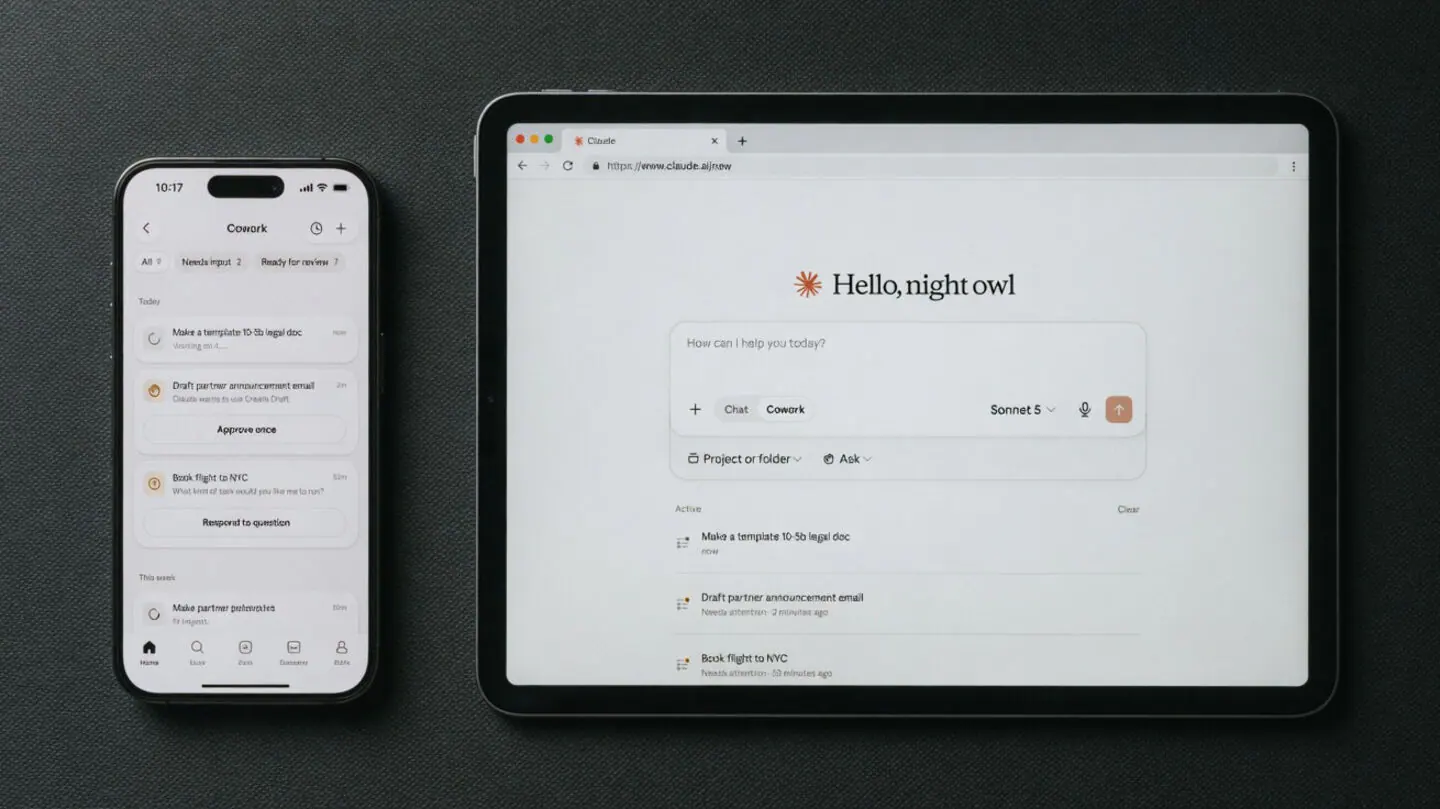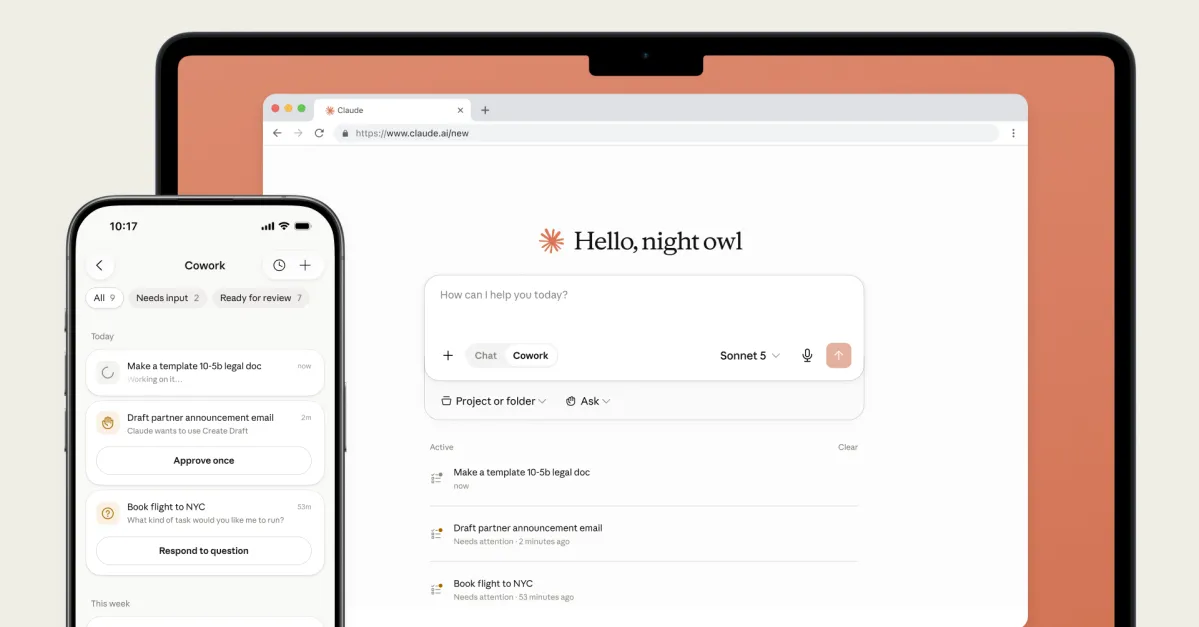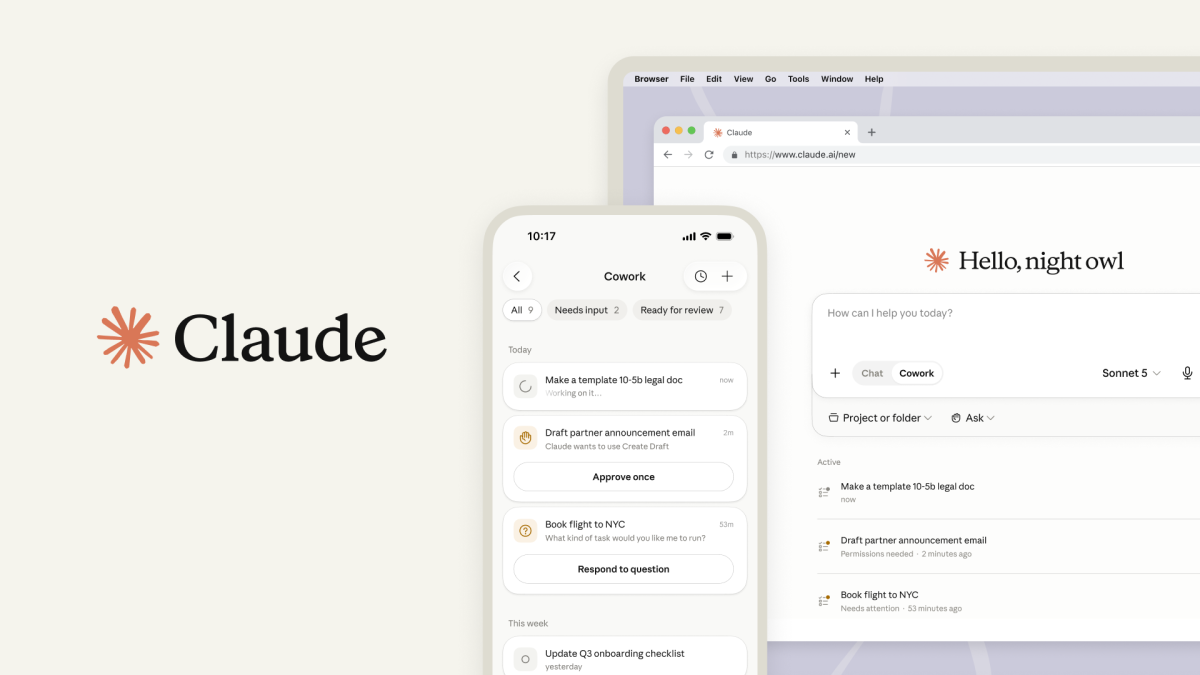
Anthropic has expanded Claude Cowork, its agentic tool for knowledge work, from a desktop-only application to web and mobile, while separately extending included access to Claude Fable 5, its most capable public model, from 7 July to 12 July before usage moves to paid credits. Both changes arrived within days of each other, alongside the launch of Claude Sonnet 5, in what several industry observers have called one of Anthropic's busiest stretches yet. Each change carries real weight on its own. Together, they sketch a company expanding its reach on one front while rationing capacity on another, and that tension is the real story.What Cowork Does NowCowork launched in January as a desktop application built on the same agentic architecture as Claude Code, minus the terminal. Instead of answering prompts one at a time, it takes on multi-step tasks: reconciling a spreadsheet, building a slide deck from call transcripts, turning a folder of contracts into a renewals tracker. A user describes an outcome and steps away; Claude returns with formatted documents, organised files, and synthesised research rather than a wall of text to copy out by hand.The expansion changes where that work can start and finish. Chat and Cowork now share a single home screen on web and desktop, so handing Claude a task begins from the same message box as an ordinary conversation. A session can start at a desk, continue after the laptop closes, and get picked up later from a phone. Scheduled tasks now run with every device offline: set a Monday morning briefing for six a.m., and Claude works through the relevant email threads and transcripts overnight, building the document and leaving a follow-up email drafted but unsent, ready to review over coffee. When Claude reaches a decision only a person can make, the question now reaches a phone instead of waiting inside a closed laptop.Editing works differently too. When Claude drafts a document, highlighting the section that needs work and clicking "Edit with Claude" lets a person type the change directly, and Claude edits that exact spot rather than needing the whole request re-explained from scratch. Anthropic frames the overall expansion as boldly going wherever the user already is, rather than asking the user to come find the work. It is a fitting description: a five-year mission built one platform expansion at a time, chat and Cowork merging into a single always-available crew member rather than two separate tools competing for the same message box.What Still Needs the Desktop AppThree capabilities remain desktop-exclusive, and the reason is architectural rather than arbitrary. Direct local file access, browser control through Claude in Chrome, and Computer Use, where Claude clicks, types, and navigates a screen directly, all reach into a user's own machine. A remote session running on Anthropic's servers depends entirely on the desktop app being open and connected to bridge the gap to a laptop's file system or installed browser. The web version, by contrast, opens Cowork to anyone working somewhere a desktop application is off-limits, a meaningful unlock inside companies where IT departments restrict what software employees can install. Mobile apps for iOS and Android add a sidebar entry point for checking status, approving a pending decision, or reading a finished deliverable from a phone.Every Cowork session still runs inside an isolated environment on Anthropic's own servers, separate from the user's computer and network, regardless of which surface started it. Shell commands and code Claude writes execute inside that sandbox. Isolation protects the local machine, while the folders and tools a user has explicitly connected remain the outer boundary of what Claude can read or touch. Permission settings work the same way they do in ordinary chat, and enterprise admins get separate controls to manage feature access and spend across an organisation.Who Is Using ItAnthropic paired the launch with usage data drawn from 1.2 million anonymised Cowork sessions across more than 600,000 organisations, sampled between 11 and 31 May. The headline figure cuts against the coding-tool reputation Claude built its early audience on: more than 90 percent of Cowork usage sat entirely outside software development. Business process work, pulling scattered updates into a single report, building onboarding checklists, reconciling spreadsheets, accounted for 33.4 percent, the largest single category, concentrated in finance, HR, and administrative roles. Content creation and copywriting followed at 16.4 percent: drafts, slide decks, social posts, and proposals that would otherwise land on a marketing team's desk. Software development made up just 8.7 percent of sessions.Anthropic's own read on the numbers is that everyday business work is where Cowork's value is landing, even as coding tools keep most of the industry's attention. That reading lines up with a broader shift already underway across the AI industry this year, where the momentum unlocked by the viral rise of independent agent projects earlier in 2026 pushed every major lab toward the same conclusion: an agent confined to one machine stays an agent most people leave untouched.Fable 5, in Short: What the Model IsClaude Fable 5 sits in Anthropic's Mythos-class tier, a level the company places above its Opus family, and it is the first model from that tier the public has ever been able to use directly. It launched on 9 June with a 1-million-token context window, a maximum output of 128,000 tokens, and benchmark results that put real distance between it and the field: an 80.3 percent score on SWE-Bench Pro, roughly 11 points ahead of the next-best publicly available model on Anthropic's own published comparisons. Stripe reportedly ran Fable 5 against a 50-million-line Ruby codebase and had it complete a full migration in a single day, work the company estimated would otherwise have taken a team more than two months. Anthropic's own demo reel includes a smaller, stranger example: earlier Claude models needed a stack of helper tools, maps, and hint systems to complete Pokemon FireRed. Fable 5 finished the game working from raw screenshots alone, relying purely on what appeared on screen. It reads as a novelty, but it demonstrates the model reasoning about what it sees on screen and deciding what to do next without scaffolding, the same skill that underpins Computer Use and long, autonomous Cowork sessions. AI researcher Andrej Karpathy called Fable 5 "a major-version-bump-deserving step change forward," a rare piece of unprompted praise from someone who has watched every major model release of the past several years.Capability at that level comes with a cost Anthropic built in deliberately. Fable 5 ships with classifiers that watch for risky requests across cybersecurity, biology and chemistry, and attempts to copy the model's own abilities. When one fires, the request gets quietly rerouted to Claude Opus 4.8 instead, and Anthropic reports that happens in under 5 percent of sessions, with a rerouted answer billed at Opus rates rather than Fable's. The company has been candid about why a full Mythos-class model, called Mythos 5, has stayed off the general market: building a safeguard set Anthropic trusts to prevent misuse of the raw, unfiltered capability remains a work in progress. Fable 5 is the compromise, carrying the intelligence while gating the parts Anthropic judges too dangerous to leave open.The Rocky Three Weeks Before This WeekFable 5's path to this week's rate limit extension runs through a genuine detour. On 12 June, three days after launch, the US Commerce Department directed Anthropic to suspend access to both Fable 5 and Mythos 5 worldwide, after Amazon researchers reported a prompting method that got Fable 5 to identify software vulnerabilities and, in one case, produce a working demonstration of how to exploit one. Anthropic's own testing afterward found that the vulnerability identification itself extended well past Fable 5: less capable models including Opus 4.8, GPT-5.5, and Kimi K2. 7 could find the same flaws, and when it came to producing the exploit demonstration, every model Anthropic tested could match it, including much older models like Haiku 4.5 and Sonnet 4.6. The finding mattered because it undercut the idea that Fable 5 offered a uniquely dangerous capability rather than a capability every frontier model already had.Anthropic spent the suspension doubling its safety research headcount on the specific problem and building the classifier system now in place. The US government restored access on 30 June, and Fable 5 returned globally on 1 July across the Claude Platform, , Claude Code, and Cowork, with Mythos 5 separately restored for a set of vetted US organisations under the government-approved Glasswing programme. Cloud availability through AWS, Google Cloud, and Microsoft Foundry is still being re-enabled in stages, with full restoration still awaiting a published date.The Extension Itself, and What ChangedThis is the part worth being precise about, because several outlets have already muddled the details. On relaunch, Anthropic included Fable 5 in existing subscriptions for up to 50 percent of a user's weekly usage limit, originally through 7 July, after which continued use would require separately purchased usage credits. On the day that window was set to close, Anthropic extended it to 12 July. Every other term held in place. The 50 percent cap stayed the same, the credit pricing after the window stayed the same, and Fable 5 still draws down a weekly usage allowance roughly twice as fast as a standard model, so the extension buys time rather than loosening the underlying limit.Credit pricing after the window is $10 per million input tokens and $50 per million output tokens, with a 90 percent discount on cached input, exactly double what Opus 4.8 costs on the same metrics. Users who exhaust their 50 percent Fable allocation, or who reach 12 July without switching, face a straightforward choice: pay for continued Fable access through credits, or fall back to another Claude model already included in the plan. One detail worth a note of caution: Anthropic has kept the exact token or dollar figure behind "50 percent of weekly usage" unpublished for every plan, since the underlying weekly ceiling is itself dynamic. Anyone quoting a precise message count is estimating rather than citing an official figure.The extension appears to be a straightforward act of goodwill with a side benefit for Anthropic. Fable 5 was available for a shorter stretch than originally planned, given the three-week suspension, and five extra days lets subscribers who rationed their allocation during the uncertainty put it to use. It also hands Anthropic a second wave of positive coverage during a week already carrying a lot of product news, and declaring the deadline extended before it lapsed rather than after reads like a company managing its own innings rather than reacting to one that got away from it. Anthropic has said the credit-only phase is temporary and that it intends to restore Fable 5 to standard subscription inclusion once capacity allows, treating access as a rationing problem tied to demand rather than a permanent pricing decision.Why the Timing Is the Actual StoryBoth announcements make far more sense read side by side than apart, and that is where the bigger picture shows up. A Ramp AI Index report published in May, tracking spending across more than 50,000 US businesses, found that Anthropic had overtaken OpenAI in business adoption for the first time since the two companies began competing, at 34.4 percent of businesses paying for Anthropic services against OpenAI's 32.3 percent. A year earlier, Anthropic sat under 8 percent. Ramp's own lead economist credited the run to Claude Code winning over technical teams first, then broadening out through tools like Cowork, in his words, to reach the much larger population of employees who go entire careers without opening a terminal. Overtaking a rival that held a commanding lead for two straight years is the kind of result that would have looked implausible on paper twelve months earlier. Cowork's mobile push fits the same pattern already reshaping the rest of the industry this year, the one kicked off by the open-source agent OpenClaw's unexpected rise: once one product proved people wanted an agent that follows them across a phone rather than staying pinned to a single machine, every major lab, Anthropic included, adjusted its roadmap toward the same destination.That same report carried a warning worth keeping in view. Anthropic earns more as customers consume more tokens, which the Ramp economist flagged as a structural incentive to steer usage toward pricier models even when a cheaper one would do the job. Reliability issues and rate limits drew user complaints earlier in the year, prompting a usage-limit reset across the board in April. A compute deal with SpaceX for access to more than 300 megawatts of capacity at a Memphis data centre followed soon after, a sign that demand was outrunning what Anthropic's existing infrastructure could comfortably serve. Set against that backdrop, rationing Fable 5 to half of a weekly allowance and pricing it at double Opus reads less like an arbitrary decision and more like a company declaring its innings early on purpose, protecting a scarce resource while it builds the capacity to stop rationing it at all.The Trade-OffsA few frictions are worth naming in the open rather than smoothing over. Fable 5 reroutes flagged requests to Opus 4.8 in the background, which leaves a user chasing a deadline genuinely unsure which model produced a given answer. Fable 5 also carries a mandatory 30-day data retention requirement for safety monitoring, and this particular model skips the zero-retention option entirely, a real consideration for any business handling sensitive client data. And a genuine mix-up keeps circulating online: Fable 5's $10/$50 pricing gets confused with Sonnet 5's separate and far cheaper rate on the same published pricing table, a five-times difference that will throw off anyone's cost estimate if the two get swapped.Some analysts, watching Fable 5's price against Opus 4.8's continued strength on most everyday tasks, have suggested the bigger model earns its premium mainly on long, autonomous jobs rather than routine daily work, making it closer to a specialist tool than a wholesale replacement for what most users already run. That is a reasonable read of the pricing on its own terms: paying double only makes sense when a task genuinely needs what the extra capability buys.Where This Leaves Everyone ElseFor India specifically, both changes land the same way they do everywhere else: Claude's mobile apps and stay available through the same global app store listings and browser access Indian users already had, with any India-specific pricing or access carve-out still absent from Anthropic's own materials. Given how much of Anthropic's enterprise story runs through Ramp's US-weighted spending data, the honest answer is that India's specific adoption curve for either Cowork or Fable 5 remains outside what the current public data covers.FAQWhat is Claude Cowork?Claude Cowork is Anthropic's agentic tool for knowledge work, built on the same architecture as Claude Code. Instead of responding to one prompt at a time, it takes on multi-step tasks like building reports, organising files, and drafting documents, then delivers finished output for review.Is Claude Cowork available on mobile now?Yes. Cowork expanded from a desktop-only application to web and mobile in July 2026, rolling out in beta starting with Max subscribers before extending to other plans. Mobile apps are available for iOS and Android.What can't Claude Cowork do on mobile or web?Direct local file access, browser control through Claude in Chrome, and Computer Use (where Claude clicks and navigates a screen directly) all require the desktop app, since these features reach into a user's own machine rather than running in Anthropic's remote environment.What is Claude Fable 5?Fable 5 is Anthropic's most capable publicly available model, released 9 June 2026 in the company's Mythos-class tier, above its Opus family. It leads most published coding and reasoning benchmarks and is built for long, autonomous, multi-step work.How long is the Fable 5 rate limit extension?Anthropic extended included access to Fable 5 on Pro, Max, Team, and select Enterprise plans from the original 7 July cutoff to 12 July 2026. The cap itself, up to 50 percent of weekly usage limits, is unchanged; only the deadline moved.What happens to Fable 5 access after the extension ends? After 12 July, continued Fable 5 use requires separately purchased usage credits at $10 per million input tokens and $50 per million output tokens, roughly double the cost of Claude Opus 4.8. Anthropic says this is temporary and plans to restore standard subscription access once capacity allows.end of article
How Claude Cowork Now Finishes Your Work While Your Laptop Sleeps
Two announcements landed in the same week: Anthropic's agent tool now follows users onto their phones, while access to its most powerful model just got a five-day reprieve before the metered pricing kicks in. Read together, they explain where the company is betting its next year.
2,715 words~12 min read