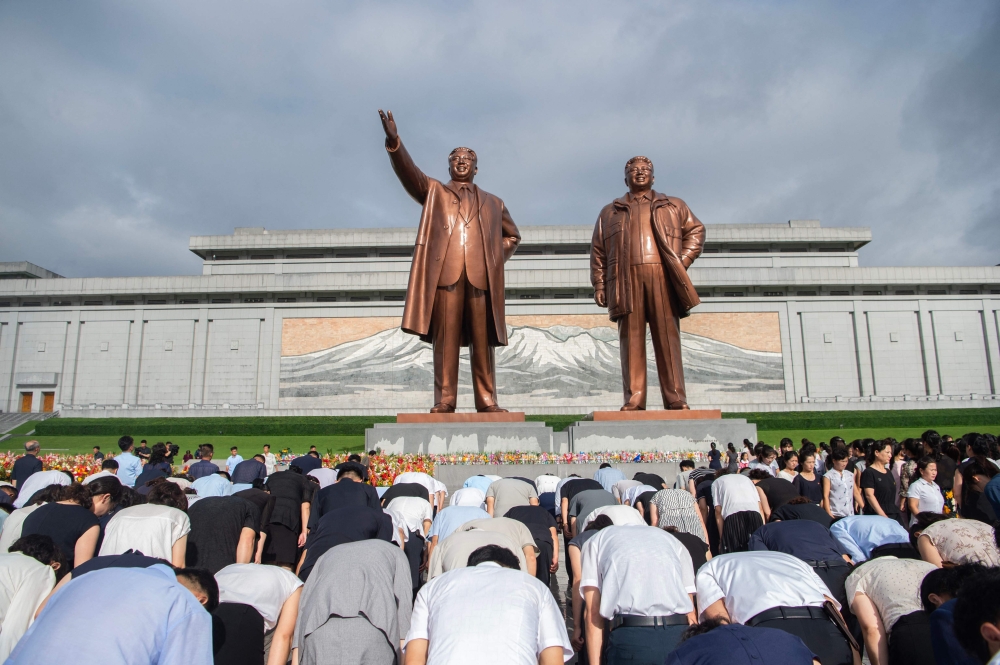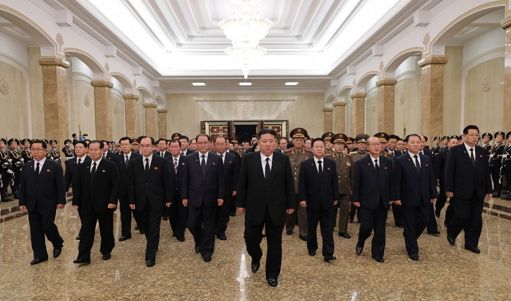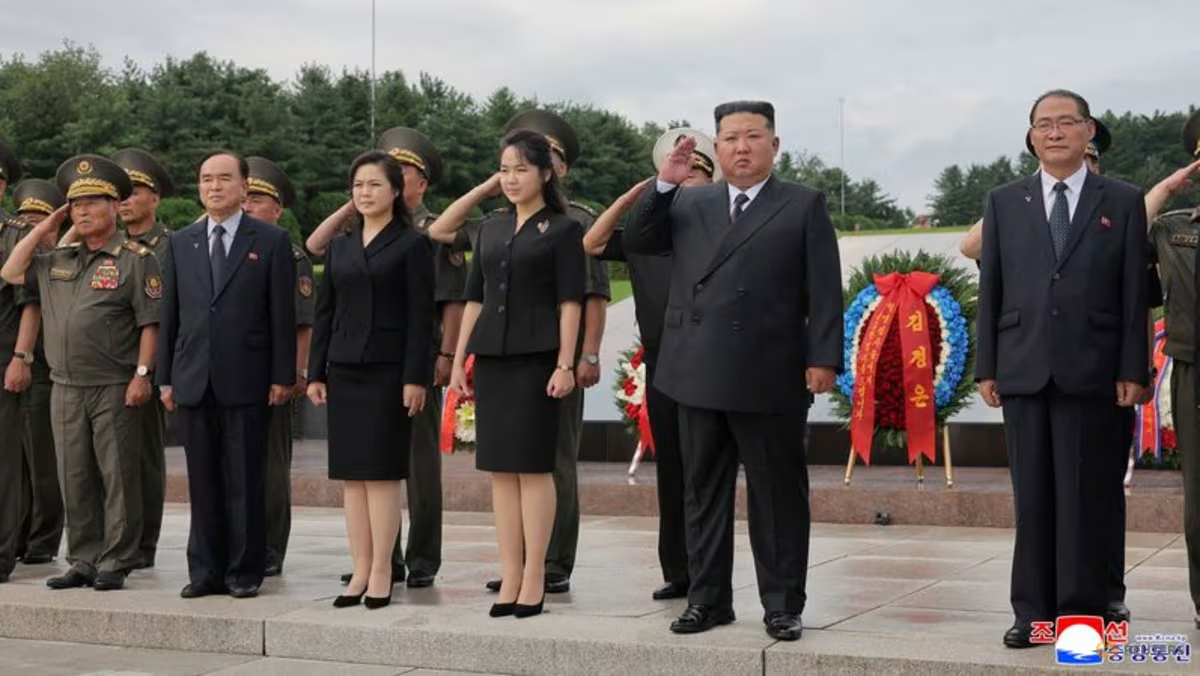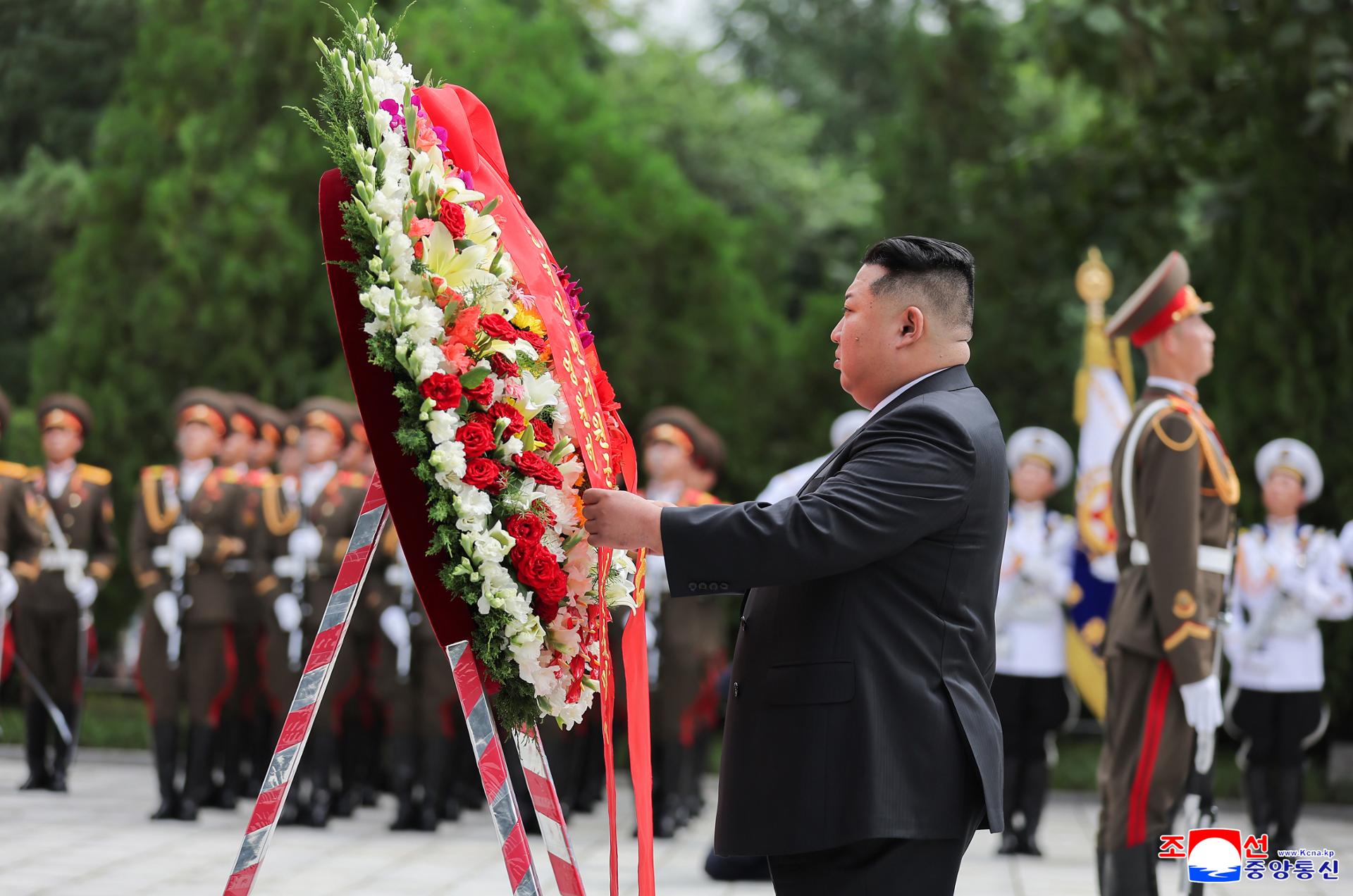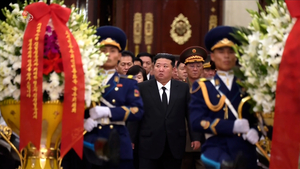
North Korean leader Kim Jong-un pays tribute at the Kumsusan Palace of the Sun alongside senior party and government officials at midnight on Tuesday, marking the 32nd anniversary of the death of state founder Kim Il-sung, in this image released by Korean Central Television on Wednesday. (KCTV-Yonhap) North Korean leader Kim Jong-un visited the mausoleum of state founder Kim Il-sung early Wednesday to mark the 32nd anniversary of his grandfather's death, prompting analysis that Pyongyang is seeking to reinforce the legitimacy of the ruling bloodline while further consolidating Kim's leadership.Kim visited the Kumsusan Palace of the Sun at midnight, accompanied by senior party, government and military officials, according to the North's state media, the Korean Central News Agency.At the palace, where the embalmed bodies of Kim Il-sung and Kim Jong-il — Kim's father — lie in state, the North Korean leader laid flower baskets before their statues and paid tribute."Comrade Kim Jong-un made deep bows to them, praying for their immortality," the KCNA said.The state-run Rodong Sinmun described July 8 as "the greatest memorial day of our party, state and people," saying participants pledged to more resolutely carry forward the revolutionary cause pioneered by Kim Il-sung and work for "the eternal dignity and glory of our Party, state and people."Kim Il-sung died of heart failure on July 8, 1994, at the age of 82. His son and successor, Kim Jong-il, died of a heart attack on Dec. 17, 2011, at age 69.This year's commemoration is expected to be relatively subdued, as North Korea typically reserves major state ceremonies, mass rallies and other large-scale commemorative events for milestone anniversaries ending in five or zero.The latest visit comes as Kim Jong-un has increasingly sought to establish his own political identity, relying less on the legacies of his father and grandfather to legitimize his rule.Yang Moo-jin, a distinguished professor at the University of North Korean Studies, said the North's characterization of Kim Il-sung's death anniversary as "the greatest memorial day of our party, state and people" reflects both ideological and political messaging.According to Yang, North Korea previously referred to the occasion as "the greatest memorial day of the nation." It replaced "nation" with "our party, state and people" after Kim Jong-un declared the two Koreas to be separate and hostile states in late 2023. The revised wording was also used for the anniversary of Kim Jong-il's death in December 2025.Yang said the wording change appears to reaffirm Pyongyang’s “two hostile states” policy while underscoring its “our state-first principle” as a core governing ideology.He also noted that since 2024, North Korean state media has increasingly avoided the term “Day of the Sun” for Kim Il-sung’s April 15 birthday, instead referring to the occasion as “April 15” or the “April holiday.” Kim Jong-un has also skipped some commemorative visits to the Kumsusan Palace of the Sun marking the birthdays of his predecessors, a pattern Yang said suggests Pyongyang is adjusting how it commemorates past leaders while elevating Kim’s own leadership.Yang said the contrasting treatment of birthdays and death anniversaries reflects a carefully calibrated propaganda strategy."By downplaying the birthdays of past leaders while continuing to observe their memorial days with full respect, Kim seeks to reduce dependence on the mystique surrounding his predecessors and elevate his own status as an independent supreme leader under 'Kim Jong-unism,'" he said."At the same time, paying formal tribute on memorial days preserves the legitimacy of the Mount Paektu bloodline and reinforces his image as the rightful heir carrying forward the legacies of his predecessors." The Mount Paektu bloodline refers to the Kim family's hereditary claim to legitimacy, rooted in the official North Korean narrative that Kim Il-sung led the anti-Japanese guerrilla struggle from Mount Paektu, a mountain regarded as sacred in Korean history.
N. Korea's Kim pays tribute to founder on death anniversary while reinforcing own leadership
North Korean leader Kim Jong-un visited the mausoleum of state founder Kim Il-sung early Wednesday to mark the 32nd anniversary of his grandfather's death, prom
624 words~3 min read