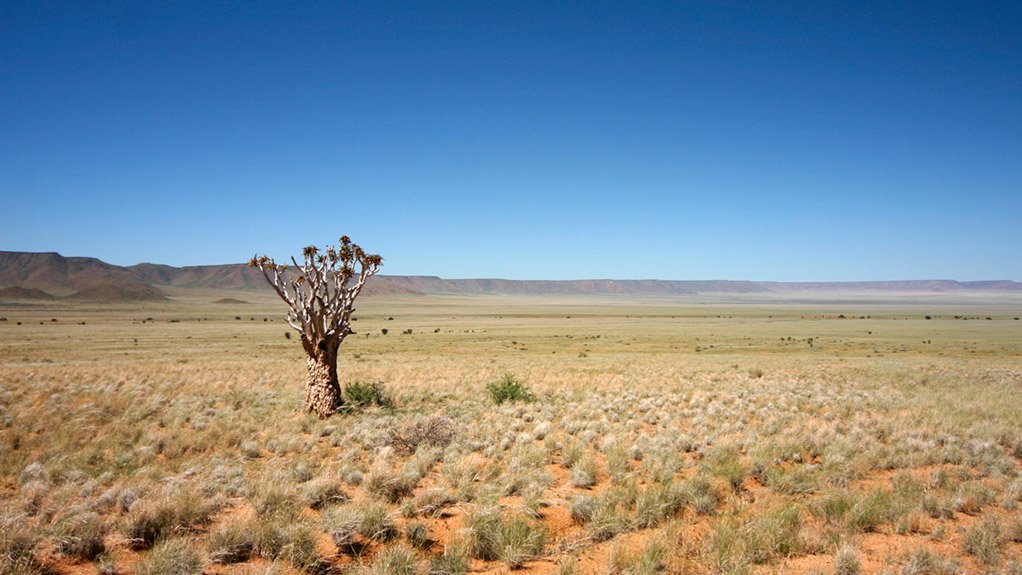
Earth scientists at the University of Cape Town’s (UCT’s) Department of Geological Sciences have identified a hitherto unknown geological fault underneath the Karoo basin. This fault extends across the Karoo basin, running from west-northwest to east-southeast, at a depth varying from 2 km to 12 km. Moreover, this fault seems to be critically stressed, meaning that it can generate earthquakes.
This discovery, published in the “Seismological Research Letters”, was made as a result of a study into a swarm of mainly small earthquakes (although one reached a magnitude of 4.8) located near Leeu Gamka, in the Western Cape province, and which started unexpectedly in 2007. So far, at least 66 of these earthquakes have been detected. These earthquakes were all entirely natural.
The quakes were detected and located using a network of 23 temporary seismic stations, plus advanced subsurface imaging methods. The data collected signals that this fault extends through the sedimentary rock layers in the Karoo basin that are being considered for exploration for shale gas. Indeed, the deepest of the earthquakes may even take place in the crystalline rock basement underneath the sedimentary rocks.
“Our study shows that critically stressed faults are already present beneath parts of the Karoo,” highlights study lead author and UCT PhD graduate Benjamin Whitehead. “These structures are capable of generating earthquakes under current stress regime, which means they should be carefully identified and monitored before any future shale gas development.”