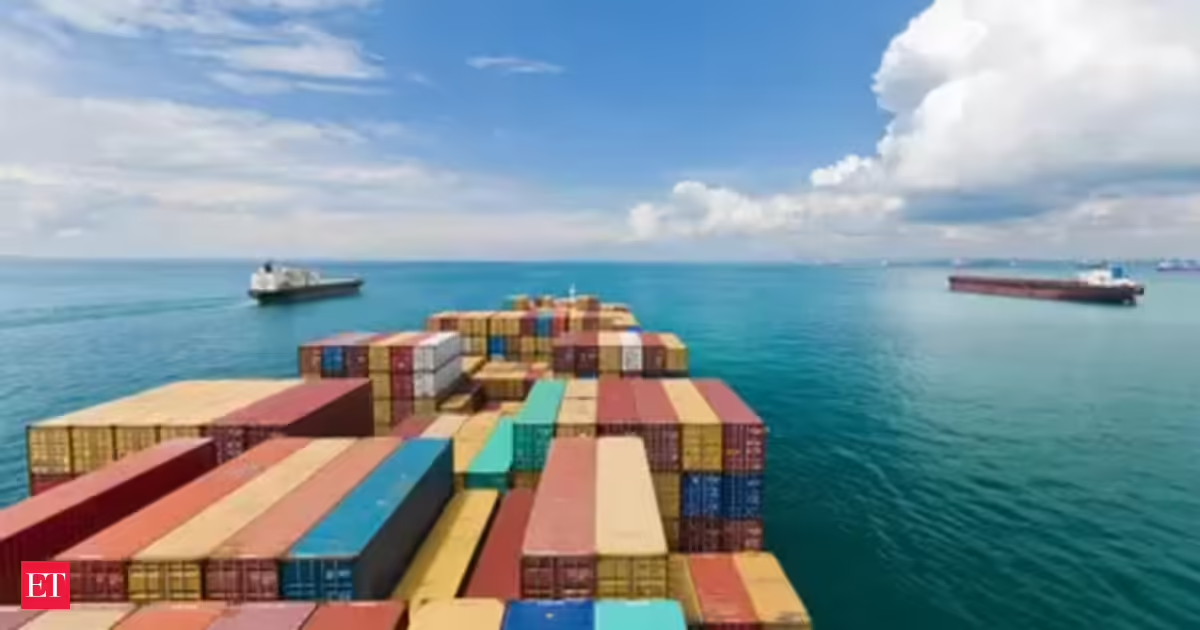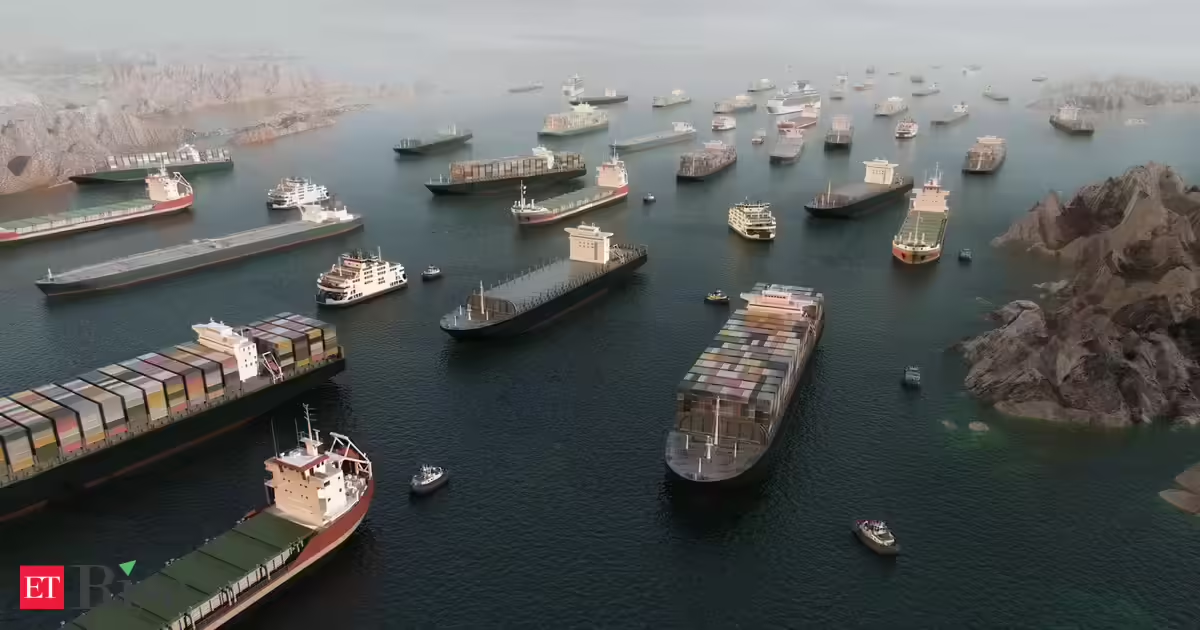
The United States and Iran agreed to a 14-point preliminary Memorandum of Understanding (MoU) towards ending the West Asian crisis and reopening the Strait of Hormuz. Although there have been initial hiccups, it is expected that, with the reopening of the Strait, global crude oil supply will stabilise and prices will normalise at a lower level. Following these developments, India should adjust its strategies, keeping in mind both the 2026-27 outlook and medium-term growth prospects.The West Asian crisis had resulted in a period of relatively higher crude prices. The monthly average price of the Indian crude oil basket was $114.5 per bbl in April 2026. It declined to $106.2 per bbl in May 2026 and further to $86.3 per bbl as of June 24, 2026. For the remaining three quarters of 2026-27, crude oil prices are expected to remain below this level, provided the truce continues.2026-27 growth prospectsThe National Statistical Office’s provisional estimates of GDP growth of 7.7% for 2025-26 confirm India’s strong post-COVID-19 pandemic recovery. This was preceded by real GDP growth rates of 7.2% and 7.1%, respectively, in 2023-24 and 2024-25 as per the new GDP series. Real Gross Value Added (GVA) growth was even more impressive at 7.9% in 2025-26, with the manufacturing, trade, transport, and financial and real estate sectors recording growth rates exceeding 10%. With nominal GDP growth at 8.9%, the implicit price deflator-based inflation rate stood at 1.1% in 2025-26.For 2026-27, growth prospects are likely to be impacted because of the disruptions in crude supply and higher prices affecting the first quarter, and due to a deficiency in rainfall associated with the onset of El Niño. The India Meteorological Department has estimated a 10% shortfall (as compared with the Long Period average). Up to June 24, 2026, the estimated shortfall is nearly 43%.The combination of El Niño and fertilizer shortages pose a potential risk to India’s agricultural output in 2026-27. In particular, in the immediate term, the kharif crop is likely to be affected. There may also be an impact on the rabi crop which is to follow. Therefore, it is important to build up fertilizer reserves and address issues of potential shortages when it comes to important crops, which may warrant a reconsideration of crop-specific import and export policies. The Reserve Bank of India (RBI) has projected real GDP growth of 6.6% for 2026–27.Fiscal prospects, petroleum economyOne important feature of 2026-27 growth is the likelihood of relatively higher nominal GDP growth as compared to 2025-26. This is because the implicit price deflator (IPD), which depends on Wholesale Price Index (WPI) and Consumer Price Index (CPI) inflation, is likely to be higher than the 2025-26 level of 1.1%. The RBI’s June 2026 Professional Forecasters’ median projections for WPI and CPI inflation for 2026-27 are 8% and 4.9%, respectively. With a resolution of the West Asian crisis, we consider WPI and CPI inflation rates for the full year to be lower at 6% and 4.5%; using weights of 60% and 40%, respectively, we can broadly estimate IPD-based inflation to be 5.4%. Combining this with a real GDP growth of 6.6%, we may have a nominal growth of about 12.4% in 2026-27, higher than the budgeted growth of 10.1%. This would have a positive impact on tax revenues. The Government of India should be able to realise its budgeted estimate of tax revenues absorbing the adverse revenue impact of any excise duty cuts. On the expenditure side, however, subsidies may be higher than budgeted.The RBI has given a dividend of ₹2.69 lakh crore to the Government. This amount covers a significant portion of the budgeted ‘Dividends and profits from RBI and Financial Institutions’ in 2026-27 at ₹3.16 lakh crore. Given these developments, we expect the 2026-27 budgeted fiscal deficit at 4.3% of GDP to be either realised or only marginally exceeded.The evolution of India’s petroleum economy has been characterised by certain notable features. First, India’s dependence on imported crude oil has increased to more than 90% in 2025-26 from 54.9% in 1998-99. Second, the volume of domestic production of crude oil has fallen over time to 26 million metric tons (MMT) in 2025-26 from a peak of 35.9 MMT in 2011-12. Third, demand for petroleum products/petroleum, oil, and lubricants (PoL) has increased, thereby generating the need for larger imports. Fourth, domestic consumption of PoL products has increased to 243.2 MMT in 2025-26 from 90.6 MMT in 1998-99. Fifth, India has developed an impressive capacity for refining crude to produce various PoL products. This capacity has improved over time. Sixth, the energy intensity of India’s output, as well as the intensity of use of PoL products in GDP, has fallen over time. This augurs well for sustaining an energy-efficient growth at a reasonably high level for a relatively longer period.India may continue to augment its refining capacity, which has helped save refining costs compared to the situation if it had directly imported refined petroleum products. The trend towards growing dependence on imported crude oil needs to be reversed by emphasising the exploitation of domestic crude resources while accelerating the transition to greener and alternative energy sources, including nuclear power.Build reservesWith a lowering of global crude prices and normalisation of supplies, the government should shore up its fertilizer reserves and reserves for other critical primary commodities including crude. There is a need to further diversify sources of imported crude and also reduce reliance on imports through the Strait of Hormuz. A policy for building strategic reserves of key primary commodities, along with estimates of the required volumes and needed infrastructure, should be put in place.The current account deficit was 0.6% of GDP in 2025-26, with the fourth quarter showing a surplus of 0.7% of GDP. Prospects for 2026-27 indicate a deterioration in this magnitude. The RBI’s June 2026 Survey of Professional Forecasters had estimated a current account deficit of 2.1% of GDP for 2026-27, as per their median estimate. With normalisation of the global oil market and the opening of the Hormuz strait, we expect this to be lower at about 1.5% of GDP.The prospects of the Indian economy outlined above is on the assumption that peace will prevail in West Asia from now on. If this assumption turns out to be incorrect and if the war continues, India along with many other countries will face an extremely difficult situation.C. Rangarajan is former Chairman, Prime Minister’s Economic Advisory Council, and former Governor, Reserve Bank of India. D.K. Srivastava is former Director, Madras School of Economics. The views expressed are personal
India’s economic prospects after the West Asian crisis’
With a resolution of the West Asian crisis, India should adjust its strategies, keeping in mind both the 2026-27 outlook and medium-term growth prospects
1,082 words~5 min read