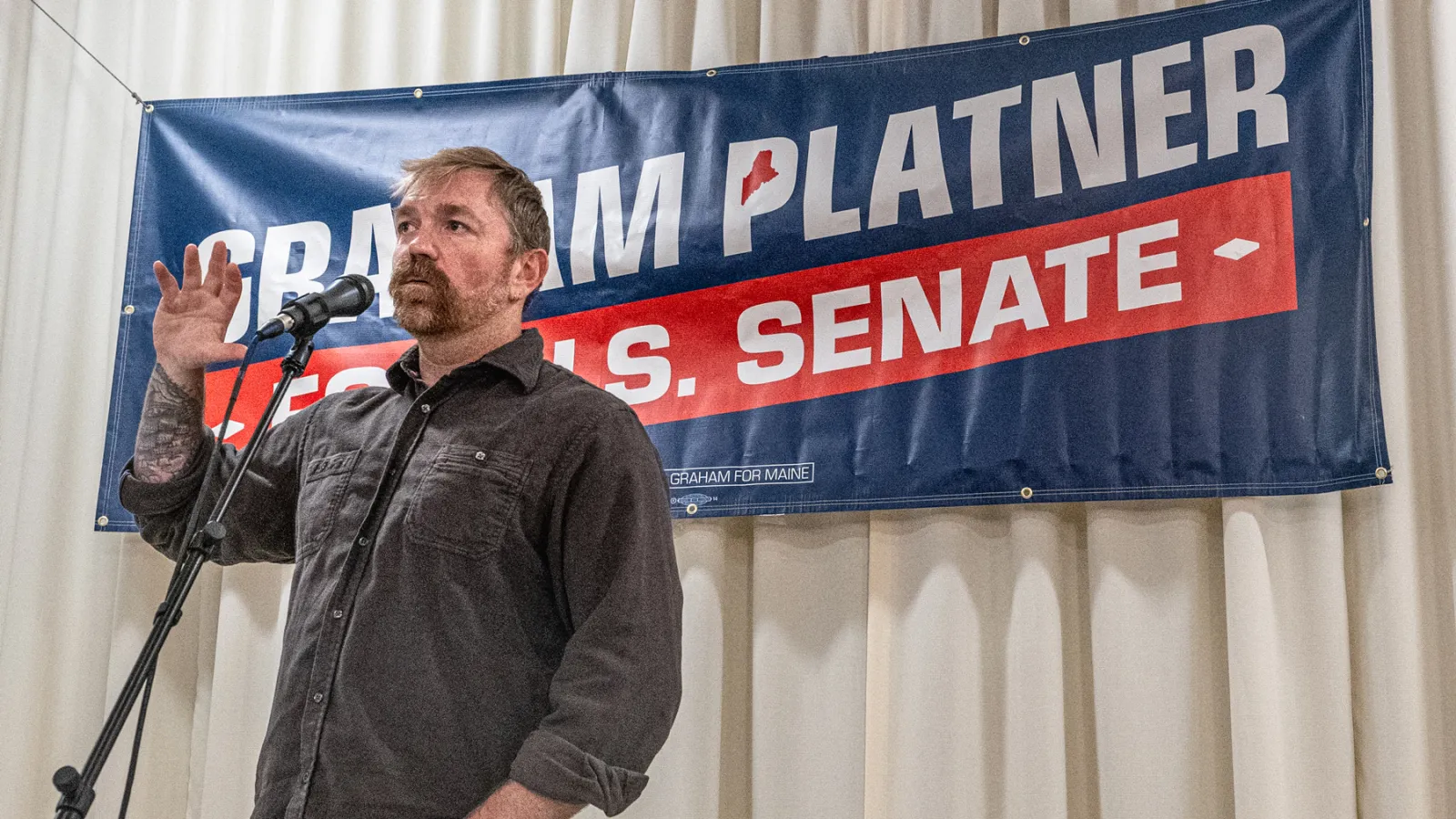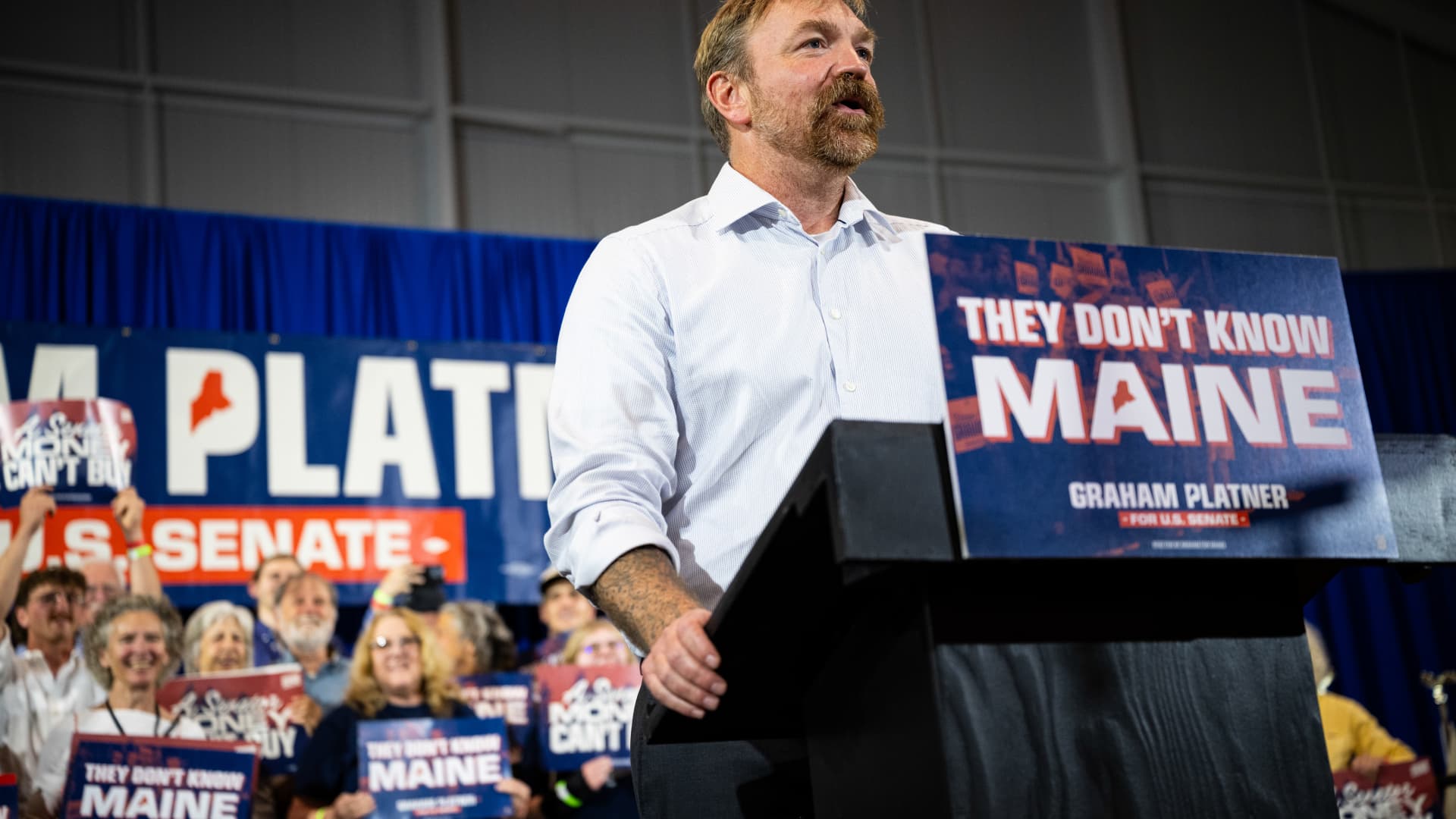
A little more than a month ago, the Times published a bombshell story about Graham Platner, a military veteran and an oysterman who was the presumptive Democratic nominee for Senate in Maine. The paper shared the accounts of three women who had dated Platner within the past fifteen years and had found his behavior unsettling. The over-all picture was not without nuance, but the story contained some disturbing allegations, including that Platner had been physically “rough” with one of the women, Lyndsey Fifield. Platner acknowledged that he had been a “far from perfect boyfriend” during a “very dark period” of his life, but he strenuously denied having been violent, and his campaign sought to discredit Fifield by pointing out that she is a longtime right-wing operative. In the wake of the allegations, I wrote that Platner had, in many ways, been running against a myth of personal perfection in politics; he had previously weathered storms, around offensive Reddit posts and a tattoo that resembles a Nazi insignia—which he claimed to have got in ignorance—that, per conventional wisdom, ought to have blown him off course. I argued that he was about to find out the extent to which voters were willing to forgive him his baggage.A few days later, Platner won his primary with seventy-two per cent of the vote, a margin that would have been astonishing a year ago, when no one knew who he was, and that qualified as convincing enough when measured against headier expectations that preceded the Times story. (Janet Mills, the Maine governor, who had been Platner’s chief rival, had long since suspended her campaign, citing a lack of funds, but she let it be known that she was still gratefully accepting votes.) “The national pundits, the political establishment, they keep looking for that one story, that one headline, that one moment in my life that they can define the campaign by,” Platner said, in a victory speech. “But in trying so hard to understand me, they fail to understand that this is not about me at all. This is a movement about us.” After that, his campaign seemed to stabilize; polls showed him locked in a squeakily tight race with Susan Collins, the Republican incumbent. On Monday, however, another shoe dropped: Jenny Racicot, the most recent of Platner’s girlfriends to have spoken with the Times, further alleged, in interviews with Politico and other outlets, that, in 2021, Platner became intoxicated, went over to her home uninvited, and raped her, before falling asleep in her bed. Racicot told Politico—which corroborated her account by reviewing messages that she sent before and after Platner started running for office—that she had initially not wanted to be known as a rape victim, but had changed her mind after discourse about Fifield’s political affiliations dominated the reaction to the Times story. “One of the reasons I didn’t come forward sooner was, the huge moral conflict that I had between supporting his politics, but not supporting him as a person,” Racicot added. “I just want the truth out there.”Platner’s campaign denied any nonconsensual behavior, and characterized the allegations as having been “coached and coordinated by out of state establishment operatives.” Nonetheless, in a video message, Platner nodded to “political reality” and said that he would take some time to “reflect” on his path forward. Quickly, that path appeared to close. Chuck Schumer, the Senate Minority Leader, and Kirsten Gillibrand, the leader of the Senate Democratic campaign arm, pledged to starve Platner of funding if he stayed on the ballot. Schumer has never been a huge fan of Platner. But many of those who are, or were, also called on him to drop out, including Ro Khanna—the California congressman who rallied with Platner the day after the initial Times story was published, despite finding its claims troubling—and Senators Elizabeth Warren and Bernie Sanders. Hasan Piker, a left-wing influencer seen as a lightning rod for anger at the Democratic establishment, said on a live stream that Racicot’s allegation was a “holy shit” moment, and chided a commenter for speculating that “Mossad paid her ass.” Our Revolution, the Sanders-aligned progressive group, cut Platner loose, too. If it was too soon to say how exactly Maine voters might feel about this latest baggage, the writing appeared to be on the wall.On Monday night, the Times reported that Platner had not yet decided to drop out and would consider doing so, per a source, only if offered “a guarantee of being replaced by a candidate who he believes is true to the values and vision and policy agenda” of his campaign; on Tuesday, the paper reported that Platner, on a call with staff, implied he would not be in the race for long. (His campaign has stopped running ads on Facebook and Instagram.) At time of writing, there still was a chance, however slim, that this might prove to be Democrats’ “Access Hollywood” moment, echoing Donald Trump’s ultimately successful attempt to push past the revelation of his infamous “grab them by the pussy” boast to Billy Bush, after which G.O.P. pooh-bahs turned on him before shuffling back into line. Indeed, critics of Platner have long cast him as a sort of Democratic Trump, at least in the sense that, as they see it, the left’s embrace of him has evinced a similarly troubling dynamic that rationalizes away obvious character flaws in the name of beating a greater evil.And yet, I’ve found comparisons of Trump and Platner to be lazy. Sure, he is capable of speaking with some of the same accents—not least when attacking the media or the motives of his accusers—and is a controversial neophyte riding a wave of anger at the status quo. These days, though, Trump is the status quo, and the Democratic base seems concerned, above all, with fighting this reality, not aping it. In part, Platner’s enduring appeal, especially through the Reddit and tattoo controversies, clearly did reflect an overdue reckoning with whether character-based purity tests are tenable—or even desirable—in the present political climate. But I see this reckoning less as a liberal analogue to the Trumpian permission slip for awful behavior, and more as an outgrowth of frustration about a consultant-driven politics that presents candidates as beyond reproach, then throws them to the wolves when they prove to be imperfect. Platner’s campaign has often had an angry edge, but, as I wrote last month, his rhetoric was frequently softer, especially when it came to his past indiscretions; he has used a language of therapy, self-improvement, and belonging which it is almost impossible to imagine coming out of Trump’s mouth, or his Truth Social account. If Platner survived the Times story about his exes, then that may primarily be because some of the allegations therein were murky, and the worst of them were plausibly consistent with Platner’s tale of personal growth. In a party that has long been disgusted by Trump’s impunity and has recently become obsessed with the Epstein files—a topic that Platner himself prominently invoked—an outright claim of sexual assault was always likely to form a bright line. All the early evidence suggests that Platner will not be able to step over it and stay alive.Eric Swalwell—another prominent anti-Trump fighter, albeit not one from Platner’s wing of the Party—found this out recently; after multiple women accused him of rape, which he denies, and other inappropriate behavior, he was swiftly drummed out of both Congress and the California governor’s race, which he had arguably been leading. At the time, I wrote that his trajectory pointed to a wider problem for the Democratic Party: that it knows very well what it stands against, but not what it stands for. Since Swalwell’s ouster, an intraparty battle over the back end of this equation appears to have come into sharper focus, not least in congressional primaries, in New York City and beyond, in which candidates endorsed by the Democratic Socialists of America beat more moderate opponents. As is always the case, excessive extrapolation from individual races carries risks: some of the recent tussles between Democratic insurgents and their foes defy easy ideological categorization; in higher-profile races, particularly for the Senate, candidates backed by Schumer have attracted widespread support. (The beneficiary of Swalwell’s exit in California was Xavier Becerra, a former Biden Administration official who is no one’s idea of a communist, or no sane person’s, anyway.) Still, a broad fury at the perceived timidity of the Democratic establishment is palpable, whatever its ideological inflection.Platner’s campaign, among others, has been a rebuke to that establishment. He will likely be out of its way soon enough. But Democratic leaders should not bank on simply parachuting in a favored moderate without resistance; indeed, in its statement ditching Platner, Our Revolution warned “the Democratic establishment” that “this is not your opening.” Mills, the governor, enjoys the contradictory dual distinction of having won the most votes against Platner but also having been humiliatingly rejected from a position of strength; one strategist suggested to the news site NOTUS that the nomination is now hers if she wants it, but others find the idea fantastical. Other mooted Platner replacements include a bevy of candidates who recently lost out in the gubernatorial primary to succeed Mills; the early progressive energy seemed to be congealing around Troy Jackson, the former president of the state Senate, who has already made it about as clear as possible that he wants the gig. The process for picking a new nominee has yet to be defined, beyond a requirement that Platner formally drop out by next week, but time is tight, and Democratic power brokers reportedly want to avoid the perception of a stitch-up, which would be particularly untenable given the painful legacy of Kamala Harris’s uncontested ascent to the top of the Presidential ticket following Joe Biden’s withdrawal. (Already, online wags are quipping that Harris will be the nominee in Maine.) The alternatives to a stitch-up, of course, entail a lack of control, and perhaps even chaos.Looming over all of this is the question of electability—a ubiquity in politics that is especially intense in a state that looks central to Democrats’ hopes of reclaiming the Senate. (Collins is the only Republican senator seeking rëelection in a state that Harris won.) In Maine, lots of considerations might be valid at once. Given that the midterms are shaping up primarily to be a referendum on Trump, it’s plausible that the Democrats could nominate a candidate with “I ❤️ THE STATUS QUO” tattooed on their forehead and still win. At the same time, a perceived moderate lost to Collins, in 2020, even with Trump on the ballot—though this was before the right-wing Justices whom Collins voted to confirm to the Supreme Court overturned Roe v. Wade. It’s true that another establishment figure, Mills, just got shellacked by Platner in the primary; then again, Biden-adjacent age concerns may have been the decisive factor in that race. (She’s seventy-eight.) Platner was clearly a vehicle for organic, broad-based populist energy. And yet, after listening to hours of his interviews, I found him to be an uncommonly engaging and articulate candidate. There’s no guarantee that someone less charismatic will automatically mop up his support.When I wrote about Platner last month, it was through the lens—or, more accurately, two different lenses—of authenticity. The first examined the common, superficial application of the term to politics (and, yes, electability), according to which the image of Platner—a gruff, tattooed, legibly working-class outsider—initially appeared as a godsend, only to be undermined by the slow, likely fatal unveiling of his painfully real flaws. (Jackson is a logger from Trump country, and, inevitably, has already been described as authentic.) The second lens looked at a yearning, among voters, for true connection and meaning—and for change—in an alienating, disconcerting world of political corruption, consolidated corporate power, and the threat of A.I.-enforced obsolescence. Platner—bearing the scars of his post-9/11 military service and the financial crisis—tapped into this idea. As Morris Katz, a Platner adviser and progressive strategist, told Politico last year, he “embodies the trauma of a country that lost its way.”Katz and others who helped to recruit Platner have since taken heat for not adequately vetting him in advance; they certainly failed to foresee the likely destructive impact of the intense personal trauma that follows him around, both his own and that of other people. Whatever the immediate consequences of that failure, the more symbolic trauma to which Katz spoke—which Beltway pundits baffled by Platner’s enduring popularity seemed consistently to misunderstand, or to miss entirely—will persist, and continue to find political expression. Platner’s rise and probable fall shows that character still matters, but that it isn’t the sole organizing principle of politics these days, on either side. His primary-night suggestion that he would not be defined by a single killer headline has not aged well. And yet his insistence that his campaign wasn’t really about him, however self-serving, contains more than a seed of truth. ♦
Graham Platner’s Point of No Return
Following an allegation of sexual assault, the Democratic Senate nominee in Maine is considering his future. What would his exit mean for the race, and for the broader direction of American politics?
2,155 words~10 min read