Story audio is generated using AI
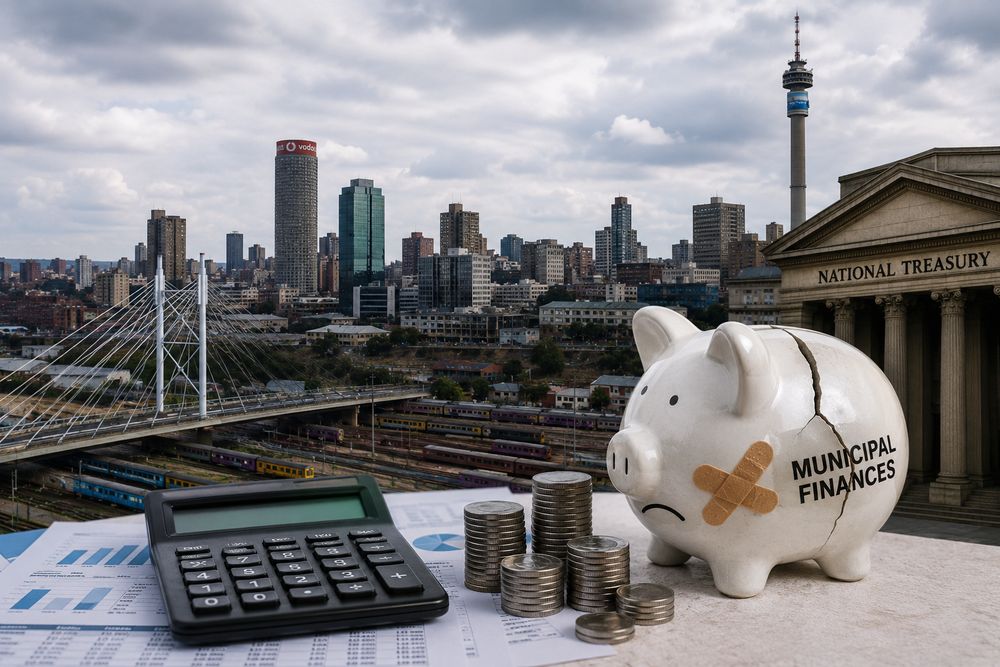
The National Treasury has temporarily withheld July equitable share transfers to 69 municipalities across South Africa, citing years of persistent financial mismanagement, repeat audit failures and continued noncompliance with the Municipal Finance Management Act, in one of its strongest interventions yet against failing local governments.The municipalities, which span all nine provinces and include major metros such as Johannesburg, Buffalo City, Nelson Mandela Bay and Mangaung, were informed of the decision in advance and given an opportunity to explain why their transfers should not be withheld before the Treasury acted.The Treasury said the move was intended to instil fiscal discipline, ensure municipalities properly managed public money, addressed unauthorised, irregular, fruitless and wasteful expenditure, and held officials accountable where required by law. It described the measure as corrective rather than punitive and said it did not expect the temporary withholding of funds to affect service delivery.Read: Analysts warn Joburg service delivery crisis threatens SA’s economyMiyelani Holeni, group chief adviser at Ntiyiso, said the decision represented one of the strongest fiscal interventions available to the Treasury under section 216(2) of the constitution and section 38 of the Municipal Finance Management Act.“While the Treasury has previously withheld transfers from individual municipalities, applying the intervention simultaneously to 66 municipalities across all nine provinces reflects a much firmer approach to enforcing financial discipline,” Holeni said.He cautioned, however, that the timing could create unintended consequences for smaller municipalities that rely heavily on the equitable share because they have limited own-revenue bases.The intervention follows years of deteriorating municipal finances documented by both the Treasury and the auditor-general.Holeni said the Treasury’s escalation reflected the fact that years of technical support, guidance and training had failed to reverse systemic governance failures.“South Africa’s intergovernmental system is designed around support before sanction. The Treasury generally provides guidance, technical support, training and opportunities for municipalities to correct deficiencies before resorting to withholding funds,” he said.However, he said the scale of irregular, unauthorised and fruitless expenditure, together with the growing number of unfunded budgets, suggested previous interventions had not produced sufficient improvement, making stronger enforcement increasingly necessary.Holeni said municipalities also needed to strengthen their own institutional capacity by establishing dedicated compliance functions to ensure adherence to legislation and Treasury circulars.According to the Treasury, municipalities have accumulated R145.21bn in irregular expenditure since the 2021/22 financial year, including R40.14bn in 2024/25 alone. Over the same period, municipalities incurred R24.12bn in fruitless and wasteful expenditure and R118.13bn in unauthorised expenditure. The Treasury also said 116 municipalities adopted unfunded budgets during the 2024-25 financial year, while municipalities collectively owed R3.4bn in interest to Eskom and R1.21bn to water boards.The auditor-general’s latest local government audit outcomes suggest many of the municipalities targeted by the Treasury are among the country’s poorest financial performers.Holeni said he would avoid describing them simply as the country’s “worst-performing” municipalities, arguing that the Treasury’s intervention was based on specific legislative compliance failures rather than an overall assessment of municipal performance.“Inclusion therefore reflects failure to meet the Treasury’s prescribed compliance requirements rather than serving as an overall municipal performance ranking,” he said.Only 39 of South Africa’s 257 municipalities achieved clean audits in the 2024/25 financial year. Several of the municipalities now facing withheld transfers have repeatedly received qualified or disclaimer audit opinions and have featured in successive auditor-general reports for weak financial management and governance failures.Among those on the Treasury’s list are several long-standing repeat offenders.The auditor-general identified seven municipalities across the Free State, Eastern Cape, North West and Western Cape that have received disclaimer audit opinions for periods ranging from three to 10 years. North West’s Ditsobotla municipality, which is among those facing withheld funding, has received disclaimer audit opinions for more than a decade despite repeated provincial and national interventions.Several municipalities on the list have also accumulated significant unauthorised and irregular expenditure.Buffalo City reported R1.32bn in irregular expenditure and R403m in unauthorised expenditure during its 2023/24 audit, while Johannesburg incurred R2.38bn in unauthorised expenditure in 2024/25 after adopting an unfunded budget. North West’s JB Marks municipality still had R4.1bn in irregular expenditure outstanding, according to the auditor-general.The Treasury said many municipalities had failed to process unauthorised, irregular, fruitless and wasteful expenditure through their municipal public accounts committees as required by law, while others had not demonstrated effective consequence management through disciplinary action, recovery of losses and criminal referrals where appropriate.The South African Local Government Association (Salga) said while it supported measures to strengthen financial discipline and accountability, enforcement alone would not resolve the financial crisis facing many municipalities.It said local government continued to face structural and systemic fiscal challenges, including declining revenue collection, weak local economies, rising service delivery costs, ageing infrastructure, increasing bulk electricity and water costs, and growing poverty. While governance failures could not be condoned, these structural pressures also needed to be addressed if municipalities were to become financially sustainable.Salga said any withholding of equitable share allocations had to balance compliance objectives with the impact on municipal finances and service delivery, adding that it was important to distinguish governance failures from deeper structural fiscal challenges.Holeni also questioned the Treasury’s assessment that the temporary withholding would not affect service delivery.“The Treasury’s intention is clearly a ‘carrot and stick’ approach. They are now resorting to the stick as the municipalities are displaying behaviour that is repeating past offences,” he said.The impact on residents could remain limited, he said, if municipalities responded quickly, but he warned that many of the affected municipalities already faced liquidity constraints and significant debt to Eskom, water boards and other statutory creditors.“If compliance is delayed and transfers remain withheld for an extended period, the financial pressure could ultimately affect service delivery,” Holeni said.The association also revealed that the Treasury had initially intended withholding transfers from 99 municipalities before reducing the number to 66 following engagements with municipalities, which it said demonstrated the value of support and proactive intervention.The Treasury has argued that non-payment by municipalities is threatening the financial sustainability of Eskom, water boards and other public institutions.Among the municipalities on the list, Emfuleni remains one of Eskom’s biggest debtors, owing about R8.05bn for bulk electricity, while Johannesburg’s historical bulk electricity debt stands at about R5.2bn.Salga said municipal consumer debt had exceeded R480bn as at March 31 2026, with households, businesses and government entities among the largest contributors to unpaid municipal accounts. It said this was weakening municipalities’ ability to meet obligations to Eskom, water boards, the Revenue Service, pension funds and other creditors.The Treasury said it had spent years trying to improve municipal financial management through Municipal Finance Management Act circulars, direct engagement with municipalities and training interventions, but many councils had continued to ignore their legal obligations. Transfers would resume only once municipalities met the required conditions and demonstrated they had addressed the shortcomings identified by the department.Holeni said withholding transfers could encourage immediate behavioural change but would not resolve the structural weaknesses affecting local government.“Previous interventions suggest that withholding transfers can produce immediate behavioural change. However, withholding funding alone does not resolve structural governance failures. Long-term improvement depends on credible funded budgets, stronger revenue collection, accurate billing, effective oversight, consequence management and stronger financial leadership,” he said.