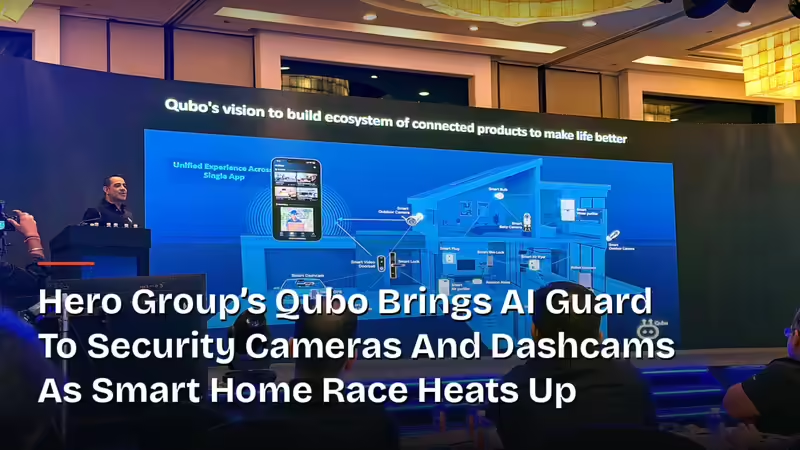
The battle for India's smart home market is entering a new phase, and it is no longer just about who can build the sharpest camera or the cheapest dashcam. Artificial intelligence has become the next major battleground.Hero Group-backed smart devices brand Qubo has announced what it describes as the next chapter in its business, unveiling a new AI platform called AI Guard that is designed to make its security cameras and dashcams respond to incidents rather than simply record them. The company also introduced a new Dashcam Pro 2K and revealed it crossed Rs. 350 crore in annual revenue during the last financial year, while selling more than 2.5 million devices since the brand was launched.The announcements were made during the company's annual Qubo Connected World 2026 event in New Delhi, where the company laid out a strategy that moves beyond connected devices towards what it calls AI-powered protection.The shift reflects a broader trend unfolding across the consumer technology industry. Whether it is smartphones, home appliances, surveillance cameras or connected cars, companies are increasingly using artificial intelligence as the feature that separates one product from another. For brands like Qubo, that means convincing buyers that a security camera should do more than preserve evidence after an incident—it should help prevent one in the first place.That is an ambitious goal, but it also reflects changing consumer expectations.AI Is Becoming The New Feature Consumers ExpectUntil a few years ago, buying a security camera was largely about image quality, storage and night vision. Today, buyers expect considerably more. Consumers increasingly want cameras that can distinguish between a family member and a stranger, recognise suspicious activity, reduce false alerts caused by pets or passing vehicles and immediately notify them when something genuinely unusual happens.That demand has accelerated as more Indian households adopt smart home devices and broadband connectivity improves across the country. Qubo believes AI Guard is designed to address precisely that need. According to the company, the platform enables its cameras to identify people and potential threats, trigger alarms automatically, back up important footage to the cloud and react to incidents without requiring users to constantly monitor live video feeds. Rather than acting as passive recording devices, the cameras are intended to become active participants in home security."At Qubo, we've always believed that technology should solve real-world problems in meaningful ways," said Nikhil Rajpal, Founder and Chief Executive Officer of Qubo. "The innovations and products unveiled today represent a significant leap in that journey. With AI Guard, Qubo Security Cameras are now designed not just to record, but to protect. Whether it's protecting a home or making every drive safer, our focus remains on building products that make every day safer and smoother," he added.That philosophy reflects an important change taking place across the broader smart security industry. Artificial intelligence is gradually shifting from being an optional premium feature to becoming a standard expectation.Why This MattersThe security camera market has become intensely competitive. Consumers can already choose from dozens of brands including TP-Link's Tapo, Xiaomi, EZVIZ, Hikvision, CP Plus, Imou and Trueview, many of which already offer AI-assisted person detection, motion zones and cloud-based alerts.Dashcams are becoming equally crowded. Brands such as 70mai, DDPAI, Redtiger, Nextbase and Hikvision have expanded aggressively in India over the past few years, helped by rising awareness around insurance claims, road accidents and fraudulent collision disputes.That means hardware specifications alone are no longer enough. Almost every camera today records in Full HD or higher. Most already include night vision, Wi-Fi connectivity and smartphone apps.The next stage of competition is likely to revolve around software. Companies now need to demonstrate that artificial intelligence genuinely improves day-to-day security instead of simply becoming another marketing buzzword.For Qubo, AI Guard is intended to be that differentiator. Rather than introducing a separate premium subscription or limiting the technology to flagship products, the company says AI Guard will become standard across all of its security cameras and its connected Dashcam 4G Live, with the wider dashcam portfolio expected to receive the technology over the coming months.That could prove significant if the rollout reaches existing customers as well as new buyers.Growth Beyond HardwareThe product announcements were accompanied by another milestone. Qubo said it generated more than Rs. 350 crore in annual revenue during the previous financial year and has now sold over 2.5 million devices since inception.Although the company did not disclose profitability or market share, the figures suggest it has grown beyond being a niche smart home startup. Its portfolio now stretches across Wi-Fi security cameras, video doorbells, smart locks, dashcams and connected appliances, making it one of the more diversified consumer IoT brands operating in India.That scale also reflects broader changes in consumer behaviour. Demand for connected security devices has accelerated since the pandemic as more people began working remotely, travelling frequently and relying on smartphones to monitor homes left unattended during the day.At the same time, dashcams have become increasingly common among Indian drivers as insurers, fleet operators and individual motorists seek video evidence following accidents and disputes.Dashcams Remain A Major FocusAlongside AI Guard, Qubo also announced the Dashcam Pro 2K, expanding its presence in one of India's fastest-growing consumer electronics categories. The new model combines front and rear cameras, records in Quad HD resolution and includes features such as a supercapacitor and G-sensor collision detection.Rather than targeting premium buyers alone, the company says the new dashcam is designed to make dual-channel recording more accessible to a wider audience. That approach reflects where the Indian dashcam market appears to be heading.As prices continue to fall, the biggest growth opportunity is increasingly expected to come from first-time buyers looking for affordable, easy-to-install systems that combine higher video quality with intelligent software features.Qubo's strategy appears to be built around exactly that idea. Instead of positioning AI as a separate product, it is attempting to weave the technology across its entire ecosystem—from home surveillance to connected vehicles.Whether that proves enough to stand out in an increasingly crowded market will depend less on the promises made during a launch event and more on how reliably AI Guard performs once customers begin using it in everyday situations.Frequently Asked QuestionsWhat is Qubo AI Guard?Qubo AI Guard is the company's new artificial intelligence platform for its security cameras and dashcams. Instead of only recording footage, it is designed to detect people and potential threats, trigger alarms, back up important footage to the cloud and take proactive action when suspicious activity is detected.Which Qubo products will get AI Guard?According to Qubo, AI Guard will be available across all of its smart security cameras and its Dashcam 4G Live. The company also plans to expand the technology to its wider dashcam portfolio over the coming months.What is the new Qubo Dashcam Pro 2K?The Dashcam Pro 2K is Qubo's latest dual-channel dashcam featuring front and rear cameras. It records in 2K Quad HD resolution and includes features such as a supercapacitor for improved reliability, a G-sensor for collision detection and support for Qubo's connected ecosystem.Why is AI becoming important in security cameras?AI helps security cameras do more than simply capture video. Modern AI systems can distinguish between people, pets and vehicles, reduce false alerts, identify unusual activity and notify users more quickly when something requires attention. As smart homes become more common, these capabilities are increasingly becoming standard rather than premium features.How does Qubo compare with brands such as Xiaomi, Tapo and EZVIZ?Qubo competes with brands including Xiaomi, TP-Link's Tapo, EZVIZ, Hikvision, CP Plus and Imou in the smart security camera market, while also taking on dashcam makers such as 70mai and DDPAI. The company's latest strategy focuses on integrating AI across its product range instead of competing solely on camera specifications or pricing.How big is Qubo's smart devices business?Qubo says it crossed Rs. 350 crore in annual revenue during the last financial year and has sold more than 2.5 million devices since the brand was launched. The company offers products across security cameras, dashcams, smart locks, video doorbells and connected home devices.Will existing Qubo users receive AI Guard?The company has confirmed that AI Guard will become standard across its current range of smart security cameras and the Dashcam 4G Live. It has also said the remaining dashcam portfolio will receive the technology over the next few months, although it has not yet shared a detailed rollout schedule.Why does this announcement matter?The launch signals Qubo's shift from selling connected devices to building AI-powered security products that can actively respond to potential threats. It also highlights how competition in India's smart home market is increasingly moving beyond camera hardware towards artificial intelligence, automation and connected services.end of article
Hero Group's Qubo Brings AI Guard To Security Cameras And Dashcams As Smart Home Race Heats Up
Qubo has announced the next phase of its smart home strategy with the introduction of AI Guard, an artificial intelligence platform designed to make its security cameras and dashcams respond to potential threats instead of simply recording them. Alongside the software upgrade, the Hero Group-backed brand has launched a new dual-channel Dashcam Pro 2K and revealed it crossed Rs. 350 crore in annual revenue during the last financial year. The move comes as competition in India's connected security...
1,435 words~7 min read