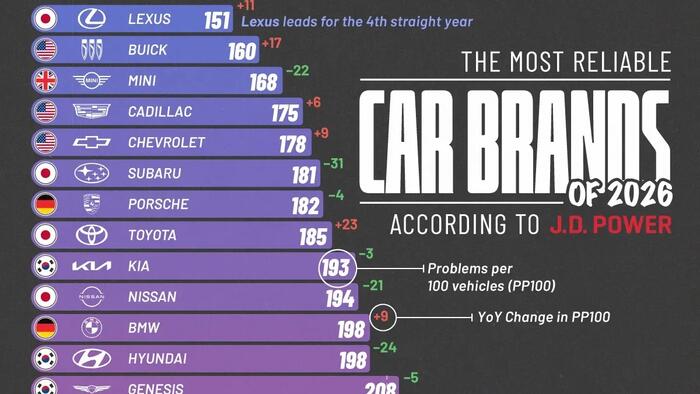
Are modern cars really much worse, in quality terms, than their predecessors? Before we turn to the experiences of those who work with cars, let’s look at some basic data. In the US market, the JD Power company has, for decades, been independently rating the “initial quality” of new cars on sale, and ranking them brand by brand. Now, US model line-ups don’t automatically tally with their European equivalents, but they’re similar enough for the results to warrant our attention. JD Power’s Initial Quality Survey rating is scored by problems per 100 vehicles, or PP100. These problems, recorded during the first 90 days of ownership, include simple complaints from owners about issues using voice recognition or annoyances with Bluetooth connectivity, but also include mechanical issues. So let’s look back to 2010, where we find that the best-scoring brand that year was Porsche, which registered 83 problems per 100 cars, which, at less than one issue per car, looks pretty good. The average across the industry that year was 109 problems per 100 cars. Now let’s look at 2025, and the best-scoring brand, Lexus – a name synonymous with high quality and reliability – scored 166 problems per 100 cars. In 2025, the industry average was 192 problems per 100 cars. It’s worth noting that the JD Power survey counts all reported issues, from infotainment frustrations to mechanical defects, rather than measuring long-term durability. There was a bit of an improvement in the 2026 numbers, but that still saw the best-performing brand, Porsche, log 138 problems per 100 cars, and the industry average stands at 175 problems per 100 cars. Which brings us to a yard in rural Offaly. It houses the workshop of Morgan Maher Motors, and Morgan Maher himself has decided to swerve the quality question and opt for a 25-year-old Nissan Patrol instead. Morgan Maher of Morgan Maher Motors in Offaly with one of his restored Nissan Patrols Maher loves Patrols, having fallen for the model when he saw them, as a child, when they were used by the Irish Defence Forces as escort cars for cash-in-transit vans. Now, he spends his working hours restoring Patrols – mostly the Y61 model, built from 1997 until 2024 in some countries, but on sale in Ireland until the July 2008 motor tax changes wiped out its pricing structure. “I have a Patrol out there with a 4.2 engine, which has a throttle cable and no exhaust gas recirculation, nothing really. But that engine is so reliable. I think the difference is that back then, someone was set a task to design something, say a bracket for holding the alternator, and their only task was to do that as good as it could be done. “Now? It’s like ‘okay, we need an alternator bracket – what’s the cheapest one we can buy? What’s the smallest? What’s the lightest?’”Certainly, driving one of Maher’s restored Patrols makes it easy to understand why enthusiasts remain so attached to older engineering. For an almost 30-year-old car, the Patrol I sampled was certainly slow – the old 2.8 diesel is low on power by modern standards – but also unstressed, smooth, and seemingly milled from a solid block, rather than assembled from components. Maher’s not the only one concerned about the long-term reliability of modern machinery. David Corbally, who runs ServiceStop, an independent garage in north county Dublin, says: “I would hate to be in a situation where I’m selling cars, rather than repairing them, because they’re so unpredictable.”David Corbally of Service Stop in Oldtown, Co Dublin. Photograph: Dara Mac Dónaill
Are new cars lacking in quality and becoming more difficult to repair?
Modern cars may be safer and cleverer, but whether they’ll prove better over 20 years on our roads is another matter
1,021 words~5 min read