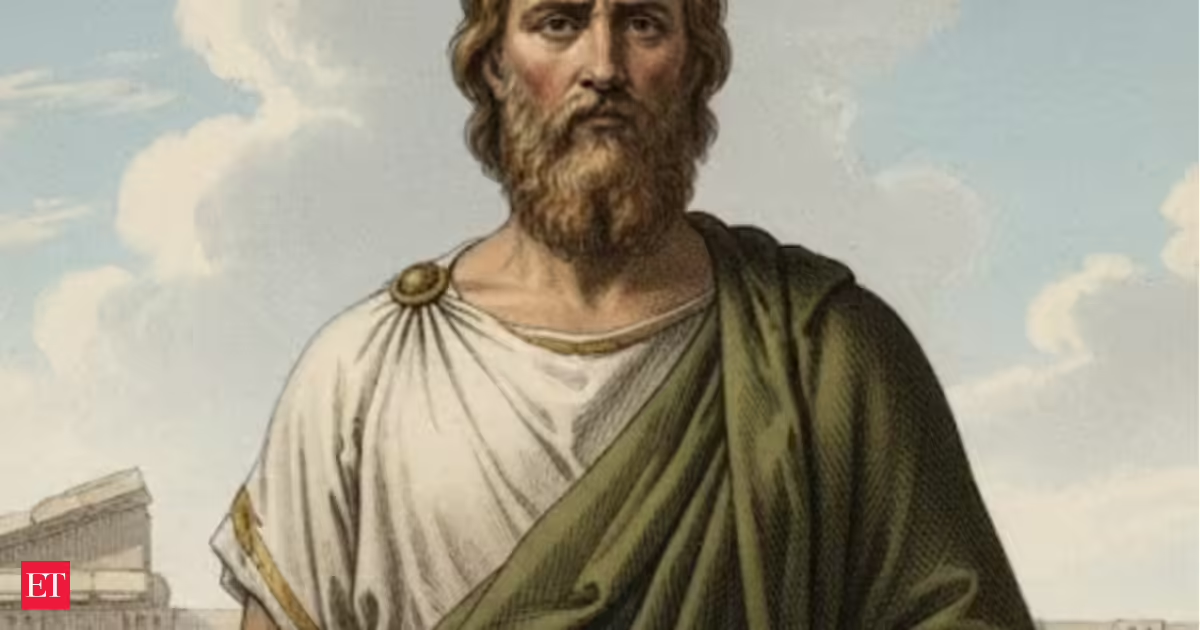
Quote of the day by Heraclitus draws attention to one of the best-known ideas from the ancient Greek philosopher. The quote says, "Those who approach life like a child playing a game, moving and pushing pieces, possess the power of kings." It encourages people to face life with curiosity, flexibility and thoughtful action instead of fear and attachment to outcomes. The message remains relevant because modern life often brings uncertainty and constant change. Heraclitus believed people could understand life better by accepting change, using reason and recognizing the connections between opposite forces that shape the world around them.Understanding today's quoteThe quote, "Those who approach life like a child playing a game, moving and pushing pieces, possess the power of kings," encourages people to approach life with openness instead of fear.A child playing a game stays focused on the present moment. The child learns from mistakes, changes plans when needed and continues playing without worrying about every result. Heraclitus suggests that people can gain similar freedom by treating life's challenges as opportunities to learn instead of permanent failures.The quote does not encourage carelessness. Instead, it promotes thoughtful action without becoming trapped by anxiety. People still make decisions, but they do not allow stress or fear to control every move.Quote of the day by Heraclitus: Meaning and relevanceThe meaning of the quote is rooted in accepting change. Heraclitus believed that change is a natural part of life and cannot be avoided. Many people become frustrated when situations do not match their expectations. The philosopher argues that this attachment creates unnecessary suffering. When people understand that life constantly changes, they become more flexible and better prepared for new circumstances.You Might Also Like:The quote also highlights the importance of curiosity. Children naturally explore, ask questions and experiment. Applying the same mindset to work, relationships and personal goals allows people to discover new possibilities instead of remaining limited by fixed thinking. This idea also supports emotional balance. When people stop treating every setback as a crisis, they can think more clearly and make better decisions.Lessons people can apply in daily lifeThe quote offers several lessons that remain useful in everyday situations.Accept change instead of resisting itChildren may spend hours building a sandcastle, knowing it may disappear when the tide arrives. They enjoy the activity instead of becoming attached to the final result. Heraclitus believed people should develop a similar attitude. Careers change, relationships evolve and circumstances shift. Accepting these changes allows people to continue moving forward instead of remaining trapped in disappointment.You Might Also Like:Make thoughtful moves without stressThe original Greek word translated as "game" is often connected with games such as draughts or checkers. This suggests that life requires planning and careful choices. However, planning should not become constant worry. Every move should be considered, but people should also accept that not every outcome can be controlled.Keep curiosity aliveCuriosity helps people learn throughout life. A playful mindset encourages creativity, learning and problem-solving. Instead of fearing mistakes, people can view them as part of growth. This approach also prevents work from becoming only a source of pressure. Curiosity creates opportunities to discover new skills and perspectives.Recognize hidden harmonyHeraclitus believed opposite forces work together rather than against each other. Success and failure, joy and sadness, gain and loss all help people understand each other. Without one, the other cannot be fully appreciated. Recognizing these relationships helps people understand that difficult moments also contribute to personal development.Heraclitus was an ancient Greek philosopher born around 540 BCE in Ephesus, located in Anatolia, now part of modern-day Selçuk, Turkey. He died around 480 BCE. Although very little is known about his personal life, his ideas became some of the most influential in the history of philosophy.Heraclitus is remembered for developing ideas about cosmology, change and the concept known as the logos, often translated as reason or the universal principle connecting everything. He is believed to have written one book, but it has not survived. Today, scholars know his philosophy through short fragments quoted by later writers.His philosophy of change and the logosHeraclitus believed the universe follows an orderly pattern even though everything appears to be changing. According to him, the logos is the universal principle connecting all things. He argued that many people failed to understand this principle and therefore misunderstood the world around them.He explained that opposite ideas depend on each other. Health and disease help define one another. Good and evil exist in relation to each other. Hot and cold gain meaning through comparison.These examples demonstrate his belief that opposites are connected rather than completely separate. He argued that there is a hidden harmony beneath the apparent conflicts people experience.Fire and the changing universeHeraclitus viewed fire as the basic material principle of the universe. He described the world as an "ever-living fire" that constantly changes while maintaining balance. According to his philosophy, fire changes into air, water and earth through natural processes. At the same time, these elements return to fire, creating a continuous cycle.This ongoing movement keeps the universe balanced despite constant transformation. His explanation emphasized that change does not create disorder. Instead, change allows the world to maintain its overall stability.The river comparison that became famousOne of Heraclitus' most well-known ideas compares life to a river. He explained that people never step into the same river twice because different water is always flowing. This comparison illustrates that everything changes continuously.Although a river appears to remain the same, its water is constantly moving. Human life follows the same pattern. People grow, circumstances evolve and experiences shape new perspectives. Later, the philosopher Plato discussed this idea while explaining Heraclitus' understanding of constant change.Why the quote still matters today?The quote continues to connect with people because modern life changes rapidly. Technology develops, workplaces evolve and personal situations often shift without warning. Heraclitus reminds people that resisting every change increases stress, while accepting life's movement creates greater freedom.His message also encourages curiosity, flexible thinking and thoughtful decision-making. Instead of trying to control every outcome, people can focus on learning, adapting and making their next move with purpose. More than two thousand years after his lifetime, his words continue to offer practical guidance for handling uncertainty with confidence and balance.
Quote of the day by Heraclitus: 'Those who approach life like a child playing a game, moving and pushing pieces, possess...' Life lessons on curiosity, adaptability, strategy, stress and hidden harmony
Quote of the day by Heraclitus explains how approaching life with the mindset of a child can help people deal with change, make better decisions and reduce stress. The famous Greek philosopher believed that life is always changing and that people gain freedom when they stop resisting it. His words continue to inspire discussions about curiosity, adaptability, strategy, hidden harmony and personal growth in everyday life.
1,030 words~5 min read